Rahul Gandhi: India Has Become a Side Player in Global Diplomacy
Synopsis
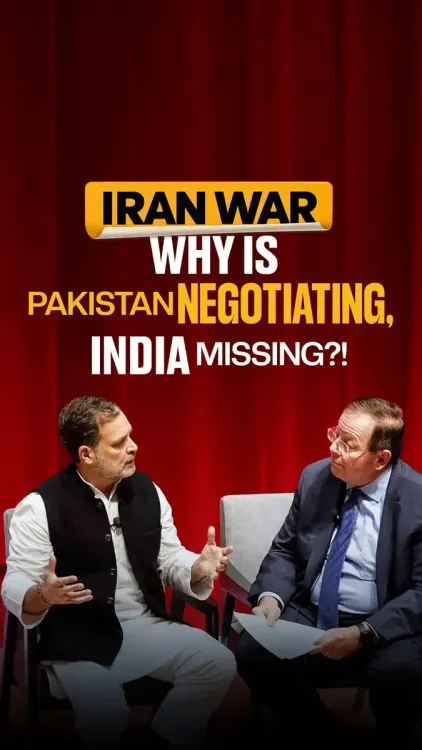
Congress leader Rahul Gandhi has sharply criticised India's foreign-policy posture, saying India has become a 'side player' while Pakistan negotiates with Iran and the United States. He called on India to help shape the emerging multipolar world order, invoking its Non-Aligned Movement legacy and its weight as a 1.5-billion-strong civilisation.
Key Takeaways
Rahul Gandhi described India as a 'side player' in global diplomacy, shocked that Pakistan is negotiating with Iran and the United States while India watches.
He argued India has abandoned its tradition of strategic autonomy established since independence in 1947 and embodied in the Non-Aligned Movement (1961) .
Gandhi linked the Iran conflict's economic fallout to deepening domestic pain inside India, arguing foreign disengagement has real costs for Indian citizens.
He framed the current moment as a civilisational transition: the post- World War II Western-led security architecture is giving way to a multipolar order built by multiple civilisations.
Gandhi called for India — as a nation of 1.5 billion people — to actively shape the next global architecture through both speaking and 'listening equally.' The Ministry of External Affairs had not issued a response to the remarks as of the time of publication.
While Pakistan is reportedly at the table with both Iran and the United States, Congress leader Rahul Gandhi says India is merely watching — and on Thursday, 19 November 2026, he made clear he finds that not just troubling, but shocking.
India Watching from the Sidelines — Gandhi's Stark Accusation
Gandhi's words carry a sharp edge: 'I'm pretty shocked that Pakistan is busy negotiating with the Iranians and the Americans, while India is just looking.' For the Leader of the Opposition, this is not a minor diplomatic gap — it is a civilisational abdication. A nation of 1.5 billion people, with a history of shaping global conversations through strategic autonomy, now has a voice and a view, he says — but 'that view is missing.'
The charge lands against a specific backdrop. Gandhi invokes what he calls an 'Iran war' — a conflict whose economic and security ripples, he argues, have already deepened pain inside India, 'pushing people over the edge.' He does not elaborate on the conflict's details, but the thrust is unmistakable: external crises are not abstract; they arrive at Indian doorsteps.
From Non-Alignment to Multi-Alignment — What India Once Was
India's foreign-policy tradition, Gandhi argues, was always built on strategic independence. Since independence in 1947, India's guiding principle was what benefits India — not reflexive alignment with any bloc. That instinct gave birth to the Non-Aligned Movement in 1961, co-founded by India as a declaration that the Global South would think for itself in a bipolar world.
The irony Gandhi is pointing to is generational: a country that once refused to be sidelined by two superpowers is now, in his telling, sidelining itself. 'We had a mind of our own,' he says. 'We have stepped back from the stage.'
Shaping the Next World Order — Gandhi's Civilisational Argument
The sharpest part of Gandhi's argument is forward-looking, not just critical. He frames the current moment as a civilisational inflection point: the post-World War II security architecture — built and governed by the West — is being replaced by something new. The next global order, he argues, 'will be built by multiple civilisations.'
In that transition, he insists, India cannot be a spectator. 'A nation of 1.5 billion people must help shape it.' His vision for India's role is not merely assertive but deliberate — 'an order designed not just by speaking, but by listening equally.' It is a pointed pivot from the standard power-projection framing: influence through restraint and genuine engagement, not volume.
The Domestic Cost of a Passive Foreign Policy
Gandhi connects global disengagement directly to domestic suffering — a rhetorical move that grounds the foreign-policy debate in everyday Indian reality. The Iran conflict's economic fallout, he argues, has magnified existing pain inside India. 'We cannot sit in India and remain unconcerned about what is happening in the rest of the world,' he says flatly.
It is a challenge to the government to answer not just on diplomatic positioning — in multilateral forums like the UN or BRICS — but on the material consequences for Indian households of a foreign policy he characterises as passive. The Ministry of External Affairs has not yet responded to the remarks.
The question Gandhi is placing on the table is less about any single negotiation and more about India's posture in an era of global reordering. If the next architecture is truly being built right now, the cost of an empty chair may compound with every passing month.
Point of View
It has vacated the arena entirely. By anchoring the argument in India's Non-Aligned Movement legacy, he is attempting to reclaim a nationalist foreign-policy identity for the Congress, repositioning the party as the custodian of strategic autonomy rather than ceding that ground to the ruling dispensation. The 'civilisational' framing — multiple civilisations shaping the next order — also signals a deliberate attempt to match the government's own civilisational rhetoric on its own terrain. Whether the critique gains traction will depend heavily on whether India's absence from visible West Asia diplomacy becomes a sustained news cycle, or whether the government can demonstrate behind-the-scenes engagement that reframes the narrative.
NationPress
19 Nov 2026
Frequently Asked Questions
What did Rahul Gandhi say about India's foreign policy in November 2026?
Rahul Gandhi said India has become a 'side player' in global diplomacy, expressing shock that Pakistan is actively negotiating with Iran and the United States while India is 'just looking.' He called on India to help shape the emerging multipolar world order, drawing on its legacy of strategic autonomy since independence.
Why is Rahul Gandhi criticising India's role in Iran-Pakistan-US talks?
Gandhi argues that by India's size, history, and relationships, it should be a central participant in major global conversations, not a bystander. He believes India's foreign-policy tradition — rooted in independence and strategic autonomy — is being abandoned, leaving India without meaningful influence at a critical moment of global reordering.
What is India's Non-Aligned Movement legacy and why is it relevant?
India co-founded the Non-Aligned Movement in 1961 as a declaration that developing nations would pursue independent foreign policies rather than align with either the US or Soviet blocs during the Cold War. Gandhi invoked this legacy to argue that India once had a 'mind of its own' in global affairs — a posture he says the current government has abandoned.
What did Rahul Gandhi mean by the next global architecture being built by multiple civilisations?
Gandhi argued that the post-World War II security order, designed and led by Western powers, is now transitioning to a multipolar system shaped by multiple civilisations. He said India — with 1.5 billion people and a deep civilisational history — must be an active participant in designing this new global order rather than watching from the margins.
Has the Indian government responded to Rahul Gandhi's foreign policy criticism?
As of the time of publication, the Ministry of External Affairs had not issued a formal response to Gandhi's remarks. India's positions in multilateral forums such as the UN and BRICS remain a key area to watch for any official counter-narrative.