Rahul Gandhi and the opposition dilemma: critique or negativity?
Synopsis
Nepal's opposition leader toured flood-hit areas, submitted a nine-point plan to the PM, and praised the army — without abandoning his opposition role. The contrast with Rahul Gandhi's approach in India — from Parliament disruptions to the Operation Sindoor aircraft question — raises a sharper question: is India's main opposition offering critique, or just noise?
Key Takeaways
Bhishma Raj Angdembe of Nepal's Nepali Congress submitted a nine-point memorandum to PM Balendra Shah during the Nepal flood crisis, offering a constructive opposition model.
Congress leader Rahul Gandhi has repeatedly dismissed uncomfortable journalist questions by labelling reporters as BJP sympathisers, according to reports.
Gandhi's display of an alleged copy of General M.M.
Naravane's unpublished memoir during the Budget Session triggered repeated parliamentary adjournments; the claims were subsequently disputed.
Gandhi's question during Operation Sindoor — asking how many Indian aircraft were lost because Pakistan knew — drew criticism over timing, given Pakistan's concurrent information campaign.
Critics argue India's opposition has shifted toward 'opposition without proposition' — raising issues without offering concrete alternatives or policy counter-proposals.
With social media shaping political messaging, analysts warn that designing politics for the next viral clip risks subordinating substantive governance accountability.
When Nepal was reeling from catastrophic floods, the country's main opposition leader did something that drew quiet admiration: he toured the devastated regions, met the Prime Minister, submitted a nine-point memorandum on rescue and relief, and praised the Nepal Army's response — all without surrendering his role as an opposition figure. The leader was Bhishma Raj Angdembe of the Nepali Congress, and the contrast he presents with India's current opposition dynamic is difficult to ignore.
The Purpose of Opposition
A functioning democracy depends on a robust opposition. Its mandate is to question the government, scrutinise policy, hold power accountable, and ensure governance remains transparent and responsive. These are not merely textbook principles — they are the structural guardrails of representative government.
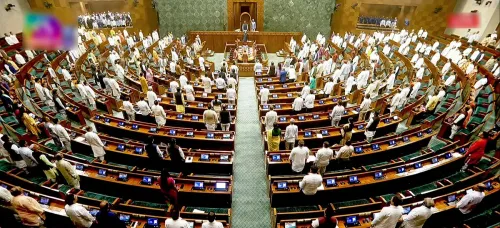
Critics argue, however, that over the past decade, opposition politics in India has increasingly drifted from this mandate. In Parliament, substantive debate has repeatedly been lost to disruptions, protests, and adjournments. The pattern has been especially pronounced since the National Democratic Alliance (NDA) government's second term, and has continued into the current 18th Lok Sabha, where many newly elected members have reportedly struggled to find floor time to speak.
Questions About Rahul Gandhi's Approach
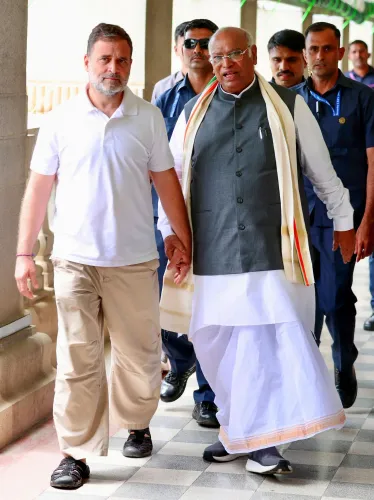
Congress leader and Leader of Opposition Rahul Gandhi has been at the centre of this debate. When a journalist recently asked him about the Opposition's role in parliamentary disruptions, Gandhi reportedly dismissed the question by labelling the journalist as a Bharatiya Janata Party (BJP) sympathiser. A similar response reportedly followed when another reporter asked him about the families of Delhi Police personnel injured during protests at Jantar Mantar.
Critics argue that reflexively attaching a political label to every uncomfortable question is itself a form of deflection — one that closes down the kind of accountability journalism that opposition politics claims to champion.
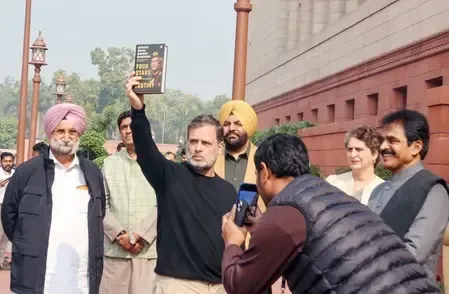
During the Budget Session in February, Gandhi displayed what he described as an alleged copy of former Army Chief General M.M. Naravane's unpublished memoir and raised claims based on it in Parliament. The episode triggered repeated adjournments. Subsequently, Naravane and the publisher clarified that the memoir had not been published, and the claims were disputed — but not before significant parliamentary time had been consumed.
Spectacle Over Substance
During the Monsoon Session, the Opposition — led by Gandhi — raised the paper leak issue and the alleged crackdown on protesting students. These were legitimate concerns, well within the Opposition's mandate to pursue. But observers note that the questions were rarely accompanied by concrete counter-proposals or alternative policy frameworks — a pattern that critics describe as 'opposition without proposition.'
This dynamic has been compounded by the pull of social media. With political messaging increasingly calibrated for short-form content, a protest near the Prime Minister's residence, for instance, generated significant online traction. A protest is an established democratic tool. But analysts caution that when the spectacle begins to overshadow the issue it represents, the underlying cause risks being diluted.
Gandhi's remark during a public event — where he mocked Prime Minister Narendra Modi's tendency to embrace foreign leaders and made a comment widely interpreted as a reference to Italian Prime Minister Giorgia Meloni — drew sharp criticism. Several commentators argued that an opposition leader, particularly one holding the constitutional post of Leader of Opposition, should exercise greater restraint when referring to a sitting female head of government of a friendly nation.
Operation Sindoor and the Line Between Questioning and Narrative
The most pointed criticism of Gandhi's approach came during Operation Sindoor. Gandhi publicly asked: 'How many Indian aircraft did we lose because Pakistan knew?' The question was directed at the government — a legitimate exercise of opposition scrutiny. However, critics noted that the timing coincided with Pakistan actively promoting its own narrative about Indian aircraft losses, raising questions about whether the framing inadvertently served an adversary's information campaign.
The Opposition's right to question the government — even during military operations — is constitutionally protected and democratically vital. The debate, as analysts frame it, is not about whether to question, but about how the framing of those questions lands in a contested information environment.
What India's Opposition Could Learn From Nepal
Angdembe's conduct during Nepal's flood crisis offers a reference point. He did not abandon his opposition role — he expanded it. By inspecting affected areas, meeting the Prime Minister, and offering constructive recommendations, he demonstrated that opposition and national interest are not mutually exclusive.
India's opposition landscape — confronting real and serious issues including unemployment, examination irregularities, and corruption — has no shortage of legitimate ground to contest. The argument being made by a growing number of political observers is not that the Opposition should stop opposing, but that criticism without alternatives, and noise without solutions, ultimately serves neither accountability nor governance.
As the political calendar moves toward the next round of state elections, whether the Congress and its INDIA bloc partners recalibrate their opposition strategy — moving from reactive disruption toward constructive engagement — may well determine how voters, particularly younger ones, assess their readiness to govern.
Point of View
Yet the record of the 18th Lok Sabha so far is heavy on disruption and light on legislative counter-proposals. The Operation Sindoor episode crystallises the tension: questioning the government on military matters is constitutionally legitimate, but when the framing of those questions aligns with an adversary's active information campaign, the Opposition bears some responsibility for how it chooses its words. India's real deficit is not opposition — it is opposition with an agenda beyond the next news cycle. The Nepal model is instructive precisely because Angdembe did not become less of an opposition leader by cooperating during a crisis; he became more credible as one.
NationPress
15 Oct 2026
Frequently Asked Questions
What is the FairPoint column about Rahul Gandhi arguing?
The column argues that Rahul Gandhi's opposition approach has increasingly prioritised spectacle, social media visibility, and political attacks over constructive alternatives and policy counter-proposals. It draws a contrast with Nepal's opposition leader, who cooperated with the government during a crisis while retaining his opposition role.
What did Nepal's opposition leader do during the flood crisis?
Bhishma Raj Angdembe of the Nepali Congress toured flood-devastated areas, met Prime Minister Balendra Shah, submitted a nine-point memorandum on rescue and relief, and praised the Nepal Army's response — all while remaining in his role as opposition leader.
Why was Rahul Gandhi criticised during Operation Sindoor?
Gandhi publicly asked how many Indian aircraft were lost because Pakistan knew about the operation. Critics argued that while the question was directed at the government, its timing — when Pakistan was actively promoting its own narrative about Indian aircraft losses — risked amplifying an adversary's information campaign.
What happened with the General Naravane memoir episode in Parliament?
During the Budget Session, Rahul Gandhi displayed what he said was an alleged copy of former Army Chief General M.M. Naravane's unpublished memoir and raised claims based on it, triggering repeated adjournments. Naravane and his publisher subsequently clarified that the memoir had not been published, and the claims were disputed.
What does 'opposition without proposition' mean in this context?
It refers to a pattern where the opposition raises issues — such as paper leaks or student protests — without following up with concrete alternative policies or solutions. Critics argue this reduces opposition to a tool for generating headlines rather than driving accountability or better governance.