Parliament Monsoon Session: Govt pushed debate, Rahul Gandhi-led Opposition refused
Synopsis
India's Monsoon Session flipped the script: the government begged for debate and the Opposition said no. Rahul Gandhi's bloc blocked floor discussions on NEET-UG and Ram Mandir donations — not out of weakness, but as a deliberate media strategy to keep the narrative of government silence alive ahead of crucial state elections.
Key Takeaways
During the Monsoon Session , the BJP -led government repeatedly invited debate on NEET-UG paper leak and Ram Mandir donation allegations — a reversal of the usual Parliamentary dynamic.
Leader of Opposition Rahul Gandhi set three non-negotiable conditions, including a PM Modi apology to students and clarification from Home Minister Amit Shah on police firing orders.
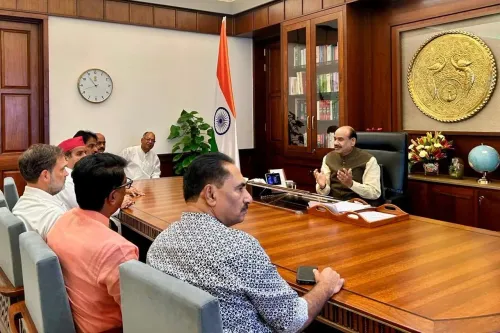
Talks held in Lok Sabha Speaker Om Birla's office and multiple other rounds failed to end the impasse.
The Opposition's SIR of voters' lists campaign had failed to yield electoral gains in Kerala and Tamil Nadu , shifting focus to education and faith-based issues.
The INDIA bloc is expected to amplify NEET-UG and Ram Mandir issues in upcoming Assembly election campaigns, particularly in Uttar Pradesh .
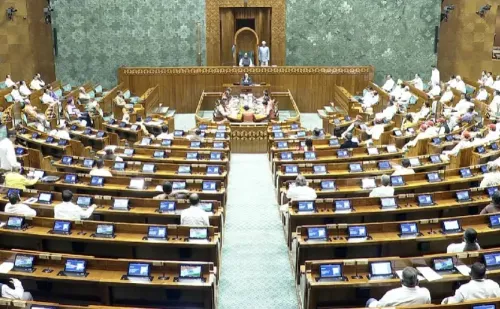
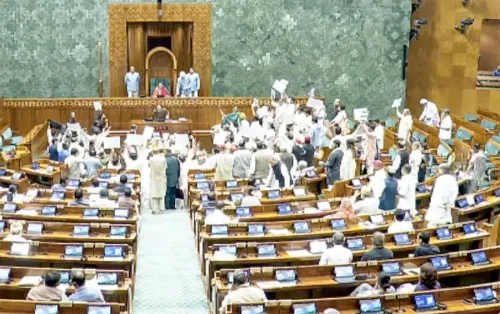
In a striking role reversal during Parliament's Monsoon Session, the ruling Bharatiya Janata Party (BJP)-led government repeatedly sought floor discussions on contentious issues — NEET-UG paper leak, alleged misuse of Ram Mandir donations, and the Election Commission's Special Intensive Revision (SIR) of voters' lists — while the INDIA bloc Opposition, led by Leader of Opposition Rahul Gandhi, declined each overture. The standoff transformed much of the session into a battle of narratives rather than substantive legislative business.
The Unusual Dynamic
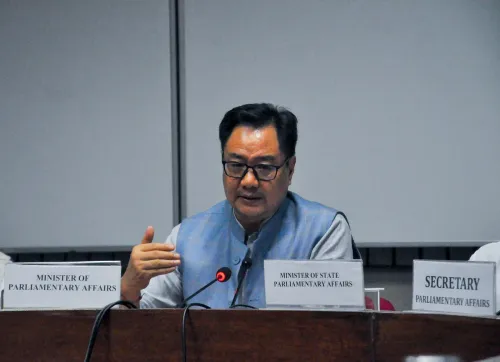
Conventionally, it is the Opposition that presses for debate while the government deflects. This session inverted that dynamic. Union Parliamentary Affairs Minister Kiren Rijiju in Lok Sabha and Leader of the House in Rajya Sabha J.P. Nadda, along with several ruling-party members, made repeated public invitations for structured debate. Multiple rounds of talks — including meetings in the office of Lok Sabha Speaker Om Birla — failed to break the impasse.
The government went a step further, reportedly attempting to merge the paper-leak debate with legislation on fast-track courts, signalling willingness to address the controversy within established Parliamentary procedure. Home Minister Amit Shah himself offered to address the House and respond to Opposition charges — an offer that was ultimately rejected.
Rahul Gandhi's Three Non-Negotiable Demands
The Opposition, according to reports, conditioned any engagement on three demands it described as non-negotiable: that Home Minister Amit Shah clarify who authorised police firing on students protesting the paper leak; that Prime Minister Narendra Modi apologise to affected students; and that accountability be established for the alleged misappropriation of donations at the Ayodhya Ram Mandir Trust.
Critics within the ruling dispensation argued that these conditions effectively pre-empted the very Parliamentary process through which such accountability is ordinarily established — namely, a floor debate where charges are articulated, members respond, and the government defends its record. Government overtures were dismissed by the Opposition as, reportedly, 'fantasy conversations.'
The Strategic Calculus
The Opposition's posture, analysts note, was shaped by electoral arithmetic. Rahul Gandhi's earlier campaign around the SIR of voters' lists had not delivered the anticipated political dividend: the BJP and its regional allies did not, in fact, outperform expectations in Kerala and Tamil Nadu, where the SIR charges would have been most consequential if accurate. Congress allies in Bihar and elsewhere reportedly found the issue too weak to weaponise effectively.
By contrast, the NEET-UG paper leak and the Ram Mandir donation allegations carry resonance in states heading to Assembly elections — particularly Uttar Pradesh. By refusing a structured debate, the Opposition kept headlines trained on alleged government silence rather than allowing the Treasury benches a platform to rebut. It was, in effect, a media strategy dressed as a Parliamentary one.
BJP's Counter-Narrative
BJP leaders publicly accused the Opposition of running away from debate and politicising sensitive issues. They characterised the refusal as obstructionist, arguing that Rahul Gandhi was using Parliament as an election campaign stage rather than a forum for policy solutions. The ruling party framed its own debate invitations as evidence of transparency — and the Opposition's refusal as evidence of bad faith.
What Comes Next
With the Monsoon Session having concluded in deadlock, the INDIA bloc is expected to carry the NEET-UG and Ram Mandir donation issues into the campaign trail as the country moves toward a clutch of state Assembly elections. The session's unresolved tensions — over education integrity and institutional accountability — are likely to define Opposition messaging heading into the next electoral cycle. Whether voters reward the strategy of controlled confrontation over Parliamentary engagement remains to be seen.
Point of View
The INDIA bloc prioritised headline management over Parliamentary function — and in doing so, handed the government a credible 'we offered to talk' defence. Rahul Gandhi's pivot from the SIR issue to NEET-UG and Ram Mandir donations reveals a bloc still searching for a sticky electoral narrative after a string of misfires. The deeper problem: when both sides treat Parliament as a campaign prop, public business is the casualty, and voters lose the one arena where policy is supposed to be scrutinised.
NationPress
27 Sept 2026
Frequently Asked Questions
What was the role reversal in Parliament's Monsoon Session?
The BJP-led government repeatedly invited the Opposition to debate contentious issues — NEET-UG paper leak and Ram Mandir donation allegations — while the Rahul Gandhi-led INDIA bloc declined. This reversed the conventional dynamic where the Opposition demands debate and the government resists.
What were Rahul Gandhi's three non-negotiable conditions?
Rahul Gandhi's bloc set three conditions: Home Minister Amit Shah must clarify who authorised police firing on protesting students during the paper-leak agitation; Prime Minister Modi must apologise to affected students; and accountability must be established for alleged misappropriation of donations at the Ayodhya Ram Mandir Trust.
Why did the Opposition refuse to debate despite government invitations?
The Opposition's strategy was reportedly to keep media focus on alleged government silence rather than allow the Treasury benches a platform to rebut charges in a structured debate. By blocking discussion, the INDIA bloc ensured headlines remained centred on government accountability, ahead of upcoming state Assembly elections.
How did the NEET-UG and Ram Mandir issues become central to the session?
Reports of the NEET-UG paper leak and alleged misuse of Ram Mandir donations gave the Congress-led Opposition issues with potential electoral resonance, particularly in Uttar Pradesh. These replaced the earlier SIR of voters' lists campaign, which had failed to yield gains in Kerala and Tamil Nadu.
What is the likely political fallout after the Monsoon Session deadlock?
The INDIA bloc is expected to carry the NEET-UG and Ram Mandir donation issues into Assembly election campaigns as symbols of alleged government corruption and arrogance. The BJP, meanwhile, is likely to counter by highlighting the Opposition's refusal to engage in Parliamentary debate as obstructionism.