Indian Railways clears ₹440 crore third line on Nimpura-Midnapur route
Synopsis
A section of South Eastern Railway is running at over 115% of its designed capacity — and Indian Railways is now spending ₹440 crore to fix it. The 14.52 km third line between Nimpura West Outer Cabin and Midnapur will add 3.52 MTPA of freight headroom on a corridor already hauling nearly 24 MTPA of coal, steel, cement, and two dozen other commodities.
Key Takeaways
Indian Railways has approved a ₹440 crore third-line project on the Nimpura West Outer Cabin–Midnapur section of South Eastern Railway .
The new line spans 14.52 km and falls under the High Utilisation Network (HUN-2) classification.
The section is currently operating at 115.71% line capacity utilisation , indicating severe congestion.
The project is expected to add 3.52 MTPA of freight capacity on a corridor already handling nearly 23.80 MTPA .
Key commodities on the route include coal, iron ore, manganese, steel, cement, fertilisers, and petroleum products.
Doubling works on the Nimpura West Outer Cabin–Gokulpur sub-section are already in progress alongside this new approval.
Indian Railways has approved a ₹440 crore project to construct a 14.52 km third railway line between Nimpura West Outer Cabin and Midnapur under the South Eastern Railway zone, according to an official statement released on 23 July. The move targets severe congestion on one of the country's busiest freight-and-passenger corridors, where line capacity utilisation has already crossed 115.71 per cent.
What the Project Covers
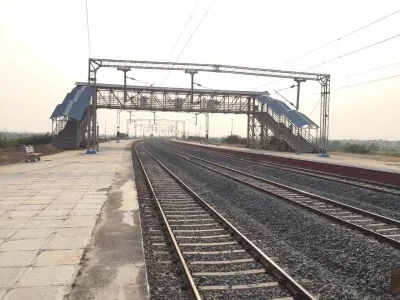
The new third line spans 14.52 km and falls within the High Utilisation Network (HUN-2) designation — a classification reserved for the most congested sections of the national rail grid. The Nimpura West Outer Cabin–Gokulpur sub-section currently operates as a single line, with doubling work already under way. The third line is intended to run alongside and complement those ongoing works, substantially boosting operational flexibility.
Upon completion, the corridor is expected to handle an additional 3.52 million tonnes per annum (MTPA) of freight, on top of an existing load of nearly 23.80 MTPA.
Why This Corridor Matters
The Nimpura–Midnapur section carries a wide mix of commodities — manganese, iron ore, coal, containers, clinker, pellet iron, iron and steel, wheat, petroleum products, limestone, fertilisers, cement, and over a dozen others. This diversity makes it a critical supply-chain artery for industries across eastern India.
A line capacity utilisation of 115.71 per cent means trains are running well beyond the section's designed throughput, leading to delays, reduced reliability, and limited room for scheduling additional services. This is not an isolated case — several HUN-2 routes across the network face similar saturation.
Expected Impact
The third line is designed to reduce operational bottlenecks, improve train punctuality, and create headroom for both passenger and freight expansion. Enhanced throughput on this corridor is expected to benefit industries reliant on bulk commodity movement, particularly steel, cement, and agricultural supply chains in the region.
Improved network reliability on this route could also ease pressure on parallel road infrastructure, which often absorbs freight spillover when rail capacity is constrained.
Broader Railway Capacity Push
The approval is part of Indian Railways' wider programme of capacity augmentation on high-density routes. The government has in recent years accelerated third- and fourth-line projects across several saturated corridors, with an emphasis on freight throughput to support the national logistics push and reduce the cost of moving goods. This project reflects that sustained priority, with the South Eastern Railway zone — a major freight gateway for mineral-rich eastern India — among the key focus areas.
A project timeline and completion date have not been specified in the official statement; further details are expected as construction planning progresses.
Point of View
Where mineral and industrial freight demand has outpaced capacity additions for years. The ₹440 crore third-line approval is necessary, but the absence of a completion timeline in the official statement is a telling omission — past capacity projects on HUN routes have faced land acquisition and execution delays that stretched timelines well beyond initial estimates. The real test will be whether this project delivers usable capacity within a defined window, not merely an approved outlay.
NationPress
21 Oct 2026
Frequently Asked Questions
What is the Indian Railways ₹440 crore third-line project?
It is an approved infrastructure project to construct a 14.52 km third railway line between Nimpura West Outer Cabin and Midnapur under the South Eastern Railway zone, at a cost of ₹440 crore. The project aims to relieve severe congestion on a corridor currently operating at over 115% of its designed capacity.
Why is a third line needed on the Nimpura–Midnapur section?
The existing section is operating at 115.71% line capacity utilisation, well above its designed throughput, causing delays and limiting scheduling flexibility. The third line will add operational headroom for both freight and passenger trains on this high-density corridor.
How much additional freight capacity will the project create?
Upon completion, the third line is expected to facilitate an additional 3.52 million tonnes per annum (MTPA) of freight movement, supplementing the corridor's existing load of nearly 23.80 MTPA.
What commodities does the Nimpura–Midnapur corridor carry?
The corridor transports a wide range of commodities including coal, iron ore, manganese, containers, clinker, pellet iron, iron and steel, wheat, petroleum products, limestone, fertilisers, cement, and several others, making it a critical supply-chain link for eastern India.
What is the High Utilisation Network (HUN-2) classification?
HUN-2 is a designation used by Indian Railways to identify sections operating at or near maximum capacity. Routes under this classification receive priority for capacity augmentation projects such as third and fourth line additions to ease congestion and improve throughput.