CM Bhajanlal Launches Rajasthan's Silicon Valley Push
Synopsis
Rajasthan's CMO has announced the formal start of work to develop the Jodhpur-Pali-Marwar industrial region and Kankani area as the state's 'Silicon Valley,' extending CM Bhajan Lal Sharma's push to attract technology and manufacturing investment to western Rajasthan.
Key Takeaways
The Chief Minister's Office of Rajasthan confirmed on 24 May 2026 that work has begun on the 'Silicon Valley of Rajasthan' initiative.
The designated zones are the Jodhpur-Pali-Marwar industrial region and the Kankani area in western Rajasthan.
CM Bhajan Lal Sharma , in office since December 2023 , has made industrial investment attraction a central policy priority.
The corridor aims to draw IT investors and electronics manufacturers and create employment for the local western Rajasthan workforce.
Rajasthan's push aligns with a broader national trend of developing secondary tech and industrial hubs beyond primary metro cities.
Specific land boundaries, incentive structures, and firm partnerships for the zones are yet to be publicly notified.
The Chief Minister's Office of Rajasthan announced on Sunday, 24 May 2026 that work has begun to develop the Jodhpur-Pali-Marwar industrial region and the Kankani area as the 'Silicon Valley of Rajasthan,' signalling a major push by Chief Minister Bhajan Lal Sharma's government to transform western Rajasthan into a high-value technology and industrial hub.
Context
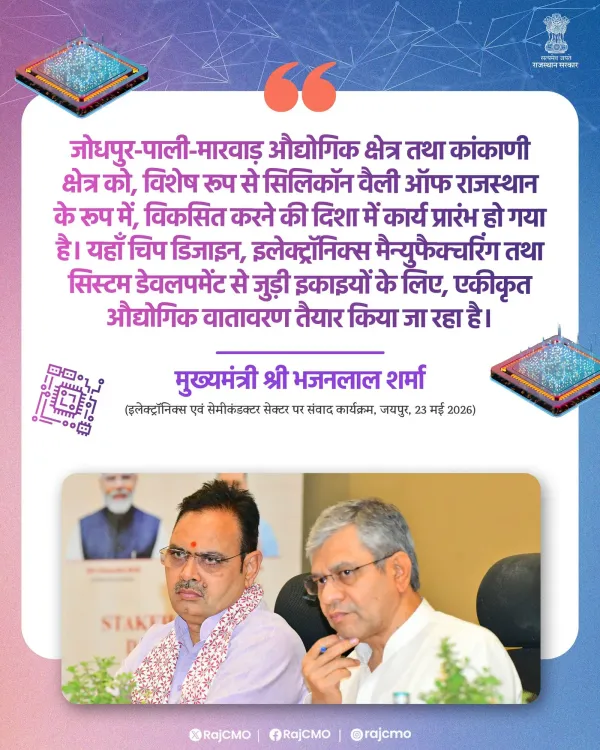
The CMO's post, shared under the hashtag #आपणो_अग्रणी_राजस्थान ('Our Leading Rajasthan'), states: 'जोधपुर-पाली-मारवाड़ औद्योगिक क्षेत्र तथा कांकाणी क्षेत्र को, सिलिकॉन वैली ऑफ राजस्थान के रूप में, विकसित करने की दिशा में कार्य प्रारंभ हो गया है' — meaning 'Work has begun towards developing the Jodhpur-Pali-Marwar industrial area and the Kankani area as the Silicon Valley of Rajasthan.' The announcement marks a formal start of implementation rather than a policy declaration, suggesting on-ground activity is now under way.
Jodhpur, the anchor city of this corridor, is western Rajasthan's largest urban centre and a longstanding hub for handicraft, textile, and defence-related industries. Pali district, adjacent to Jodhpur, has an established textile dyeing and processing industry base. The Marwar region, historically tied to both districts, offers large tracts of land and improving rail and road connectivity.
Policy Backdrop
Rajasthan's industrial development frameworks have long identified western Rajasthan corridors as priority zones for manufacturing and technology investment. The state has previously promoted electronics and IT clusters under policies aligned with national Production-Linked Incentive (PLI) schemes for IT hardware, making the current push a continuation of that strategic direction.
Indian states have increasingly pursued secondary tech and industrial hubs beyond primary metros — such as Bengaluru, Hyderabad, and Pune — to balance regional growth and leverage lower land costs and emerging connectivity advantages. CM Bhajan Lal Sharma, who took office in December 2023, has positioned industrial investment attraction as a central plank of his government's economic agenda.
Stakeholders and Impact
The primary beneficiaries of a successful Silicon Valley-style cluster in this corridor would be IT investors and electronics manufacturers seeking cost-effective alternatives to saturated metro markets, as well as the local workforce of western Rajasthan, which has historically seen significant out-migration for employment. A technology and industrial cluster of this scale could create substantial direct and indirect employment in Jodhpur, Pali, and surrounding districts.
Small and medium enterprises in the existing textile and handicraft sectors may also find opportunities to integrate with supply chains anchored by larger incoming industrial units, broadening the economic impact beyond pure technology investment.
What's Next
The immediate indicators to watch will be government notifications on land allocation, investor incentive packages, and formal partnership announcements with electronics or IT firms for the designated zones. The exact boundaries and implementation timeline for the Kankani area component of the plan are yet to be detailed in public records.
If the corridor attracts anchor investors, it could reposition western Rajasthan as a credible alternative industrial destination on India's technology and manufacturing map — a development that would carry both economic and political significance ahead of future state electoral cycles.
Point of View
Suggesting the Sharma government is keen to signal momentum on industrial development in western Rajasthan. Designating a 'Silicon Valley' corridor in the Jodhpur-Pali-Marwar belt fits a wider pattern among BJP-governed states of branding regional industrial clusters to attract investor attention and signal economic ambition. The inclusion of the lesser-known Kankani area alongside established industrial zones like Jodhpur and Pali hints at a deliberate effort to expand the footprint of this initiative beyond existing clusters. Whether the branding translates into concrete anchor investments will be the real test of this initiative's credibility.
NationPress
8 Oct 2026
Frequently Asked Questions
What is the Silicon Valley of Rajasthan project?
The 'Silicon Valley of Rajasthan' is a state government initiative to develop the Jodhpur-Pali-Marwar industrial region and the Kankani area in western Rajasthan into a major technology and manufacturing hub, with the Rajasthan CMO announcing on 24 May 2026 that work has formally begun.
Where is the Kankani area in Rajasthan?
The Kankani area is located in western Rajasthan and has been included alongside the Jodhpur-Pali-Marwar industrial corridor in the state government's Silicon Valley development plan, though its exact boundaries have not yet been publicly notified.
What is CM Bhajan Lal Sharma's industrial policy for Rajasthan?
CM Bhajan Lal Sharma, who took office in December 2023, has prioritised industrial investment attraction as a key policy goal, including the development of technology and manufacturing clusters in western Rajasthan aligned with national PLI schemes for IT hardware.
How will the Jodhpur-Pali-Marwar industrial corridor benefit local people?
The corridor is expected to create direct and indirect employment for the local workforce in western Rajasthan, a region that has historically seen significant out-migration for jobs, while also offering opportunities for existing textile and handicraft SMEs to integrate with larger industrial supply chains.
What should investors watch for in the Rajasthan Silicon Valley plan?
Investors and observers should watch for government notifications on land allocation, investor incentive packages, and formal partnership announcements with electronics or IT firms for the Jodhpur-Pali-Marwar and Kankani zones.