Rajasthan CM Bhajanlal flags welfare push for Sahariya tribe
Synopsis
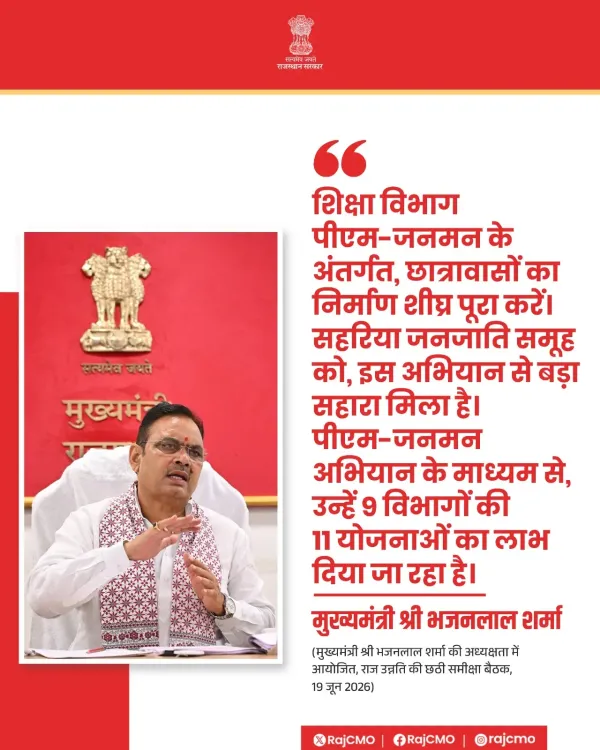
The Chief Minister's Office of Rajasthan on 20 June 2026 said an ongoing welfare campaign has provided significant support to the Sahariya tribe, a Particularly Vulnerable Tribal Group concentrated in Baran and Kota districts, tagging CM Bhajanlal Sharma in the post.
Key Takeaways
The Rajasthan CMO on 20 June 2026 stated that an ongoing campaign has given 'great support' to the Sahariya tribal group .
The Sahariya are a Particularly Vulnerable Tribal Group (PVTG) primarily located in Baran and Kota districts of Rajasthan.
Chief Minister Bhajanlal Sharma was tagged in the post, signalling direct political ownership of the initiative.
The post was made under the hashtag #आपणो_अग्रणी_राजस्थान , the BJP-led government's broader development branding.
PVTGs receive special protections and targeted sub-plans under the national tribal welfare framework of the Ministry of Tribal Affairs .
Rollout details and coverage metrics for the campaign in Sahariya-dominated blocks remain to be officially published.
The Chief Minister's Office of Rajasthan on Saturday, 20 June 2026 highlighted the impact of an ongoing welfare campaign on the Sahariya tribe, tagging Chief Minister Bhajanlal Sharma and associating the effort with the state's development agenda under the hashtag #आपणो_अग्रणी_राजस्थान ('Our Foremost Rajasthan').
Context
The post states: 'सहरिया जनजाति समूह को, इस अभियान से बड़ा सहारा मिला है' — 'The Sahariya tribal group has received great support from this campaign.' The statement positions the campaign as a meaningful intervention for one of Rajasthan's most marginalised indigenous communities.
The Sahariya are classified as a Particularly Vulnerable Tribal Group (PVTG), a category reserved by the central government for tribal communities facing the most acute socio-economic disadvantage. In Rajasthan, they are concentrated primarily in Baran and Kota districts.
Policy Backdrop
PVTGs such as the Sahariya have historically been targeted under special sub-plans within broader tribal welfare frameworks administered by the Ministry of Tribal Affairs. These frameworks cover health, nutrition, education, housing and livelihood, and require state governments to co-invest alongside central allocations.
Chief Minister Bhajanlal Sharma, who assumed office in December 2023, has positioned tribal welfare as a priority under the BJP-led Rajasthan government. The hashtag #आपणो_अग्रणी_राजस्थान has been used by the CMO to brand a cluster of governance and outreach initiatives aimed at projecting Rajasthan as a leading state in inclusive development.
Stakeholders and Impact
The Sahariya community, spread across tribal blocks in Baran and parts of Kota, has historically recorded low human development indicators including high rates of food insecurity and limited access to formal healthcare. Any sustained campaign targeting this group carries direct implications for thousands of families in these districts.
PVTG-focused interventions also benefit allied stakeholders — local anganwadi workers, health sub-centres, and block-level administration — who serve as delivery channels for welfare programmes. Effective implementation typically requires convergence across the departments of tribal affairs, health, and social justice.
What's Next
The key question following this announcement is the measurable reach of the campaign in Sahariya-dominated blocks — specifically, how many households have been enrolled, what services have been delivered, and whether independent coverage data will be published by the state government.
With Rajasthan's tribal affairs machinery under renewed political focus, the rollout of such programmes in PVTG areas will likely serve as a benchmark for the state's welfare delivery credentials ahead of future electoral cycles.
Point of View
The BJP administration is weaving tribal outreach into its broader narrative of inclusive governance in a state where tribal districts carry significant electoral weight. The absence of specific campaign details, however, means the claim rests on optics until ground-level data is published. Sustained follow-through — not announcements — will determine whether this translates into measurable change for Sahariya families in Baran and Kota.
NationPress
20 Jun 2026
Frequently Asked Questions
Who are the Sahariya tribe in Rajasthan?
The Sahariya are a Particularly Vulnerable Tribal Group (PVTG) in Rajasthan, concentrated mainly in Baran and Kota districts. They are among India's most marginalised indigenous communities, with historically low access to healthcare, education and food security.
What is a Particularly Vulnerable Tribal Group (PVTG)?
A PVTG is a sub-category of Scheduled Tribes identified by the central government as facing the most severe socio-economic disadvantage. India has 75 officially recognised PVTGs, and they receive special welfare sub-plans under the Ministry of Tribal Affairs.
What did the Rajasthan CMO post about the Sahariya tribe?
On 20 June 2026, the Rajasthan CMO posted that an ongoing campaign has given 'great support' to the Sahariya tribal group, tagging Chief Minister Bhajanlal Sharma and using the state's development hashtag #आपणो_अग्रणी_राजस्थान.
What welfare schemes exist for tribal groups in Rajasthan?
Rajasthan implements both central and state-level schemes for tribal welfare, covering health, nutrition, housing and livelihood. PVTG communities like the Sahariya receive additional targeted interventions under special sub-plans co-funded by the state and central governments.
Who is Bhajanlal Sharma?
Bhajanlal Sharma is a BJP leader who became Chief Minister of Rajasthan in December 2023. His government has positioned tribal welfare and inclusive development as key priorities of its administration.