CM Bhajan Lal launches Rajasthan youth ITBP border programme
Synopsis
The Chief Minister's Office of Rajasthan has announced a youth exposure programme pairing young participants with Indo-Tibetan Border Police personnel, aiming to build awareness of border-area challenges, culture and development needs under CM Bhajan Lal Sharma's 'Aapno Agrani Rajasthan' agenda.
Key Takeaways
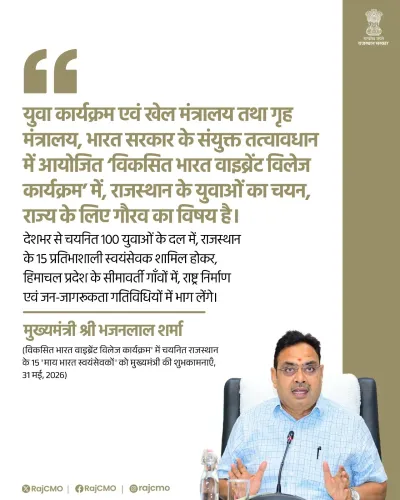
The Chief Minister's Office of Rajasthan announced on 1 June 2026 a youth programme involving deployment alongside ITBP personnel at border areas.
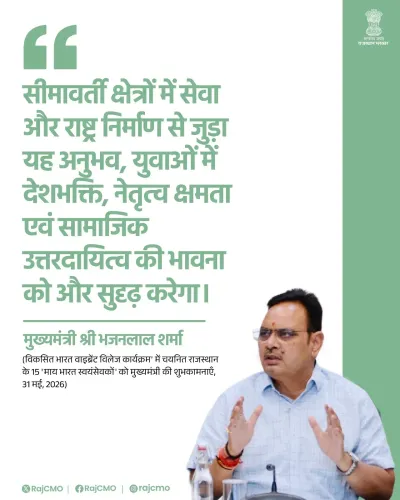
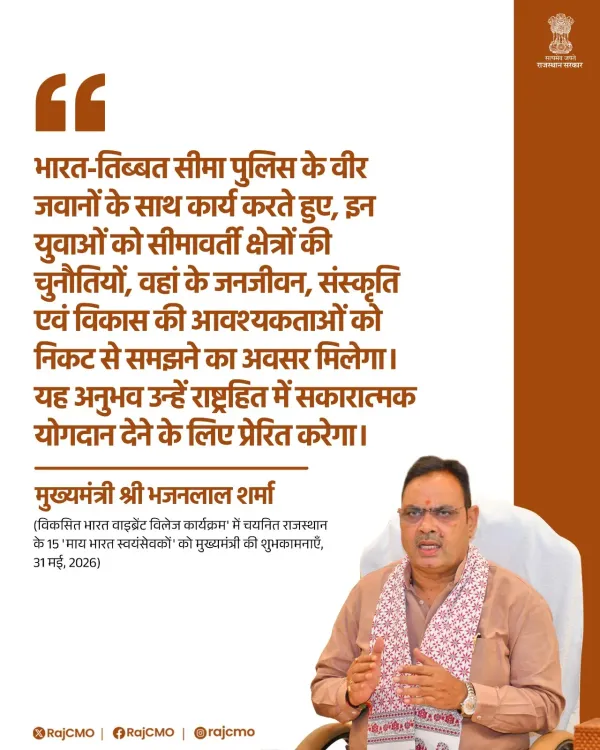
Chief Minister Bhajan Lal Sharma framed the initiative as an opportunity for youth to understand frontier challenges, local culture and development needs at first hand.
The programme falls under the #आपणो_अग्रणी_राजस्थान (Our Progressive Rajasthan) campaign of the state government.
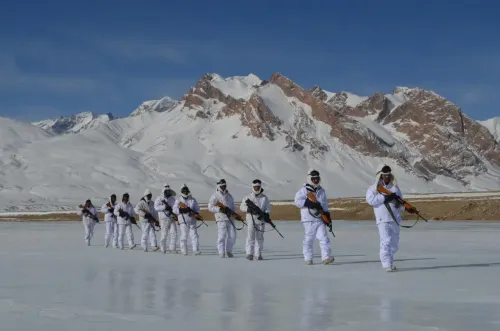
The Indo-Tibetan Border Police , raised in 1962 , guards the Line of Actual Control and has a history of civic action programmes in remote Himalayan regions.
Exact participant numbers, programme duration and districts covered have not yet been disclosed by the government.
The initiative mirrors similar state-paramilitary youth attachment models run by other Indian state governments.
The Chief Minister's Office of Rajasthan announced on Monday, 1 June 2026 that young participants from the state will be deployed alongside personnel of the Indo-Tibetan Border Police (ITBP) as part of a new border-area exposure initiative. The programme, flagged under the hashtag #आपणो_अग्रणी_राजस्थान (Our Progressive Rajasthan), is aimed at deepening youth awareness of frontier challenges, local life, culture and development needs.
Context
The post from the Chief Minister's Office, attributed to Chief Minister Bhajan Lal Sharma, states that by working alongside the brave personnel of the Indo-Tibetan Border Police, 'these young people will get an opportunity to closely understand the challenges of border areas, the life of people there, their culture, and the development needs.' The announcement positions the initiative as both a civic education exercise and a bridge between Rajasthan's youth and the realities of India's sensitive northern frontier.
Policy Backdrop
The Indo-Tibetan Border Police was raised in 1962 following the India-China conflict and is today one of India's seven Central Armed Police Forces, responsible for guarding the Line of Actual Control. Beyond its primary security mandate, the ITBP runs civic action and community outreach programmes in remote Himalayan districts. Several Indian state governments have periodically arranged short-term attachments for students and young volunteers with central paramilitary forces, using such exposure to build security awareness and surface local development gaps. The Rajasthan initiative fits squarely within this established state-centre coordination model.
Chief Minister Bhajan Lal Sharma, who took office in December 2023 after the BJP's victory in the Rajasthan assembly elections, has framed youth engagement and border-area development as priorities of his administration. The #आपणो_अग्रणी_राजस्थान campaign umbrella — translating broadly as 'Our Progressive Rajasthan' — has been used to highlight multiple governance and outreach milestones since then.
Stakeholders and Impact
The primary beneficiaries of the programme are young participants from Rajasthan, who will gain first-hand exposure to high-altitude border terrain and the socio-cultural fabric of communities living along India's frontier with Tibet. Border communities themselves stand to benefit indirectly: structured youth visits can generate documented feedback on infrastructure deficits, healthcare access and livelihood gaps that policymakers can act upon. ITBP personnel, for their part, serve as mentors and hosts — a role the force has played in similar civic-action exercises in other states.
Rajasthan, while best known for its border with Pakistan, has a significant contingent of residents with family ties to the armed forces and paramilitary services, giving such programmes a natural resonance in the state's public discourse.
What's Next
The Chief Minister's Office has not yet disclosed the exact scale, duration, districts covered or number of youth participants in this cohort. Announcements on those operational details, as well as participant feedback and any development recommendations emerging from the programme, will be closely watched by youth welfare and border-policy observers. If institutionalised, the initiative could serve as a template for other BJP-governed states seeking to replicate the model of paramilitary-youth collaboration on border development outreach.
Point of View
Blending patriotic sentiment with development discourse. The 'Aapno Agrani Rajasthan' branding also suggests the administration is keen to project the state as a proactive partner in national security, not merely a recipient of central defence policy. Whether the programme translates into concrete development recommendations or remains largely symbolic will determine its long-term policy value.
NationPress
15 Sept 2026
Frequently Asked Questions
What is the Rajasthan government's new ITBP youth programme?
The Chief Minister's Office of Rajasthan announced on 1 June 2026 that young participants will work alongside Indo-Tibetan Border Police personnel to gain first-hand understanding of border-area challenges, local culture and development needs.
Who announced the Rajasthan ITBP youth border initiative?
The announcement was made by the Chief Minister's Office of Rajasthan, attributed to Chief Minister Bhajan Lal Sharma, under his 'Aapno Agrani Rajasthan' governance campaign.
What is the Indo-Tibetan Border Police and what does it do?
The Indo-Tibetan Border Police is a Central Armed Police Force raised in 1962 to guard India's border with Tibet along the Line of Actual Control. It also conducts civic action and community outreach programmes in remote Himalayan areas.
How many youth will participate in the Rajasthan ITBP border programme?
The exact number of participants, programme duration and districts covered have not yet been officially disclosed by the Rajasthan government.
What is the Aapno Agrani Rajasthan campaign?
'Aapno Agrani Rajasthan' — meaning 'Our Progressive Rajasthan' — is a branding campaign used by the Bhajan Lal Sharma-led BJP government in Rajasthan to highlight governance milestones, youth engagement and development initiatives since December 2023.