Rajasthan CMO: 35+ policies for ease of doing business
Synopsis
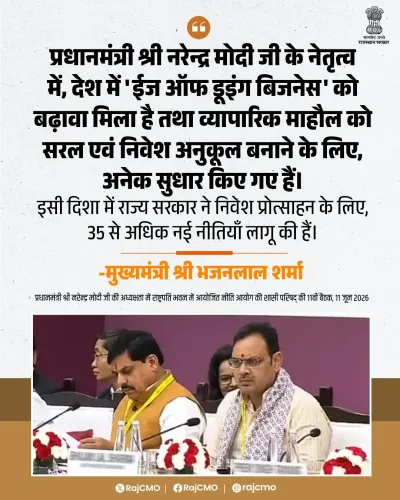
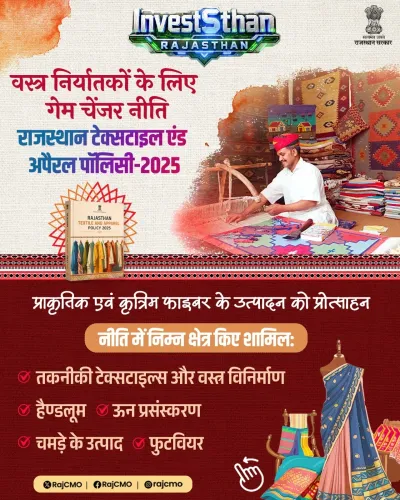
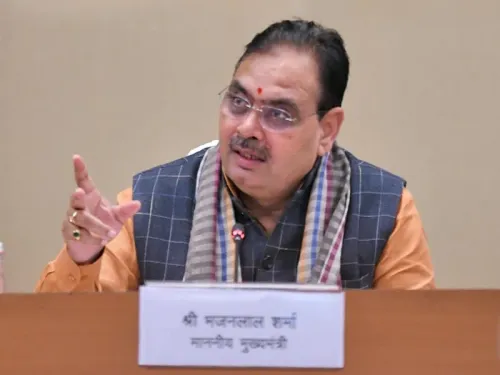
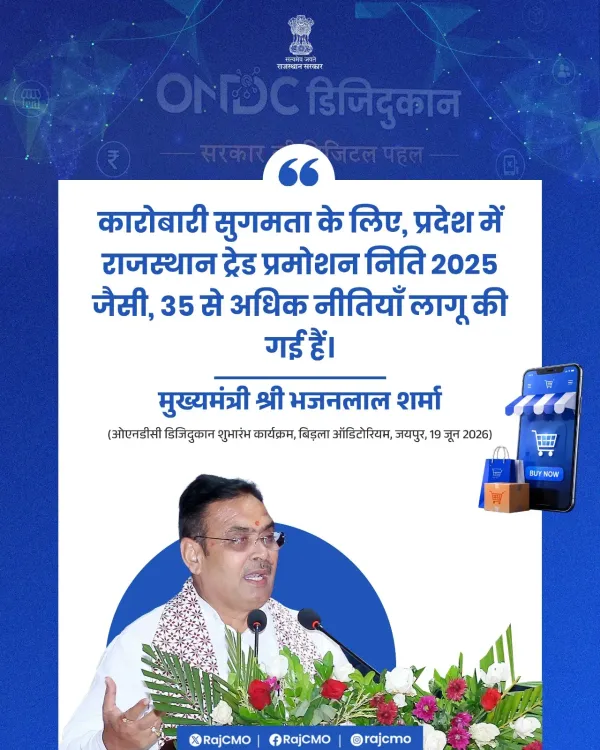
The Chief Minister's Office of Rajasthan announced that over 35 policies, led by the Rajasthan Trade Promotion Policy 2025, have been implemented under CM Bhajan Lal Sharma to boost ease of doing business and attract investment to the state.
Key Takeaways
The Chief Minister's Office of Rajasthan announced implementation of more than 35 policies focused on ease of doing business.
The Rajasthan Trade Promotion Policy 2025 is cited as the flagship measure within this policy cluster.
The announcement was made on 20 June 2026 by the official CMO account, tagging Chief Minister Bhajan Lal Sharma .
The push aligns with the BJP government's post-December 2023 agenda of investment facilitation and competitive federalism.
Key stakeholders include businesses, traders and investors seeking to operate or expand in Rajasthan.
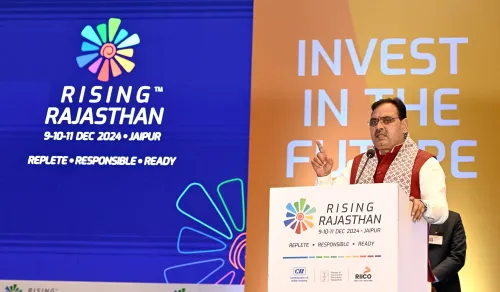
Measurable outcomes such as investment approvals and export growth are expected to be disclosed at future budget presentations and investment summits .
The Chief Minister's Office of Rajasthan announced on Saturday, 20 June 2026 that the state has implemented more than 35 policies aimed at improving ease of doing business, citing the Rajasthan Trade Promotion Policy 2025 as a flagship measure under Chief Minister Bhajan Lal Sharma.
Context
The post, shared under the hashtag #आपणो_अग्रणी_राजस्थान ('Our Leading Rajasthan'), states: 'For ease of doing business, more than 35 policies, including the Rajasthan Trade Promotion Policy 2025, have been implemented in the state.' The announcement positions Rajasthan as an active competitor in attracting domestic and foreign investment through a structured policy ecosystem.
Policy Backdrop
Since the BJP government under Chief Minister Bhajan Lal Sharma came to power following the December 2023 assembly elections, the state has signalled a renewed push toward investment facilitation and business-friendly reforms. The Rajasthan Trade Promotion Policy 2025 is cited as one of the headline instruments in this broader framework, which spans more than three dozen sector-specific and cross-cutting policies.
This approach aligns with the national agenda of competitive federalism, where states design layered policy clusters to improve their ease-of-doing-business rankings and draw capital away from rival states. Rajasthan, with its significant mineral reserves, tourism potential and an expanding manufacturing base, has particular incentive to streamline approvals and reduce regulatory friction for traders and investors.
Stakeholders and Impact
The primary beneficiaries of this multi-policy framework are businesses, traders and investors operating in or looking to enter Rajasthan. A dense policy environment — when effectively implemented — reduces the time and cost of starting, running and expanding enterprises, which can translate into job creation and export growth for the state.
Small and medium enterprises, which form the backbone of Rajasthan's trade economy, stand to gain from simplified compliance pathways if the policies are backed by administrative reform at the district and block levels. Larger industrial investors and multinational firms evaluating Rajasthan as a destination may also weigh this policy count as a signal of government intent.
What's Next
The quantitative outcomes of these policies — including new business registrations, investment approvals and export figures — are expected to surface at upcoming state budget presentations and any investment summits the Rajasthan government convenes. The state's performance on national ease-of-doing-business indices will serve as an independent benchmark against which these claims can be measured.
Observers will watch whether the breadth of policies translates into on-ground implementation, particularly in single-window clearance systems and time-bound approvals that businesses consistently identify as bottlenecks across Indian states.
Point of View
Positioning Rajasthan as a policy-dense, reform-oriented state in the competitive landscape of Indian industrial destinations. Citing a specific count of 35-plus policies and naming the Rajasthan Trade Promotion Policy 2025 signals an attempt to move beyond vague intent and offer a quantifiable metric of governance action. However, the real test lies in implementation depth — a large number of policies can as easily signal regulatory complexity as reform ambition, and investors typically look for single-window efficiency over policy volume. The announcement fits a broader BJP pattern of using social media to project economic governance credentials ahead of investment summits and state budget cycles.
NationPress
20 Jun 2026
Frequently Asked Questions
What is the Rajasthan Trade Promotion Policy 2025?
The Rajasthan Trade Promotion Policy 2025 is a state government policy aimed at facilitating trade and improving ease of doing business in Rajasthan; it has been cited by the Chief Minister's Office as the flagship measure among more than 35 such policies currently in effect.
How many ease-of-doing-business policies has Rajasthan implemented?
According to the Chief Minister's Office of Rajasthan, more than 35 policies have been implemented in the state to improve ease of doing business as of June 2026.
Who is the Chief Minister of Rajasthan in 2026?
Bhajan Lal Sharma of the BJP has been the Chief Minister of Rajasthan since December 2023 and continues in that role as of June 2026.
What is the meaning of 'Aapno Agrani Rajasthan'?
Aapno Agrani Rajasthan translates to 'Our Leading Rajasthan' in English; it is a hashtag used by the Rajasthan government to brand its development and governance initiatives on social media.
How is Rajasthan trying to attract investment?
Rajasthan is implementing a cluster of more than 35 sector-specific and cross-cutting policies, including the Rajasthan Trade Promotion Policy 2025, to reduce regulatory friction, streamline approvals and improve its ease-of-doing-business ranking to attract domestic and foreign investors.