Smriti Irani backs women as real estate leaders at NAREDCO MAHI meet
Synopsis
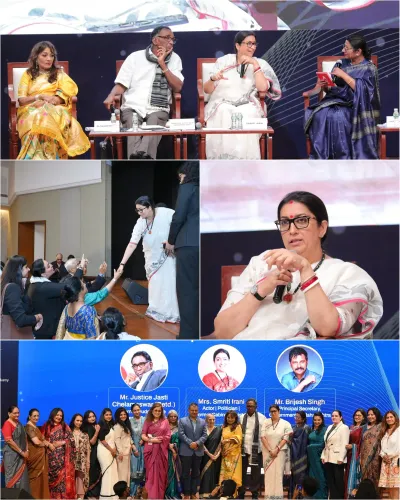
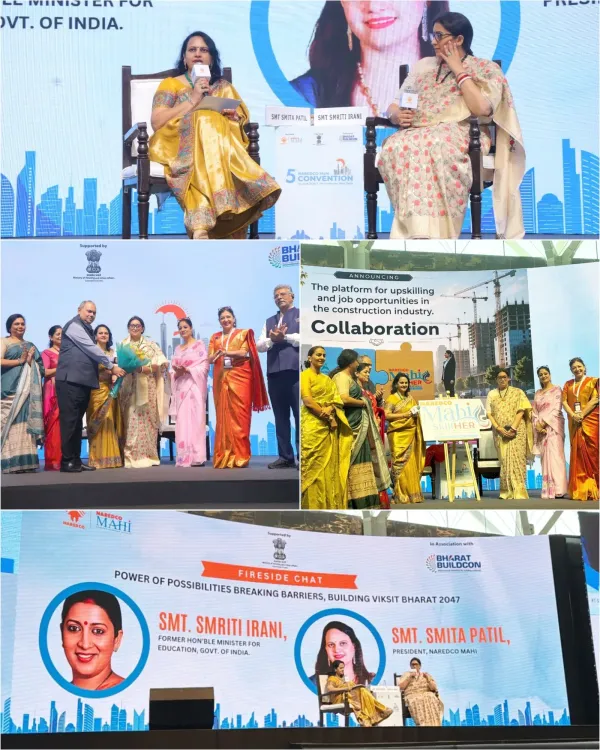
BJP leader Smriti Irani addressed the 5th NAREDCO MAHI Real Estate Convention on 20 June 2026, urging the sector to recognise women as leaders and decision-makers. She backed the newly launched SkillHER programme, calling women's economic empowerment most meaningful when they become creators of wealth and custodians of assets.
Key Takeaways
BJP leader Smriti Irani spoke at the 5th NAREDCO MAHI Real Estate Convention on 20 June 2026 .
The convention's theme was 'Breaking the Perception Ceiling: Women Shaping the Nation for Viksit Bharat' .
Irani called for women to be recognised as leaders, entrepreneurs, and decision-makers — not just participants — in the real estate value chain.
NAREDCO MAHI launched #SkillHER , a programme to train women for leadership and entrepreneurial roles in real estate.
Irani stated that women's economic empowerment is most meaningful when they become 'creators of wealth and custodians of assets.' The initiative connects to broader national frameworks including Viksit Bharat 2047 , Skill India , and RERA .
BJP leader Smriti Irani, former Union Minister of Women & Child Development, addressed the 5th NAREDCO MAHI Real Estate Convention on Saturday, 20 June 2026, calling for women to be recognised not merely as participants but as leaders, entrepreneurs, and decision-makers across the real estate value chain.
Context
Speaking at the convention themed 'Breaking the Perception Ceiling: Women Shaping the Nation for Viksit Bharat', Irani stressed that economic empowerment for women acquires greater meaning when they become 'creators of wealth and custodians of assets.' The event was organised by NAREDCO MAHI, the women's wing of the National Real Estate Development Council, which focuses on expanding female participation in India's property sector.
Irani welcomed the launch of #SkillHER, a new initiative by NAREDCO MAHI designed to equip women with skills and opportunities for leadership roles within the country's evolving real estate ecosystem.
Policy Backdrop
The convention's theme aligns with the government's broader Viksit Bharat 2047 vision, which frames sector-specific inclusion strategies as central to India's development goals. Real estate, a capital-intensive sector regulated since 2016 under the Real Estate (Regulation and Development) Act, has been identified as an area where greater female leadership can both expand the pool of skilled professionals and drive demand for women-centric housing products.
Earlier policy frameworks — including the Beti Bachao Beti Padhao scheme launched in 2015 and the Skill India Mission of the same year — laid the groundwork for targeted skilling and asset-creation programmes aimed at raising female labour-force participation. SkillHER represents a continuation of this pattern, now applied specifically to the real estate sector through an industry-body platform.
Stakeholders and Impact
The primary beneficiaries of SkillHER are women entrepreneurs and aspirants seeking entry or advancement within the real estate workforce. Industry bodies such as NAREDCO MAHI are increasingly aligning their programmes with national inclusion narratives, creating structured pipelines for women in sectors historically dominated by male leadership.
Irani's presence at the convention signals continued political attention to gender-focused economic frameworks, particularly in sectors governed by formal regulatory architecture like RERA. For women already working in real estate — from construction management to brokerage and urban planning — such platforms can translate into mentorship networks, formal skilling credentials, and leadership visibility.
What's Next
The practical impact of SkillHER will be measured by its roll-out metrics, placement records, and the extent to which state governments introduce complementary incentives following the convention's recommendations. Observers will also watch whether the initiative draws formal integration with existing central schemes such as Skill India or sector-specific RERA mandates. If the programme demonstrates measurable outcomes over the next two years, it could serve as a model for similar industry-led, gender-focused skilling efforts in other capital-intensive sectors.
Point of View
Particularly ahead of electoral cycles. By framing real estate — a sector with deep household and asset implications — as a frontier for female leadership, the party seeks to extend its gender-policy narrative beyond welfare into wealth creation. The SkillHER launch gives that narrative a concrete, trackable instrument, though its credibility will ultimately rest on verifiable placement and entrepreneurship outcomes rather than convention optics. If state governments follow with complementary incentives, this could mark a meaningful shift in how India's property sector approaches gender inclusion.
NationPress
21 Jun 2026
Frequently Asked Questions
What is the NAREDCO MAHI Real Estate Convention?
The NAREDCO MAHI Real Estate Convention is an annual event organised by the women's wing of the National Real Estate Development Council to promote female participation and leadership in India's real estate sector. The 5th edition was held on 20 June 2026.
What is the SkillHER initiative?
SkillHER is a skill development programme launched by NAREDCO MAHI to train women for leadership and entrepreneurial roles within India's real estate ecosystem. It was unveiled at the 5th NAREDCO MAHI convention on 20 June 2026.
What did Smriti Irani say at the NAREDCO MAHI convention?
Smriti Irani emphasised that women must be recognised as leaders, entrepreneurs, and decision-makers across the real estate value chain, not merely as participants. She also said that economic empowerment for women is most meaningful when they become creators of wealth and custodians of assets.
How does SkillHER relate to Viksit Bharat?
SkillHER aligns with the Viksit Bharat 2047 vision, which frames gender inclusion and sector-specific skilling as central to India's development goals. NAREDCO MAHI positions the programme as a contribution to building a developed India by empowering women in a capital-intensive sector.
What earlier government schemes support women in real estate and skilling?
The Skill India Mission and Beti Bachao Beti Padhao scheme, both launched in 2015, laid the policy groundwork for female skilling and asset-creation. The Real Estate (Regulation and Development) Act of 2016 brought regulatory transparency to the sector within which these efforts now operate.