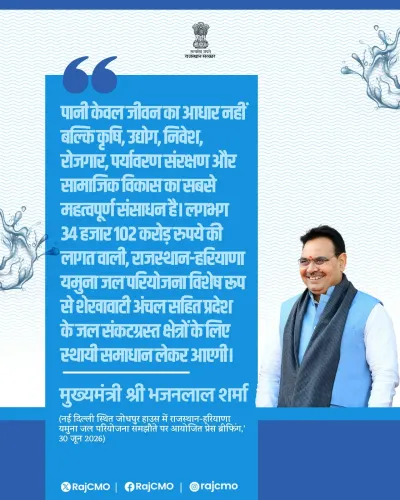
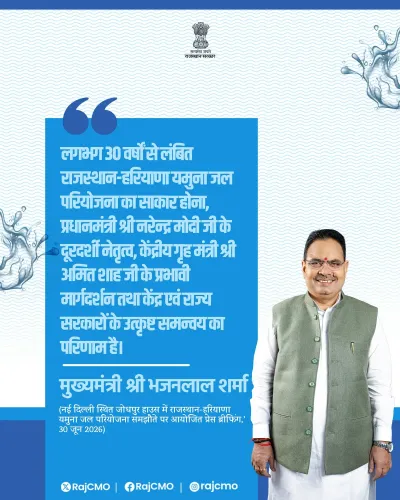
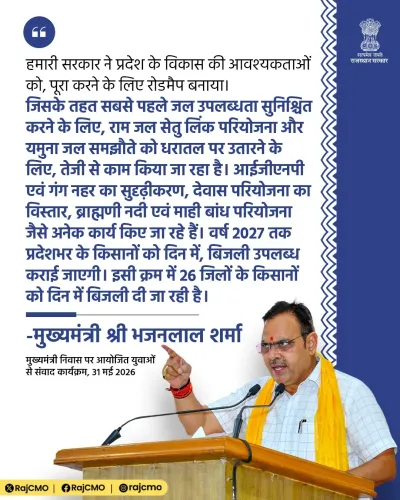
Rajasthan CMO: 4 Historic Water Pacts Under PM Modi
Synopsis
The Chief Minister's Office of Rajasthan announced four inter-state water agreements — Ramjal Setu Link Project, Yamuna Water Agreement, Narmada Water Agreement, and Kishau Multipurpose Project — crediting PM Narendra Modi's guidance as a milestone for the water-scarce state.
Key Takeaways
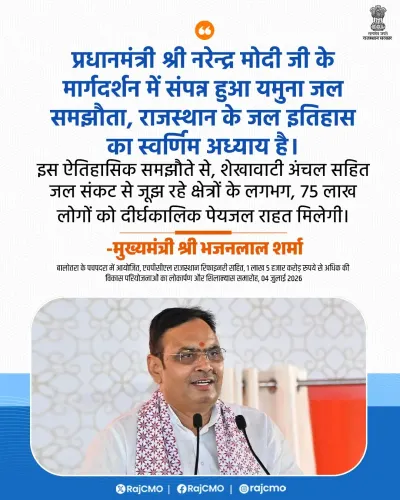
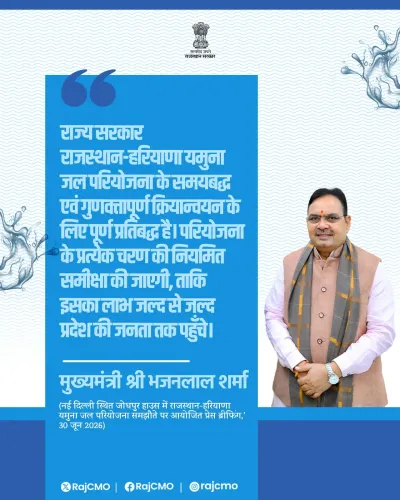
The Rajasthan CMO announced four water agreements on 29 September 2026 , tagging CM Bhajan Lal Sharma and crediting PM Narendra Modi .
The Ramjal Setu Link Project aims to transfer water within Rajasthan for irrigation and drinking purposes.
The Yamuna Water Agreement governs inter-state sharing among Haryana, Uttar Pradesh, Delhi, and Rajasthan.
The Kishau Multipurpose Project on the Tons River involves Rajasthan, Uttarakhand, and Himachal Pradesh for hydropower and irrigation.
The Narmada Water Agreement builds on the 1979 Narmada Water Disputes Tribunal award of 0.5 MAF to Rajasthan.
DPRs, environmental clearances, and fund releases remain ahead — the critical test of whether agreements become actual infrastructure.
Four inter-state water agreements that could reshape the irrigation and drinking-water landscape of one of India's most arid states have been announced by the Chief Minister's Office of Rajasthan, crediting the guidance of Prime Minister Narendra Modi for unlocking deals that have long eluded the state.
The post, shared on Tuesday, 29 September 2026, names four pacts: the Ramjal Setu Link Project, the Yamuna Water Agreement, a Narmada Water Agreement, and the Kishau Multipurpose Project — tagging Chief Minister Bhajan Lal Sharma under the hashtag #आपणो_अग्रणी_राजस्थान ('Our Foremost Rajasthan').
Why Rajasthan's water math has always been hard
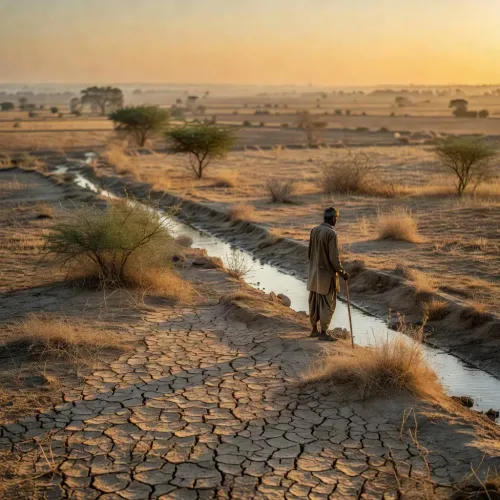
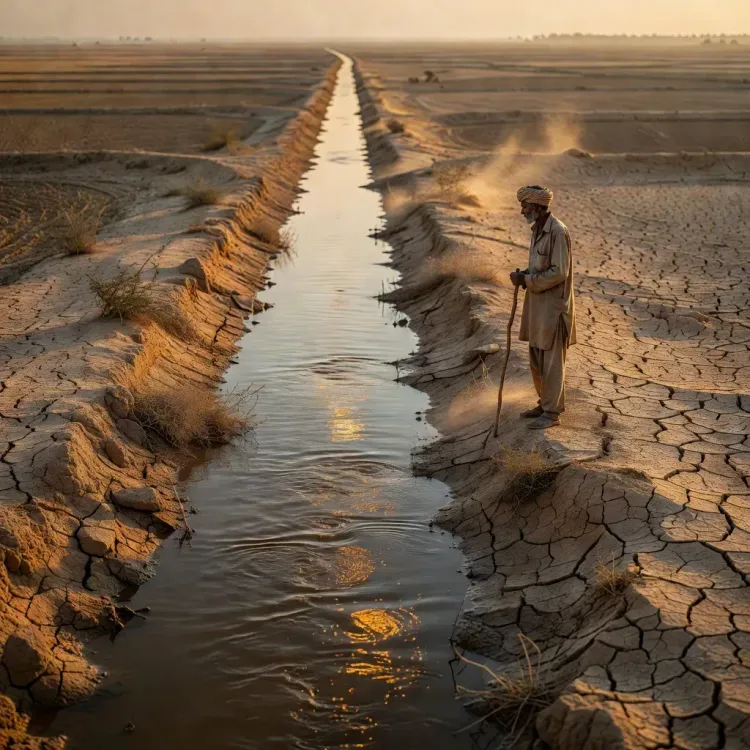
Rajasthan covers roughly 10 percent of India's landmass yet holds less than one percent of its surface water. Every major river — the Yamuna, the Narmada, the Tons — rises or flows through neighbouring states before it can be of use here, making inter-state negotiations not a technicality but an existential necessity. The state's farmers and arid-region households have lived for decades inside that gap between need and availability.
The Narmada Water Disputes Tribunal awarded Rajasthan 0.5 million acre-feet (MAF) of Narmada waters as far back as 1979, yet translating that paper entitlement into pipes, canals, and taps has required continuous central mediation. The new agreement builds on that long-standing framework.
What each of the four agreements covers
The Ramjal Setu Link Project is a river-linking initiative designed to transfer water within Rajasthan for irrigation and drinking supply — the kind of intra-state connectivity that reduces dependence on any single inter-state negotiation. The Yamuna Water Agreement is an inter-state pact governing sharing of Yamuna flows among Haryana, Uttar Pradesh, Delhi, and Rajasthan, a perennially contested allocation.
The Kishau Multipurpose Project, proposed on the Tons River, is a joint venture involving Uttarakhand, Himachal Pradesh, and Rajasthan — combining hydropower generation with irrigation and drinking water supply. The Narmada Water Agreement formalises terms around Rajasthan's share from the Narmada basin, giving legal and administrative structure to the decades-old tribunal award.
Central facilitation and the Bhajan Lal government's pitch
By framing all four deals under Prime Minister Modi's guidance, the CMO is making a pointed political argument: that the Bharatiya Janata Party government in Jaipur — led by CM Bhajan Lal Sharma since December 2023 — has leveraged its alignment with the Centre to unlock agreements that cross state boundaries and require Union arbitration. River-water negotiations in India almost invariably stall without active central push, and the post signals that push has arrived.
Rajasthan has a well-documented pattern of pursuing inter-state water sharing deals and link projects to counter chronic scarcity, with outcomes historically tied to the political chemistry between state and Centre. The announcement of four simultaneous pacts — if they advance from agreement to implementation — would represent a significant step in that long arc.
From signatures to shovels: the road that still lies ahead
Agreements in Indian water infrastructure routinely face multi-year gaps before detailed project reports are cleared, environmental approvals granted, and funds actually released. The Kishau dam, for instance, has been in planning discussions for decades across successive governments. What the CMO has announced marks an agreement phase — the downstream work of DPRs, clearances, and financing remains ahead. Whether these four pacts accelerate from paper to ground will be the real measure of their historic claim.
For Rajasthan's farmers and the millions of households in its water-scarce interior, the announcements land as a signal of intent. The state government has now set a benchmark it will be held to.
Point of View
Opposition parties will use the gap as ammunition. This announcement also fits a broader BJP pattern of framing inter-state infrastructure wins as a product of 'double-engine government,' a framing that will intensify ahead of local body elections.
NationPress
29 Sept 2026
Frequently Asked Questions
What are the four water agreements announced for Rajasthan in 2026?
The four agreements are the Ramjal Setu Link Project, the Yamuna Water Agreement, the Narmada Water Agreement, and the Kishau Multipurpose Project — all announced by the Rajasthan CMO on 29 September 2026.
What is the Kishau Multipurpose Project?
The Kishau Multipurpose Project is a proposed dam on the Tons River involving Rajasthan, Uttarakhand, and Himachal Pradesh, designed to generate hydropower and provide irrigation and drinking water.
What is Rajasthan's share of Narmada water?
The Narmada Water Disputes Tribunal awarded Rajasthan 0.5 million acre-feet (MAF) of Narmada waters in 1979, and the new agreement builds on this longstanding allocation.
Who is the Chief Minister of Rajasthan in 2026?
Bhajan Lal Sharma is the Chief Minister of Rajasthan, having taken office in December 2023 after the BJP won the state assembly elections.
What is the Ramjal Setu Link Project in Rajasthan?
The Ramjal Setu Link Project is a river-linking initiative proposed to transfer water within Rajasthan to meet irrigation and drinking water needs across the state's arid regions.