Rajasthan CMO Pushes Effective Use of 1930 Cyber Helpline
Synopsis
The Chief Minister's Office of Rajasthan on 28 May 2026 directed effective use of the national 1930 cyber crime helpline for swift fraud redressal, tagging Union Home Minister Amit Shah in a post underlining federal-state coordination on cyber security.
Key Takeaways
The Chief Minister's Office of Rajasthan on 28 May 2026 directed effective use of the 1930 national cyber crime helpline.
The 1930 helpline, operated under the Ministry of Home Affairs , enables rapid coordination between police, banks, and payment gateways to freeze fraudulent transactions.
Union Home Minister Amit Shah was tagged in the post, highlighting the federal dimension of the directive.
The helpline is part of a national framework that includes the Indian Cyber Crime Coordination Centre (I4C) , established in 2018 , and the National Cyber Crime Reporting Portal , launched in 2019 .
The directive aims to improve Rajasthan Police 's integration of central cyber crime tools into local policing workflows.
The post was shared under the hashtag #आपणो_अग्रणी_राजस्थान ('Our Leading Rajasthan'), the state government's development branding.
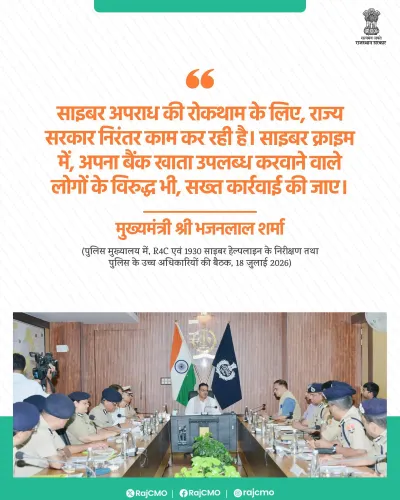
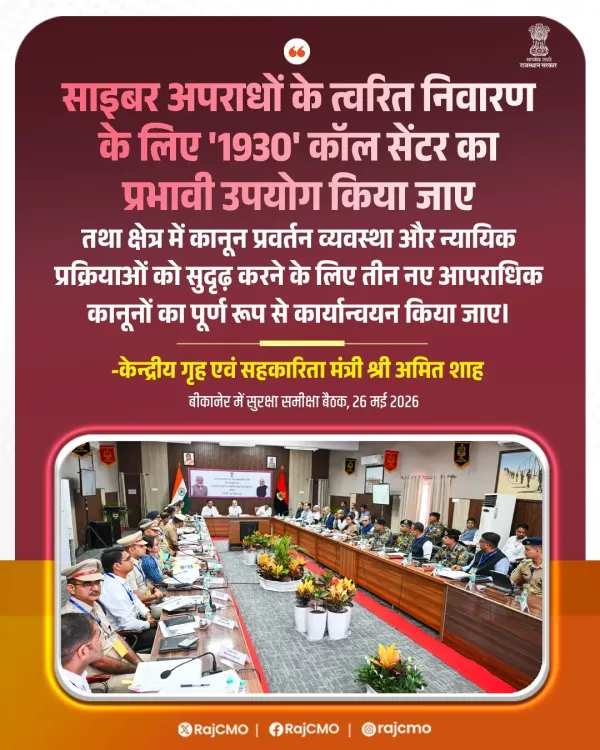
The Chief Minister's Office of Rajasthan, on Thursday, 28 May 2026, directed that the national cyber crime helpline number 1930 be used effectively for the swift redressal of cyber offences, tagging Union Home Minister Amit Shah in the communication.
The post, shared on the official CMO handle, stated in Hindi: 'साइबर अपराधों के त्वरित निवारण के लिए 1930 कॉल सेंटर का प्रभावी उपयोग किया जाए' — meaning, 'The 1930 call centre should be used effectively for the swift redressal of cyber crimes.' The message was accompanied by the hashtag #आपणो_अग्रणी_राजस्थान (meaning 'Our Leading Rajasthan'), a branding phrase associated with the state government's development agenda.
Context
The 1930 helpline is a national emergency number operated under the Ministry of Home Affairs (MHA) specifically for reporting cyber financial frauds. When a victim calls 1930 promptly after a fraud, the system enables rapid coordination between police, banks, and payment gateways to freeze fraudulent transactions before funds are transferred further. The helpline functions as the first-response layer of India's broader cyber crime architecture. Rajasthan's directive signals an intent to strengthen local uptake of this central mechanism, ensuring that citizens and police personnel in the state are actively channelling cyber fraud complaints through the designated national infrastructure rather than through slower, conventional routes.Policy Backdrop
The 1930 helpline sits within an institutional framework built progressively by the Centre. The Indian Cyber Crime Coordination Centre (I4C) was established in 2018 under the MHA to create a national architecture for preventing and investigating cyber offences. The following year, in 2019, the National Cyber Crime Reporting Portal (NCRP) was operationalised, enabling online complaint filing and inter-state coordination. Together, the I4C, the NCRP, and the 1930 helpline form a three-tier response system. States are expected to integrate these tools into local policing workflows, train front-line officers on handling 1930-routed complaints, and coordinate with banks for timely fund holds. Rajasthan, as a large state with extensive rural and semi-urban populations increasingly adopting digital payments, faces a proportionally significant exposure to online financial fraud.Stakeholders and Impact
The most direct beneficiaries of an effective 1930 deployment are ordinary citizens who fall victim to cyber financial fraud — a category that has grown sharply alongside the expansion of UPI, mobile banking, and e-commerce across India. Faster call-centre response translates directly into higher rates of fund recovery before fraudsters can move money across accounts or jurisdictions. Rajasthan Police is the key operational stakeholder, as officers handling 1930-routed complaints must be trained to initiate bank coordination within the narrow window — often a matter of hours — during which frozen funds can be recovered. The tagging of Union Home Minister Amit Shah underlines the federal dimension: effective use of the helpline requires seamless Centre-state coordination on data sharing, bank liaison protocols, and police capacity.What's Next
The CMO's public directive is likely to be followed by state-level administrative orders to Rajasthan Police on 1930 call-handling protocols and officer training. Observers will watch for any formal memoranda of understanding between the state police and the I4C, as well as performance metrics on call response times and fraud recovery rates. As digital penetration deepens in Rajasthan's tier-2 and tier-3 towns and villages, the state's ability to leverage national cyber crime infrastructure will increasingly determine how well its citizens are protected from financial fraud. The CMO's nudge towards the 1930 helpline reflects a wider federal push to make centrally built tools operationally meaningful at the ground level.Point of View
With a direct tag to the Union Home Minister, is a textbook example of states signalling alignment with Centre-driven security infrastructure — as much for administrative effect as for public visibility. It fits a pattern in which state governments use social media directives to reinforce federal priorities, particularly in domains like cyber crime where operational success depends on Centre-state data and banking coordination. The timing also reflects the political economy of digital governance: as UPI and mobile banking reach deeper into rural Rajasthan, the cost of inaction on cyber fraud becomes electorally visible. The broader implication is that India's cyber crime response architecture, however well-designed at the Centre, remains only as effective as the last-mile commitment of state police forces.
NationPress
11 Oct 2026
Frequently Asked Questions
What is the 1930 helpline in India?
The 1930 helpline is a national emergency number operated by the Ministry of Home Affairs for the immediate reporting of cyber financial frauds. Calling 1930 promptly after a fraud triggers coordination between police, banks, and payment gateways to freeze and potentially recover stolen funds.
Why did the Rajasthan CMO tag Amit Shah in the cyber crime post?
Union Home Minister Amit Shah oversees the Ministry of Home Affairs, which operates the 1930 helpline and the Indian Cyber Crime Coordination Centre. Tagging him underlines the federal nature of the directive and signals Rajasthan's intent to align with central cyber crime infrastructure.
What is the I4C and how does it relate to 1930?
The Indian Cyber Crime Coordination Centre (I4C) was established in 2018 under the Ministry of Home Affairs to build a national framework for preventing and investigating cyber crimes. The 1930 helpline and the National Cyber Crime Reporting Portal are key tools within this framework.
How effective is the 1930 helpline in recovering fraud money?
The 1930 helpline is designed to enable fund freezing within a narrow window after a fraud is reported. Its effectiveness depends on how quickly victims call and how efficiently state police coordinate with banks — which is precisely why Rajasthan's CMO has directed more effective use of the number.
What does the hashtag Aapno Agrani Rajasthan mean?
'Aapno Agrani Rajasthan' translates from Rajasthani and Hindi as 'Our Leading Rajasthan.' It is a branding phrase used by the Rajasthan state government to promote its governance and development agenda across official communications.