Rajasthan CMO: Water Management Is Foundation for Future Generations
Synopsis
The Rajasthan CMO, citing CM Bhajanlal Sharma, framed water management as a generational responsibility on October 28, 2026, reinforcing the state's long-standing focus on water conservation in one of India's most arid regions.
Key Takeaways
The Chief Minister's Office of Rajasthan posted on October 28, 2026 , attributing a water-conservation message to CM Bhajanlal Sharma .
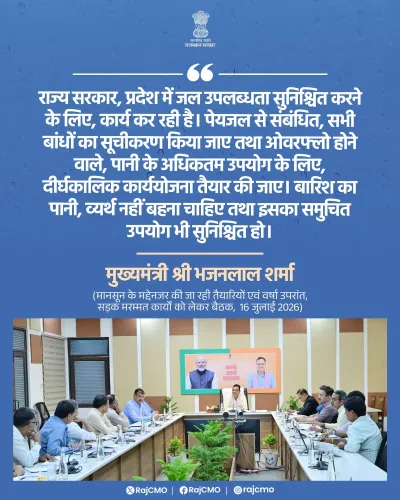
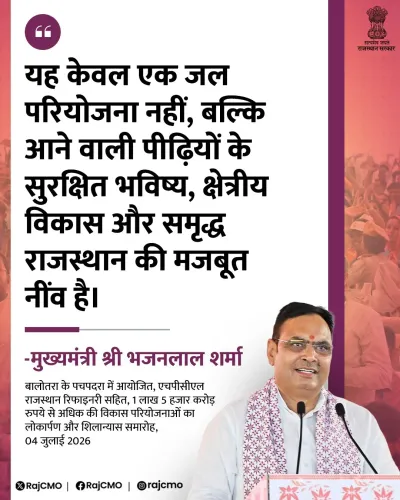
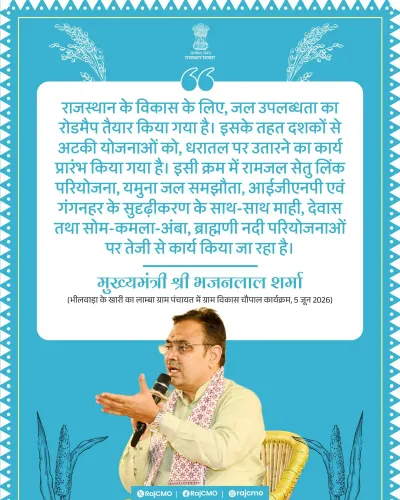
The message declared that water management is 'the foundation of a safe future for coming generations,' framing conservation as a long-term generational duty.
Rajasthan covers over 10 percent of India's landmass but faces chronic water scarcity, making the issue structurally critical.
The Mukhya Mantri Jal Swavalamban Abhiyan , launched in 2016 , remains a key programme for community-led water harvesting and groundwater recharge across Rajasthan's districts.
CM Bhajanlal Sharma has governed Rajasthan since December 2023 , continuing BJP-led emphasis on water security as part of the 'self-reliant Rajasthan' narrative.
State budget allocations for water projects and potential new Jal Swavalamban phases in 2026-27 are being closely watched.
In an arid state where water scarcity shapes daily life and farm fortunes, the Chief Minister's Office of Rajasthan on Wednesday, October 28, 2026 posted a pointed reminder: water management is not merely a present-day necessity but the very foundation of a secure future for generations yet to come.
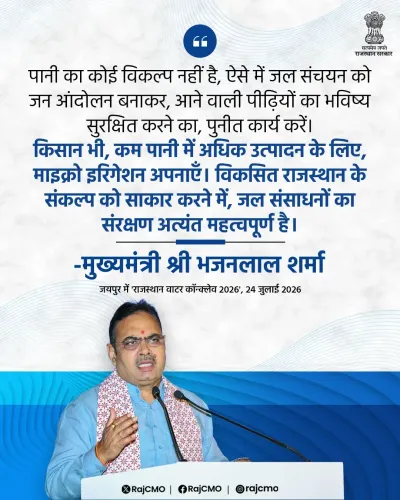
The post, attributed to Chief Minister Bhajanlal Sharma under the hashtag #आपणो_अग्रणी_राजस्थान ('Our Pioneering Rajasthan'), carried a Hindi declaration that translates as: 'Water management is not only the need of the present, but the foundation of a safe future for the coming generations.' Brief. But in Rajasthan, those words carry the weight of geography.
Why Every Drop Counts Differently in Rajasthan
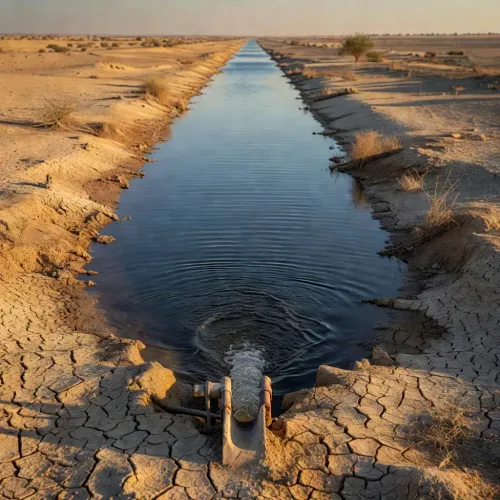
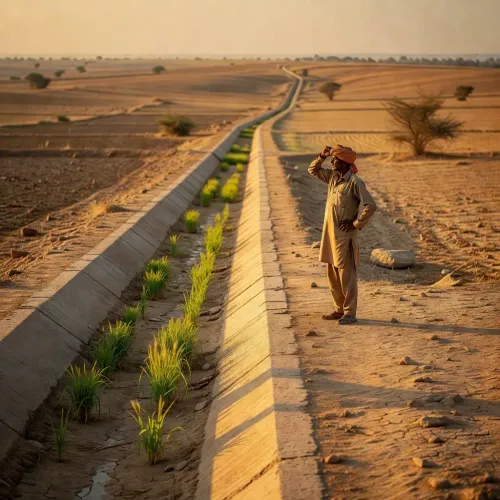
Rajasthan spans more than 10 percent of India's landmass yet holds a fraction of its surface water. The Thar Desert dominates the west, annual rainfall is erratic, and groundwater tables in several districts have been falling for decades. For the state's rural communities and agricultural sector — which together form the backbone of Rajasthan's economy — the availability of water is not a policy abstraction. It is the difference between a harvest and a loss.
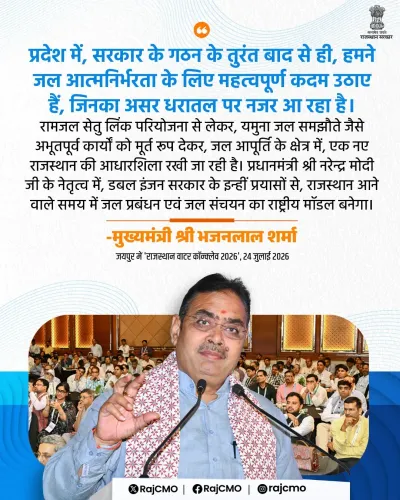
Successive state governments have responded with watershed development schemes, check-dam construction, and community-led conservation drives. The Mukhya Mantri Jal Swavalamban Abhiyan, launched in 2016, became one of the most visible of these efforts — mobilising districts to build water-harvesting structures and recharge groundwater through decentralised, community-owned infrastructure. The BJP-led administration under CM Bhajanlal Sharma, who took office in December 2023, has continued to frame water security as central to its 'self-reliant Rajasthan' vision.
The Generational Framing — and What It Signals
The deliberate pivot to 'coming generations' in today's message is notable. It moves the conversation from reactive crisis management — filling tanks before summer — to long-horizon infrastructure thinking. That framing aligns with state-level debates around budget allocations for water projects and the possibility of new district-level phases of the Jal Swavalamban programme in 2026-27.
Whether the post previews a specific policy announcement or a fresh project launch remains to be confirmed. What it does signal clearly is that water governance will remain front and centre in the Sharma administration's public messaging — and, critically, in its pitch to rural Rajasthan ahead of future electoral cycles.
In a state where the monsoon is a prayer and the well is a lifeline, making water management a matter of generational duty is not rhetoric. It is politics grounded in survival.
Point of View
Lending it electoral and moral weight simultaneously. For the Bhajanlal Sharma administration, which inherited a state with deepening groundwater stress, this kind of consistent messaging builds the narrative architecture for larger budget asks in water infrastructure. It also signals that the BJP in Rajasthan is calibrating its rural pitch around resource security themes, which have proven durable in arid-belt constituencies. The question is whether the rhetoric translates into verifiable allocations in the 2026-27 state budget.
NationPress
28 Oct 2026
Frequently Asked Questions
What did the Rajasthan CMO post about water management on October 28 2026?
The Rajasthan CMO posted a message from CM Bhajanlal Sharma stating that water management is not only a present-day need but the foundation of a safe future for coming generations, under the hashtag #आपणो_अग्रणी_राजस्थान.
Who is Bhajanlal Sharma and what is his role in Rajasthan?
Bhajanlal Sharma is the BJP Chief Minister of Rajasthan, in office since December 2023. He oversees state development priorities including water conservation and resource management.
What is the Mukhya Mantri Jal Swavalamban Abhiyan?
The Mukhya Mantri Jal Swavalamban Abhiyan is a Rajasthan government scheme launched in 2016 to promote community-led water conservation, including construction of water-harvesting structures and groundwater recharge infrastructure across districts.
Why is water management so critical in Rajasthan?
Rajasthan covers more than 10 percent of India's landmass but receives erratic rainfall due to the Thar Desert dominating its western region. Groundwater tables are falling in several districts, making water security a survival issue for rural communities and farmers.
What is the 'Aapno Agrani Rajasthan' hashtag used by the CMO?
'Aapno Agrani Rajasthan' translates to 'Our Pioneering Rajasthan' and is a BJP-aligned branding hashtag used by the Rajasthan government to promote its development and self-reliance narrative for the state.