Rajasthan CMO flags three water projects for permanent supply
Synopsis
The Chief Minister's Office of Rajasthan has highlighted three inter-basin water transfer projects — the Yamuna Jal Pariyojana, Narmada Pariyojana and Kishau Pariyojana — as the foundation of permanent drinking-water security for the state's large population, tagging CM Bhajanlal Sharma in the official post.
Key Takeaways
The Rajasthan CMO officially cited three projects — Yamuna Jal Pariyojana , Narmada Pariyojana , and Kishau Pariyojana — as guarantors of permanent drinking-water security.
CM Bhajanlal Sharma , in office since December 2023 , is being positioned as the face of the state's water infrastructure push.
Rajasthan has pursued inter-basin water transfer strategies since the 1990s to address chronic groundwater depletion in its desert and semi-arid zones.
All three projects require inter-state agreements or central clearances involving states such as Uttarakhand , Himachal Pradesh , and Madhya Pradesh .
The Narmada Pariyojana is the most established of the three, already supplying southern and western Rajasthan districts via canal networks.
Key milestones to watch include budget allocations, detailed project reports, and progress on tripartite inter-state water accords.
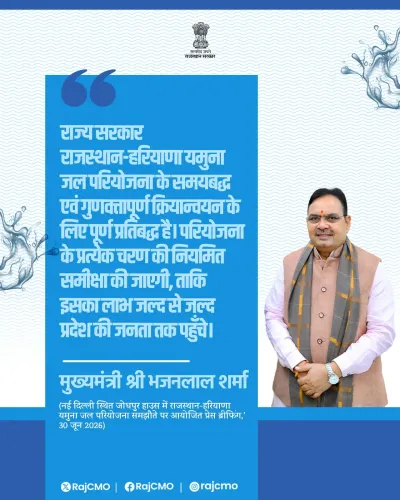
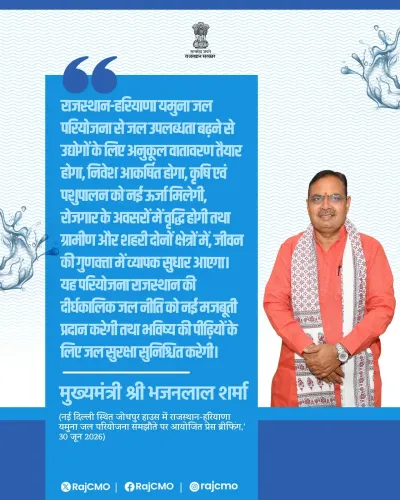
Rajasthan's most stubborn crisis has never been a policy failure — it has been a geography one. Now, the Chief Minister's Office of Rajasthan has pointed to three inter-basin water transfer projects as the state's answer to that ancient problem, asserting on 30 September 2026 that the Yamuna Jal Pariyojana, the Narmada Pariyojana, and the Kishau Pariyojana together will guarantee permanent drinking-water security for a large share of the state's population.
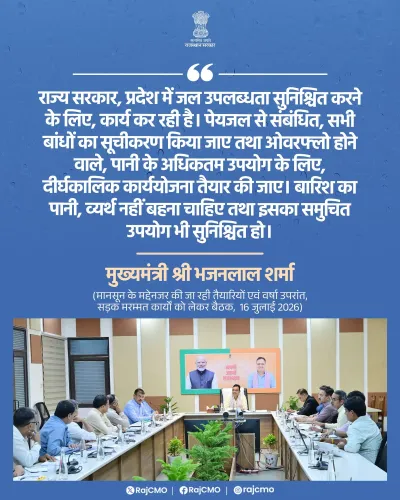
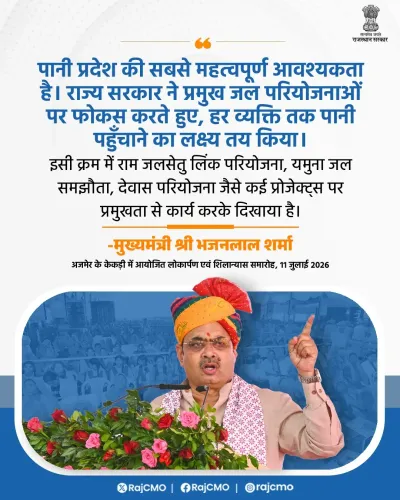
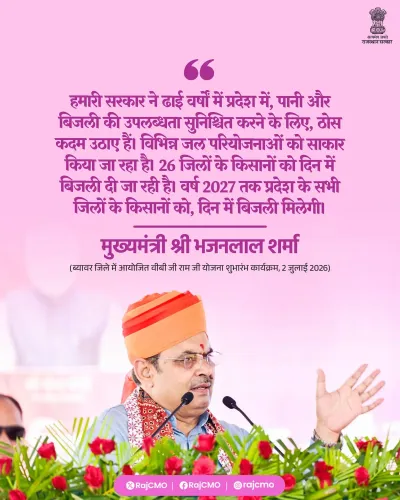
The post, tagging Chief Minister Bhajanlal Sharma and carrying the hashtag #आपणो_अग्रणी_राजस्थान ('Our Leading Rajasthan'), frames the three schemes not as aspirations but as commitments — a deliberate signal from the government's official handle that water security is central to its development pitch.
Three rivers, one arid state's survival equation
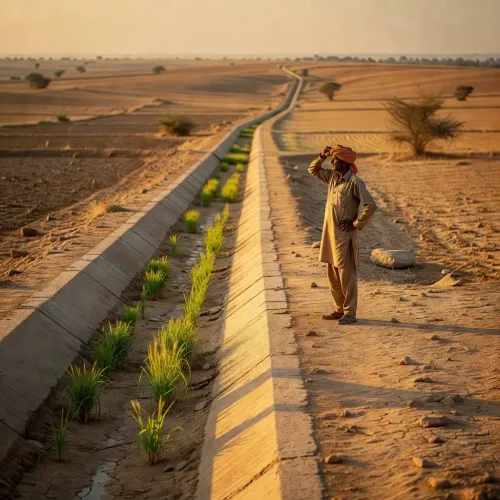
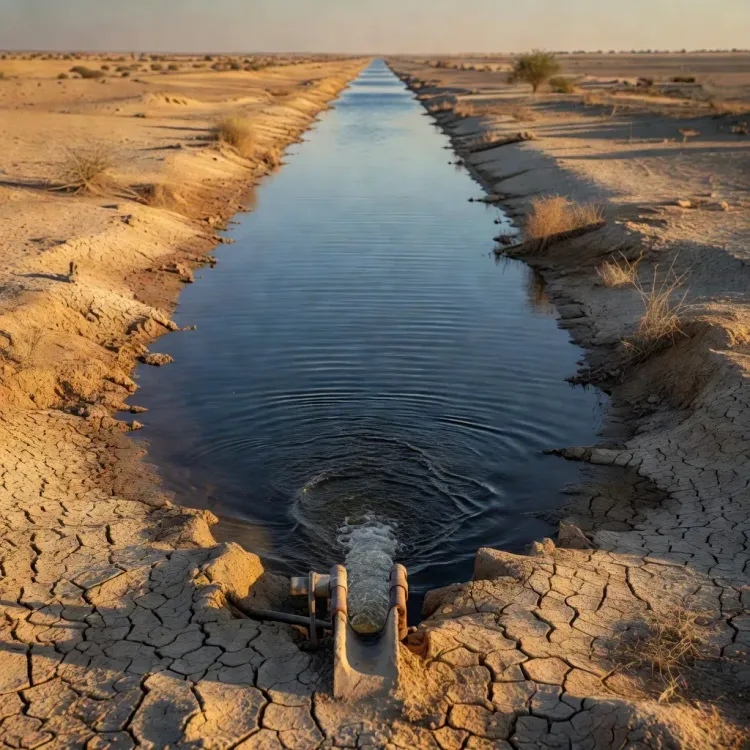
Each of the three projects draws from a different river system, and each targets a different slice of Rajasthan's geography. The Narmada Pariyojana is the most established of the three — a long-running canal network that channels Narmada waters northward into the state's southern and western districts, regions that sit far beyond any reliable natural water table.
The Yamuna Jal Pariyojana proposes to tap the Yamuna basin for drinking-water supply, extending the river's reach into a state that has historically had limited claim on its flows. The Kishau Pariyojana is a multipurpose dam project on a Yamuna tributary, designed to create storage capacity that Rajasthan can draw on for both irrigation and potable supply. Together, the three projects represent a diversified inter-basin strategy rather than a single-source bet.
Why Rajasthan keeps returning to river-transfer schemes
Rajasthan is the largest state in India by area and one of the most water-stressed. Its groundwater reserves have been in long-term decline across its desert and semi-arid zones, and rainfall is both sparse and unpredictable. State governments across party lines have pursued inter-basin transfer as the only structural solution since the 1990s, when the first serious policy frameworks for arid-zone supply emerged.
The challenge, then and now, is that none of these projects sits entirely within Rajasthan's borders. The Yamuna projects require agreements with Uttarakhand and other upstream states; the Kishau dam involves Himachal Pradesh; and the Narmada network depends on allocations negotiated with Madhya Pradesh. Central clearances, tripartite accords, and inter-state water tribunals are all part of the journey from announcement to tap.
What the government's framing signals
CM Bhajanlal Sharma, in office since December 2023, has positioned water infrastructure as a flagship priority. Grouping all three projects into a single official communication — and using the word 'permanent' (स्थायी) — is a deliberate choice: it frames the administration's water agenda as comprehensive and durable, not piecemeal.
What will matter next is whether upcoming state budgets carry the funding allocations to match the ambition, and whether detailed project reports and inter-state agreements advance on the Yamuna and Kishau fronts. For millions of households in Rajasthan's arid interior, those bureaucratic milestones are the difference between a promise and a pipeline.
Point of View
Narmada and Kishau projects under a single 'permanent water security' banner, the Bhajanlal Sharma government is staking a clear electoral and governance claim on Rajasthan's most intractable infrastructure problem. The move fits a broader BJP pattern of framing large-scale infrastructure as a civilisational fix rather than incremental policy. The real test, however, is inter-state diplomacy — Rajasthan's water future depends as much on negotiating tables in Delhi, Shimla and Bhopal as on any announcement from Jaipur. Progress on tripartite agreements and DPRs in the coming budget cycle will reveal whether this is a governance pivot or a political positioning exercise.
NationPress
30 Sept 2026
Frequently Asked Questions
What is the Yamuna Jal Pariyojana in Rajasthan?
The Yamuna Jal Pariyojana is a proposed project to supply drinking water from the Yamuna river basin to Rajasthan, requiring inter-state agreements with upstream states. The Rajasthan government has cited it as one of three key schemes for permanent water security.
What is the Kishau Pariyojana?
The Kishau Pariyojana is a multipurpose dam project on a tributary of the Yamuna river, involving Rajasthan and Himachal Pradesh, designed to create water storage for drinking supply and irrigation in the region.
How does the Narmada Pariyojana help Rajasthan?
The Narmada Pariyojana is a long-running canal network that channels water from the Narmada river northward into southern and western Rajasthan districts, areas that face severe groundwater depletion and scarce rainfall.
Why does Rajasthan face a drinking water crisis?
Rajasthan is India's largest state by area and sits largely in desert and semi-arid zones where groundwater reserves have been declining for decades and rainfall is sparse and unreliable, making inter-basin water transfer the primary long-term solution.
Who is Bhajanlal Sharma and what is his role in Rajasthan's water projects?
Bhajanlal Sharma is the Chief Minister of Rajasthan from the BJP, in office since December 2023. His government has positioned water infrastructure — including the Yamuna, Narmada and Kishau projects — as a flagship policy priority.