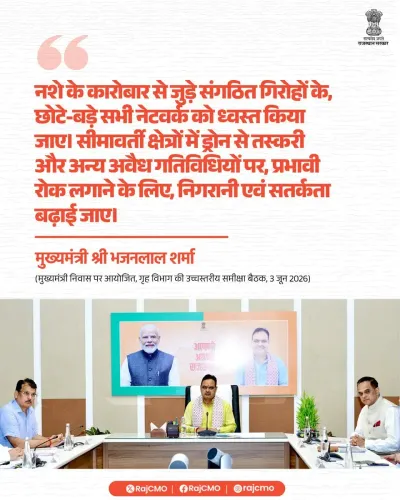
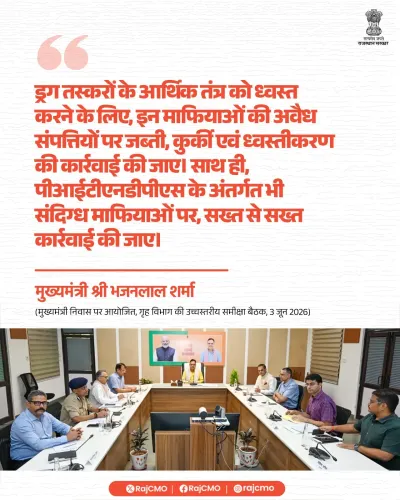
Rajasthan CMO Flags Drug Abuse as 'Root of Crime' in Public Push
Synopsis
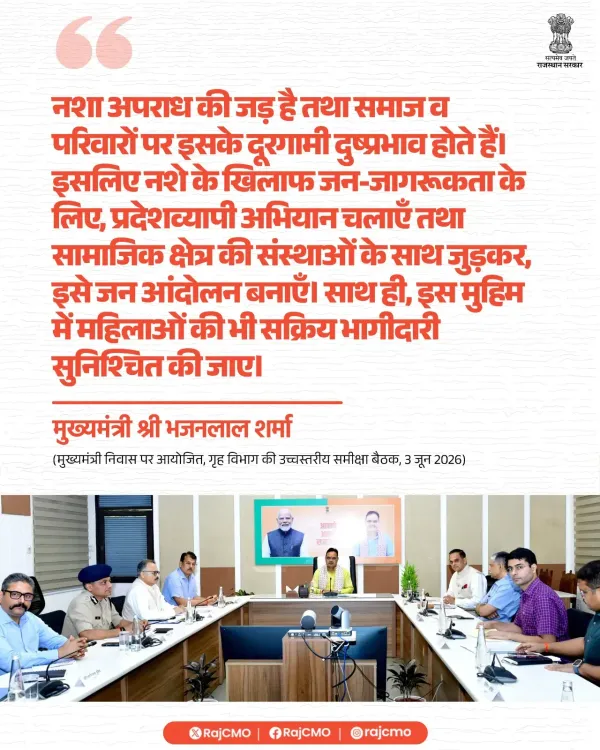
The Chief Minister's Office of Rajasthan, channelling CM Bhajan Lal Sharma, has described intoxication as the root of crime and a long-term threat to families and society. The message, posted under the Aapno Agrani Rajasthan campaign, signals continued focus on substance abuse as a law-and-order priority.
Key Takeaways
The Rajasthan CMO posted on 4 June 2026 calling drug abuse the root of crime.
Message tagged to CM Bhajan Lal Sharma under the #आपणो_अग्रणी_राजस्थान campaign.
Frames substance abuse as a threat to families and the wider society.
Aligns with the NDPS Act, 1985, India's principal anti-narcotics law.
Sharma has led Rajasthan since December 2023 with a law-and-order focus.
No new scheme announced; watch for de-addiction or awareness rollouts.
The Chief Minister's Office of Rajasthan on Thursday, 4 June 2026, issued a public message describing substance abuse as the root cause of crime and warning of its long-term damage to families and society. The post, tagged to Chief Minister Bhajan Lal Sharma and carrying the campaign hashtag #आपणो_अग्रणी_राजस्थान ('Our Leading Rajasthan'), forms part of the state government's recurring messaging on law and order.
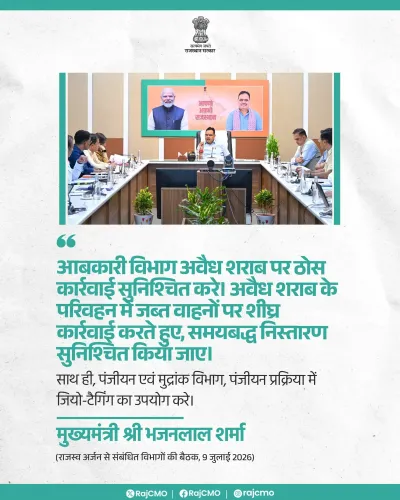
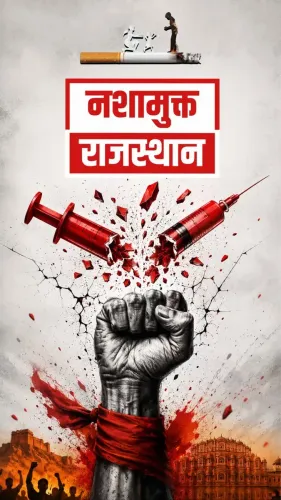
'Intoxication is the root of crime, and it has far-reaching adverse effects on society and families,' the CMO said in the post, written in Hindi. The brief statement, accompanied by a visual, did not announce a new scheme but reiterated a framing the Rajasthan government has used repeatedly to tie public-health concerns to its policing agenda.
Context
Bhajan Lal Sharma has led Rajasthan as Chief Minister since December 2023, following the BJP's victory in the state assembly elections. His administration has emphasised law and order alongside development initiatives, with official channels used to amplify campaigns on crime prevention, women's safety and substance abuse.
The hashtag आपणो अग्रणी राजस्थान, used in Rajasthani-Hindi, has become a recurring branding device for the government's outreach, framing welfare and enforcement messaging under a single identity.
Policy backdrop
India's principal legal instrument against narcotics is the Narcotic Drugs and Psychotropic Substances Act, 1985, which criminalises the production, sale and consumption of a wide range of substances and prescribes graded penalties. Enforcement is shared between central agencies and state police forces, with state governments often running parallel awareness and de-addiction programmes.
Successive state administrations in Rajasthan have linked drug abuse to organised crime, smuggling along the western border and youth unemployment. The framing in Thursday's post — describing intoxication as the 'root' of crime — is consistent with that lineage and with broader national messaging from the Centre on a 'drug-free India'.
Stakeholders and impact
The message is pitched at three audiences. For families, particularly in rural and small-town Rajasthan, it reinforces social pressure against household consumption of opium derivatives and synthetic substances. For youth, the messaging dovetails with school and college outreach programmes that state agencies periodically run in partnership with police.
For law enforcement, such high-level political signalling typically translates into intensified seizures, awareness drives and coordination with the Narcotics Control Bureau. Rajasthan's long border with Punjab and proximity to trafficking corridors have historically made narcotics a priority subject for the state police.
Civil-society groups working on rehabilitation have argued that punitive framing must be balanced with investment in treatment infrastructure, including counselling and medically supervised withdrawal. The post itself does not address the rehabilitation side of the equation.
What's next
Attention will turn to whether the messaging is followed by concrete administrative steps — including the expansion of state-run de-addiction centres, fresh awareness drives in schools, or coordinated enforcement operations. The Rajasthan government has previously announced district-level initiatives on substance abuse, and further rollouts could be tied to the same campaign branding.
If sustained, the CMO's framing of intoxication as a driver of crime is likely to shape both the policing posture and the welfare vocabulary of the Sharma administration through the rest of its term, with families and youth positioned as the central constituencies of the appeal.
Point of View
The Rajasthan CMO compresses public health, family welfare and law enforcement into a single political vocabulary that is easy to deploy across campaigns. The absence of an accompanying scheme suggests this is agenda-setting rather than policy-launching. The real test will be whether messaging translates into expanded rehabilitation capacity, not just enforcement statistics.
NationPress
22 Sept 2026
Frequently Asked Questions
What did the Rajasthan CMO say about drug abuse?
The Rajasthan CMO said intoxication is the root of crime and has far-reaching adverse effects on society and families. The post was issued on 4 June 2026 and tagged to Chief Minister Bhajan Lal Sharma.
Who is the current Chief Minister of Rajasthan?
Bhajan Lal Sharma is the Chief Minister of Rajasthan. He took office in December 2023 after the BJP won the state assembly elections.
What does the hashtag Aapno Agrani Rajasthan mean?
The hashtag translates roughly as 'Our Leading Rajasthan' in Rajasthani-Hindi. It is used by the state government as a branding device across welfare and governance outreach.
What law governs drug abuse in India?
The Narcotic Drugs and Psychotropic Substances Act, 1985, is the principal law. It criminalises the production, sale and consumption of listed substances and prescribes graded penalties.
Has Rajasthan announced new de-addiction centres?
The current post does not announce any new scheme or de-addiction centre. It is a messaging statement, and any specific rollout would be communicated separately by the state government.