Rajasthan CMO: Dismantle All Drug Networks, Big and Small
Synopsis
The Chief Minister's Office of Rajasthan has directed enforcement agencies to dismantle every organised drug network in the state, big or small. The 4 June 2026 post, tagging CM Bhajan Lal Sharma and using the Aapno Agrani Rajasthan tag, reinforces the BJP government's continuing emphasis on law-and-order and anti-narcotics action.
Key Takeaways
The Rajasthan CMO on 4 June 2026 ordered the dismantling of all organised drug networks in the state.
The post tagged Chief Minister Bhajan Lal Sharma and used the slogan #आपणो_अग्रणी_राजस्थान .
Action against narcotics in India operates under the NDPS Act, 1985 .
The national Nasha Mukt Bharat Abhiyaan , launched in 2020 , frames coordinated state efforts.
Rajasthan's long border with Pakistan has made several districts focal points for anti-narcotics enforcement.
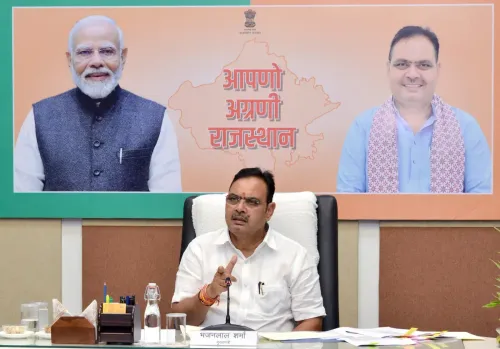
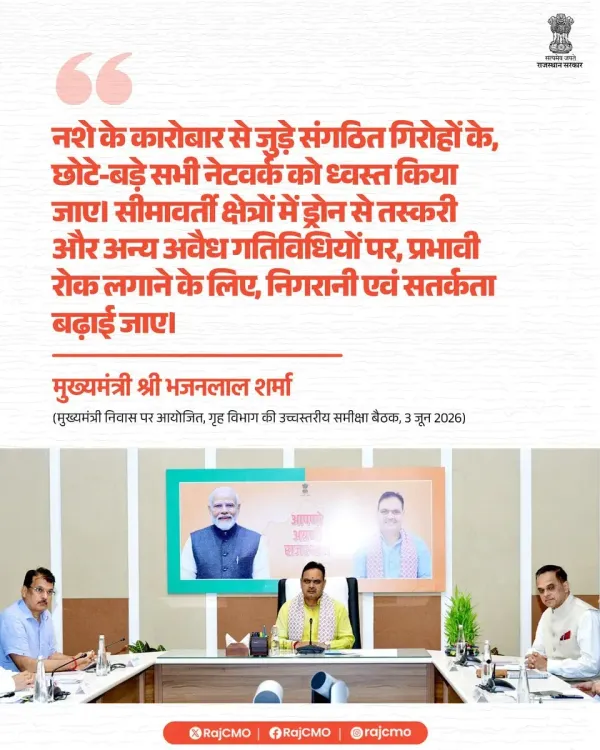
The Chief Minister's Office of Rajasthan on 4 June 2026 issued a public directive to enforcement agencies to dismantle every organised narcotics network operating in the state, in a post tagging Chief Minister Bhajan Lal Sharma. The message instructed that 'all networks, small and large, connected to the drug trade must be destroyed', framing the action under the government's Aapno Agrani Rajasthan (Our Leading Rajasthan) governance theme.
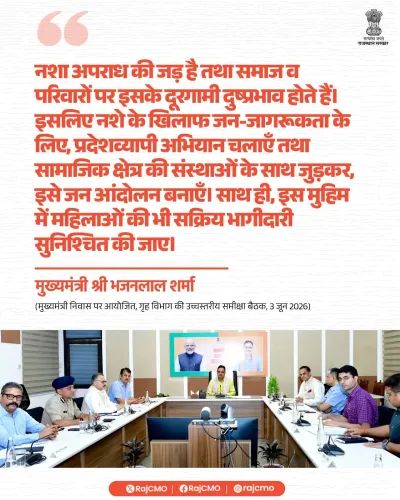
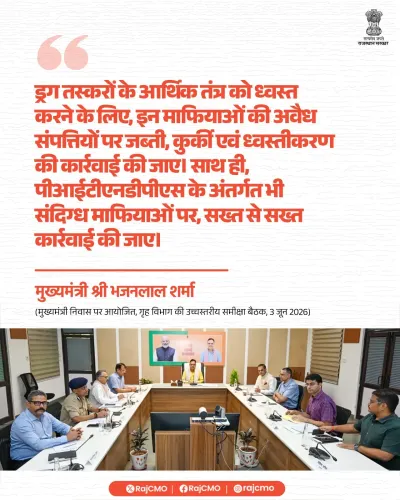
The post, in Hindi, read: 'Nashe ke karobar se jude sangathit girohon ke, chote-bade sabhi network ko dhwast kiya jaye' ('All networks, big or small, of organised gangs involved in the drug trade should be dismantled'). It was accompanied by an image and the hashtag #आपणो_अग्रणी_राजस्थान, a slogan the state government has used to brand its administrative agenda.
Context
The directive comes from the office of Bhajan Lal Sharma, who has served as Chief Minister of Rajasthan since December 2023 after the Bharatiya Janata Party returned to power in the state. Law-and-order, particularly action on narcotics, has been a recurring theme of his administration's public communication.
Rajasthan shares a long international border with Pakistan, and several of its western districts have historically been flagged by enforcement agencies as transit corridors for narcotics. State authorities have repeatedly cited the geography as a driver for sustained anti-drug operations.
Policy backdrop
Action against drug networks in India is governed primarily by the Narcotic Drugs and Psychotropic Substances Act, 1985, which has been amended periodically to expand the powers of investigating agencies and stiffen penalties for trafficking. State police forces operate under this framework in coordination with central bodies.
At the national level, the Nasha Mukt Bharat Abhiyaan, launched in 2020, has sought to align state-level enforcement and demand-reduction efforts. Rajasthan is among the states that have been part of this coordinated push, with periodic directives from the political leadership reinforcing the enforcement track.
Stakeholders and impact
The directive is aimed primarily at the state police and allied enforcement units, who are typically the first responders in narcotics interdiction. District superintendents and special anti-narcotics cells are usually tasked with translating such top-level instructions into on-ground action.
The most cited beneficiary group in such announcements is the state's youth, whom successive governments have described as the principal target of the narcotics trade. Civil society groups working on de-addiction and rehabilitation are also affected, as enforcement-led crackdowns often increase referrals to treatment facilities.
The instruction to act against both 'small and large' networks signals that the focus is not limited to high-profile trafficking syndicates but extends to local-level distribution chains, which are often harder to dismantle because of their dispersed structure.
What's next
Such directives from the Chief Minister's Office are typically followed by review meetings with the Director General of Police and district-level officers, and by coordination with central agencies including the Narcotics Control Bureau. Reporting of seizures, arrests, and disruption of supply routes in the coming weeks will be the most visible measure of follow-through.
The Aapno Agrani Rajasthan framing also suggests the state government intends to position anti-narcotics enforcement as part of its broader governance pitch, alongside other law-and-order priorities. Whether the directive translates into a sustained operational push, or remains an enforcement reminder, will shape its political and policy impact over the rest of the year.
Point of View
Where political leaderships periodically issue high-visibility anti-narcotics instructions to signal resolve. For the Bhajan Lal Sharma government, anti-drug enforcement has become a recurring strand of its law-and-order messaging, alongside its broader Aapno Agrani Rajasthan branding. The political test lies less in the directive itself and more in measurable follow-through, including arrests, seizures and disruption of recurring supply routes. Until then, the post reads as both an operational instruction and a public signal of priority.
NationPress
21 Oct 2026
Frequently Asked Questions
What did the Rajasthan CMO say about drug networks?
The Chief Minister's Office of Rajasthan directed that all organised drug networks in the state, both small and large, be dismantled. The post was made on 4 June 2026 and tagged Chief Minister Bhajan Lal Sharma.
Who is the Chief Minister of Rajasthan?
Bhajan Lal Sharma has been the Chief Minister of Rajasthan since December 2023, leading the BJP government in the state.
What law governs action against drug networks in India?
The Narcotic Drugs and Psychotropic Substances Act, 1985 is the primary law governing action against narcotics trafficking and possession in India, and has been amended periodically.
What is Aapno Agrani Rajasthan?
Aapno Agrani Rajasthan, meaning 'Our Leading Rajasthan', is a slogan used by the current state government to brand its governance and development agenda.
Why is Rajasthan a focus for anti-narcotics action?
Rajasthan shares a long international border with Pakistan, and several of its western districts have been identified by enforcement agencies as transit corridors for narcotics trafficking.