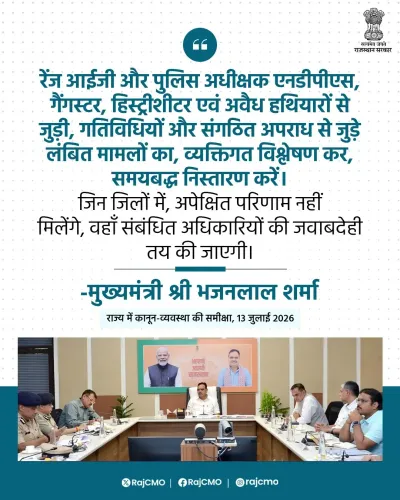
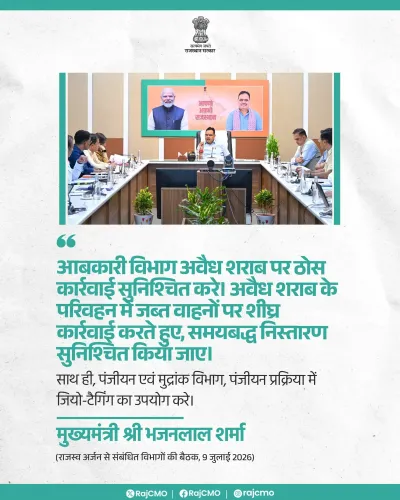
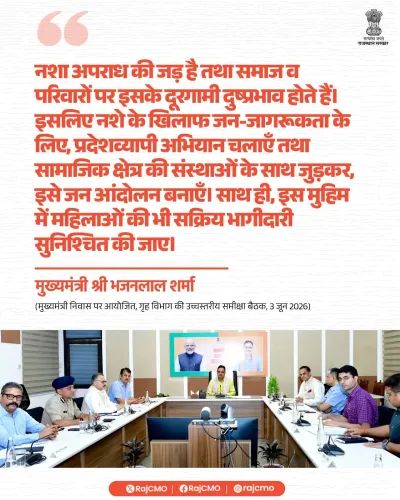
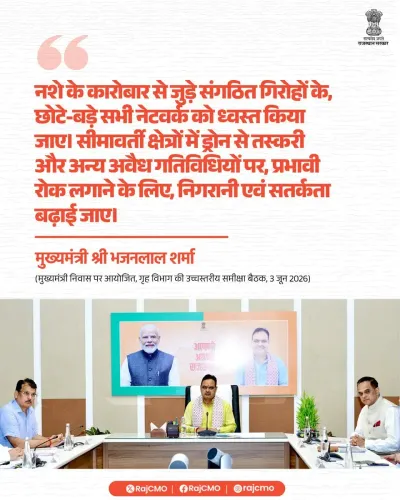
Rajasthan CMO Orders Seizure, Demolition of Drug Mafia Assets
Synopsis
The Chief Minister's Office of Rajasthan has ordered seizure, attachment and demolition of illegally acquired properties of drug traffickers, tagging Chief Minister Bhajan Lal Sharma. The directive, part of the Aapno Agrani Rajasthan push, aims to dismantle the financial backbone of narcotics syndicates operating in the border state.
Key Takeaways
Rajasthan CMO has directed seizure, attachment and demolition of illegally acquired properties of drug traffickers.
The instruction tags Chief Minister Bhajan Lal Sharma and is linked to the Aapno Agrani Rajasthan campaign.
Action is expected under existing NDPS Act and PMLA provisions that allow asset attachment.
Rajasthan's long international border has historically made it a transit corridor for narcotics.
Implementation will involve state police, district collectors and municipal authorities.
Attachment and demolition orders can be challenged in NDPS courts and the Rajasthan High Court.
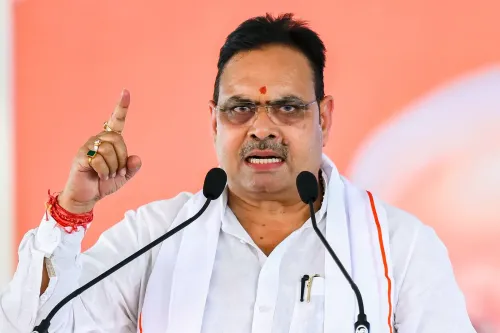
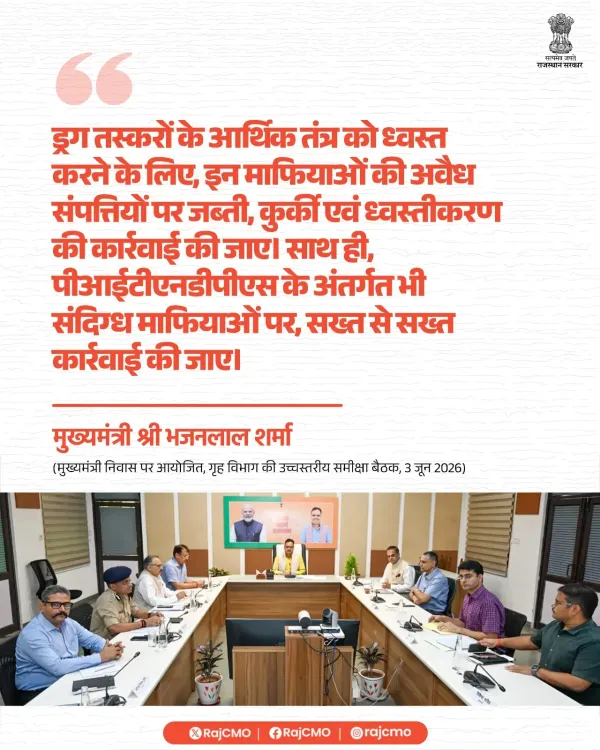
The Chief Minister's Office of Rajasthan on 4 June 2026 directed state authorities to dismantle the financial backbone of narcotics networks by ordering seizure, attachment and demolition of illegally acquired properties belonging to drug traffickers. The instruction, issued via the official handle and tagging Chief Minister Bhajan Lal Sharma, frames the action as central to the government's Aapno Agrani Rajasthan (Our Leading Rajasthan) campaign.
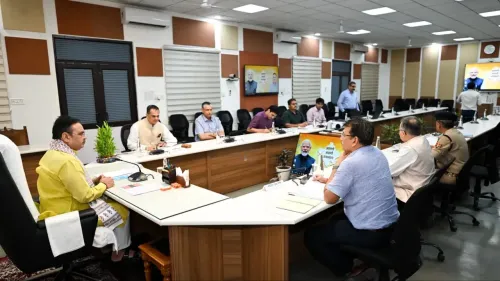
In its post, the CMO stated: 'To dismantle the economic mechanism of drug traffickers, action of seizure, attachment and demolition should be taken against the illegal properties of these mafias.' The directive was accompanied by an image and the hashtag #आपणो_अग्रणी_राजस्थान.
Context
Rajasthan, with its long international border along Pakistan, has historically figured as a transit corridor for narcotics moving across western India. State enforcement agencies have run recurring campaigns under the Narcotic Drugs and Psychotropic Substances Act, 1985 and the Prevention of Money Laundering Act, 2002, both of which permit attachment of properties traced to the proceeds of drug-related crime.
The CMO's latest instruction signals an escalation from arrests and seizures of contraband to a financial-disruption model, where the assets accumulated through trafficking are themselves the target. Demolition, in particular, has become an increasingly visible tool used by several state governments against structures alleged to have been built with proceeds of crime or on encroached land.
Policy backdrop
Since taking office in December 2023, Chief Minister Bhajan Lal Sharma has positioned organised crime, including narcotics, as a priority enforcement theme for the Bharatiya Janata Party government in Jaipur. The administration has previously announced intensified action against trafficking syndicates operating in border districts such as Barmer, Jaisalmer and Sri Ganganagar.
The directive aligns with a broader pattern across several BJP-ruled states, where governments have combined criminal prosecution with property attachment and demolition drives to choke the economic incentives of organised crime. Central agencies, including the Narcotics Control Bureau and the Enforcement Directorate, already operate parallel asset-tracing mandates under existing statutes.
Stakeholders and impact
The principal executing agencies will be the Rajasthan Police, the state's anti-narcotics task force, district collectors empowered to pass attachment orders, and municipal authorities responsible for demolition of unauthorised structures. Cooperation with central agencies under the NDPS and PMLA frameworks is likely to be sought for high-value cases.
For residents in border belts and known trafficking hubs, the directive could translate into visible enforcement action against properties owned by accused traffickers. Civil-liberties observers typically watch such drives for procedural compliance, given that attachment and demolition orders can be challenged in special NDPS courts, the Rajasthan High Court and appellate tribunals constituted under the PMLA.
Border communities, often caught between trafficking economies and enforcement crackdowns, stand to be among the most directly affected stakeholder groups. The state's stated aim is to ensure that proceeds of narcotics crime cannot be converted into stable assets such as land, housing or commercial establishments.
What's next
The coming weeks will likely see district-level identification of properties linked to accused traffickers, followed by formal attachment orders and, where applicable, demolition notices. Any seizure or demolition action is expected to attract legal scrutiny, with courts examining the evidentiary basis and procedural safeguards.
If implemented consistently, the directive could mark a shift in Rajasthan's anti-narcotics strategy from contraband-centric policing to a sustained financial-disruption model, with implications for how other border states approach the economics of organised crime.
Point of View
Attachment and demolition, the Bhajan Lal Sharma government is signalling continuity with a national enforcement arc that increasingly leans on property as a deterrent. The legal architecture under NDPS and PMLA exists, but the test will lie in evidentiary rigour and the courts' response. Watch for whether action is concentrated in border districts and whether high-value targets, not just visible structures, are pursued.
NationPress
19 Sept 2026
Frequently Asked Questions
What has the Rajasthan CMO ordered against drug traffickers?
The Chief Minister's Office has directed authorities to seize, attach and demolish illegally acquired properties of drug traffickers in order to dismantle the financial mechanism supporting narcotics networks in the state.
Under which laws can drug traffickers' properties be seized in India?
Properties linked to narcotics crime can be attached primarily under the Narcotic Drugs and Psychotropic Substances Act, 1985, and the Prevention of Money Laundering Act, 2002, both of which provide for forfeiture of proceeds of crime.
Who is the Chief Minister of Rajasthan in 2026?
Bhajan Lal Sharma is the Chief Minister of Rajasthan, having taken office in December 2023 after the BJP's victory in the state assembly elections.
What is the Aapno Agrani Rajasthan campaign?
Aapno Agrani Rajasthan, meaning 'Our Leading Rajasthan', is a governance branding used by the state government to frame priority initiatives, including law and order, development and welfare measures.
Why is Rajasthan considered vulnerable to drug trafficking?
Rajasthan shares a long international border with Pakistan and lies along established overland routes, which has historically made districts such as Barmer, Jaisalmer and Sri Ganganagar transit points for narcotics.