Rajasthan CMO highlights Agra-Bandikui, Ajmer-Chittaurgarh rail doubling
Synopsis
The Rajasthan Chief Minister's Office on 22 June 2026 highlighted the Agra-Bandikui and Ajmer-Chittaurgarh railway doubling projects as major works accelerating the state's development, tagging CM Bhajanlal Sharma under the 'Our Leading Rajasthan' campaign.
Key Takeaways
The Rajasthan CMO on 22 June 2026 publicly spotlighted multiple key infrastructure projects driving state development.
The Agra-Bandikui railway doubling aims to raise line capacity and train frequency on the Uttar Pradesh-Rajasthan corridor.
The Ajmer-Chittaurgarh railway doubling targets improved rail services across central and southern Rajasthan.
Both projects are part of Indian Railways' national capacity-augmentation programme supported through successive Union Budget allocations since 2014 .
Beneficiaries include rail passengers, traders, and the tourism sector across affected districts.
The post was tagged under #आपणो_अग्रणी_राजस्थान , the state government's ongoing development campaign.
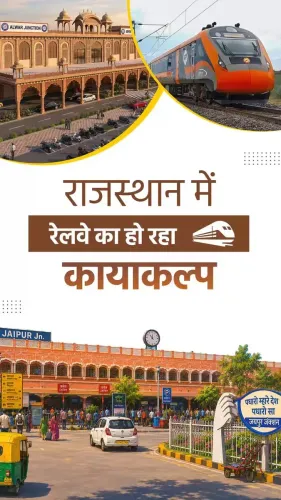
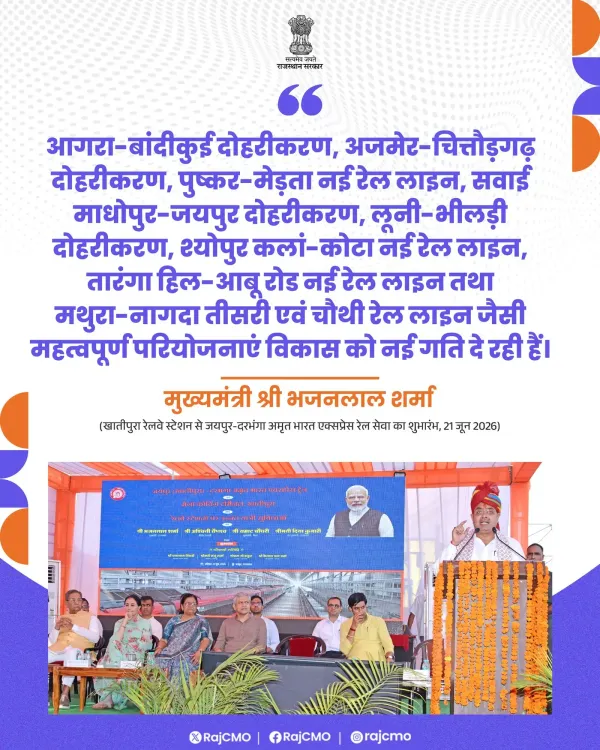
The Chief Minister's Office of Rajasthan on Monday, 22 June 2026 highlighted several key infrastructure projects giving fresh momentum to the state's development, citing the Agra-Bandikui railway doubling and the Ajmer-Chittaurgarh railway doubling among the flagship works currently under way.
Context
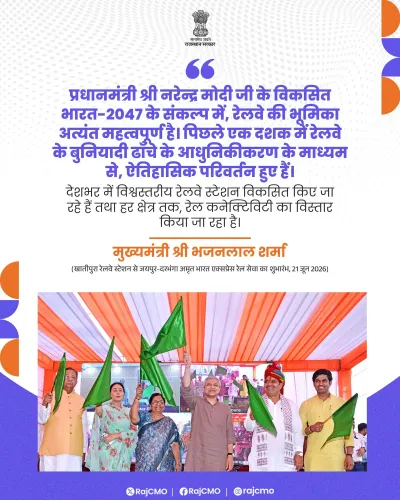
The post, shared from the official Rajasthan CMO handle and tagging Chief Minister Bhajanlal Sharma, stated — 'आगरा-बांदीकुई दोहरीकरण, अजमेर-चित्तौड़गढ़ दोहरीकरण सहित, कई महत्वपूर्ण परियोजनाएं विकास को नई गति दे रही हैं' — ('Several important projects, including the Agra-Bandikui doubling and the Ajmer-Chittaurgarh doubling, are giving new momentum to development'). The message was accompanied by the hashtag #आपणो_अग्रणी_राजस्थान ('Our Leading Rajasthan'), a recurring campaign tag used by the state government to spotlight development milestones.
The Agra-Bandikui route links Agra in Uttar Pradesh with Bandikui in eastern Rajasthan, a corridor that handles significant passenger and freight traffic. Track doubling on this line is expected to raise line capacity and allow higher train frequency. The Ajmer-Chittaurgarh corridor serves central and southern Rajasthan, connecting a major pilgrimage and commercial hub with a historically and industrially significant city.
Policy Backdrop
Railway track doubling projects in Rajasthan have featured in successive Union Budget allocations and Ministry of Railways works programmes since 2014, as part of a national network expansion drive. The state's strategic position on routes linking Delhi, Mumbai, and western freight corridors has made it a recurring recipient of central railway investment.
The current emphasis on these two corridors fits within Indian Railways' broader capacity-augmentation programme, which combines track doubling, electrification, and station redevelopment across high-density routes. Centre-state coordination has been a consistent feature of this push, particularly where both governments are led by the BJP, as is the case with the Bhajanlal Sharma administration in Rajasthan and the Union government.
Stakeholders and Impact
The primary beneficiaries of these projects are rail passengers on both corridors, who stand to gain from reduced travel times and more frequent services once doubling is complete. Rajasthan's trading community — particularly businesses dependent on freight movement through these routes — also has a direct stake in capacity improvements.
The tourism sector stands to benefit as well: the Ajmer-Chittaurgarh route connects two destinations of significant religious and heritage importance, and improved rail connectivity can meaningfully boost tourist footfall. Broader economic activity in districts along both alignments is expected to receive a fillip as logistics bottlenecks ease.
What's Next
Project completion milestones, revised timelines, and any new railway budget announcements specifically for Rajasthan will be key indicators of on-ground delivery. The state government's continued use of the #आपणो_अग्रणी_राजस्थान campaign signals that infrastructure communication will remain a central plank of the Bhajanlal Sharma administration's public outreach ahead of the next electoral cycle.
As both corridors advance, independent assessments of physical progress and passenger-service improvements will determine whether the political narrative translates into measurable gains for commuters and the broader economy.
Point of View
Using two concrete railway projects to reinforce the Bhajanlal Sharma administration's development credentials less than three years into its term. Highlighting centrally funded railway works as state-level achievements reflects a well-worn BJP playbook of aligning Union and state infrastructure spending into a unified political narrative. The 'Our Leading Rajasthan' hashtag signals that the government is building a sustained brand around infrastructure delivery, likely with an eye on voter perception ahead of the next assembly election. Whether the projects deliver on time will ultimately determine how durable that narrative proves.
NationPress
22 Jun 2026
Frequently Asked Questions
What is the Agra-Bandikui railway doubling project?
The Agra-Bandikui railway doubling project involves laying a second track on the route connecting Agra in Uttar Pradesh with Bandikui in eastern Rajasthan, with the aim of increasing line capacity and enabling more frequent train services on this busy corridor.
What is the Ajmer-Chittaurgarh railway doubling project?
The Ajmer-Chittaurgarh railway doubling project adds a parallel track between Ajmer and Chittaurgarh to improve rail connectivity and service frequency across central and southern Rajasthan.
Who is Bhajanlal Sharma?
Bhajanlal Sharma is the Chief Minister of Rajasthan, in office since December 2023, representing the BJP. He oversees the state's infrastructure and development agenda.
Who funds railway doubling projects in Rajasthan?
Railway doubling projects in Rajasthan are primarily funded and executed by Indian Railways under the Union government, with allocations made through successive Union Budgets and the Ministry of Railways' annual works programme.
What does the hashtag Aapno Agrani Rajasthan mean?
The hashtag #आपणो_अग्रणी_राजस्थान translates from Rajasthani and Hindi as 'Our Leading Rajasthan' and is used by the state government as a campaign tag to publicise development and governance milestones.