CM Bhajanlal Highlights Key Central Projects for Rajasthan
Synopsis
The Rajasthan CMO highlighted four major central government projects for the state — the Ram Jal Setu Link Project, Yamuna Water Agreement, Jaipur Metro Phase-2, and Mahi-Banswara Nuclear Power Project — crediting Prime Minister Modi's leadership for the approvals.
Key Takeaways
The Chief Minister's Office of Rajasthan on 10 June 2026 listed four major central projects sanctioned for the state.
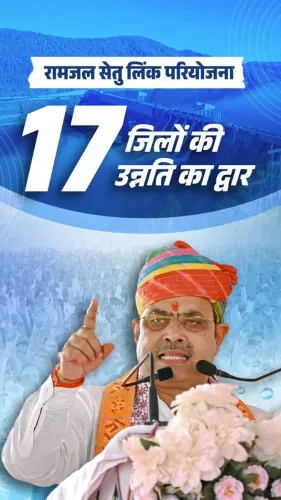
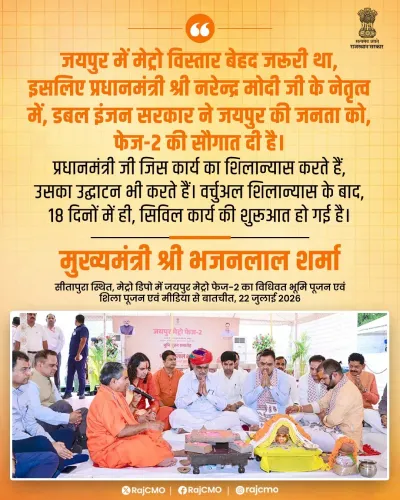
The projects include the Ram Jal Setu Link Project , the Yamuna Water Agreement , Jaipur Metro Phase-2 , and the Mahi-Banswara Nuclear Power Project .
Jaipur Metro Phase-1 has been operational since 2015 ; Phase-2 is intended to extend urban rail connectivity in the capital.
The Mahi-Banswara Nuclear Power Project in Banswara district is part of India's broader atomic energy expansion, complementing the existing Rajasthan Atomic Power Station at Rawatbhata .
The post was attributed to Chief Minister Bhajan Lal Sharma and tagged with the state government's development branding hashtag.
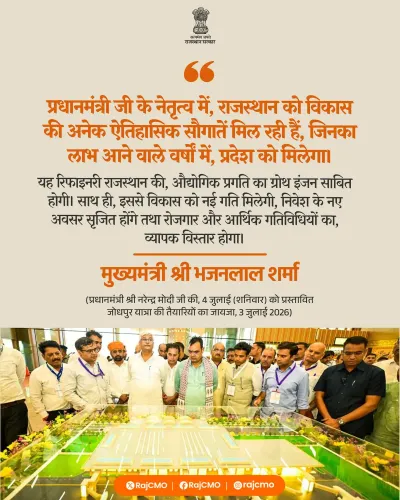
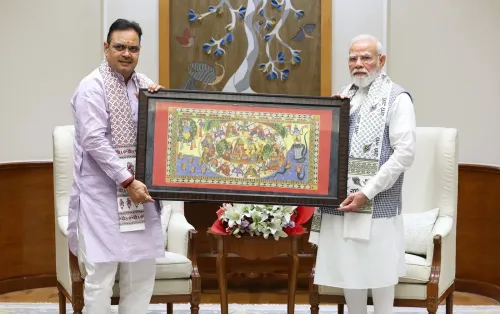
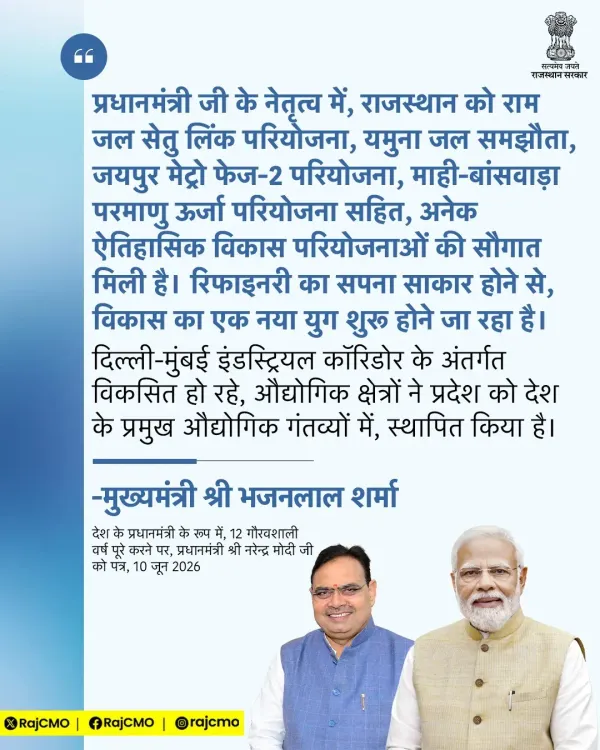
The Chief Minister's Office of Rajasthan, on Wednesday, 10 June 2026, highlighted a series of major infrastructure and resource-sharing projects sanctioned for the state under the leadership of Prime Minister Narendra Modi, citing them as 'historic development gifts' to Rajasthan.
What the Post Says
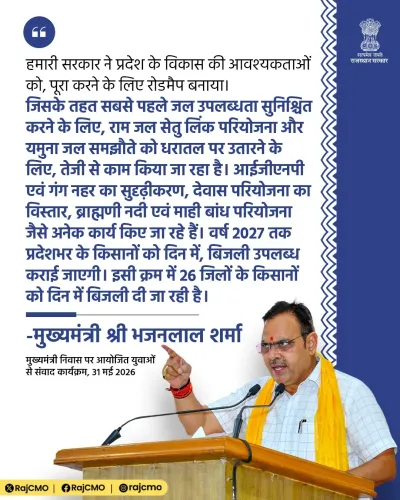
The CMO's post, attributed to Chief Minister Bhajan Lal Sharma (@BhajanlalBjp), states: 'Under the leadership of the Prime Minister, Rajasthan has received the gift of many historic development projects, including the Ram Jal Setu Link Project, the Yamuna Water Agreement, the Jaipur Metro Phase-2 Project, and the Mahi-Banswara Nuclear Power Project.' The post was tagged with the hashtag #आपणो_अग्रणी_राजस्थान ('Our Pioneering Rajasthan'), a branding phrase associated with the current BJP state government's development narrative.
Context
Bhajan Lal Sharma was sworn in as Chief Minister of Rajasthan in December 2023 following the BJP's victory in the state assembly elections, ending a Congress-led government. Since then, the state administration has consistently sought to highlight the flow of centrally-backed projects to Rajasthan, framing them as a dividend of aligned BJP governments at the state and Centre. The four projects cited span water resources, urban mobility, and atomic energy — three sectors that have seen elevated central spending in recent years.
Policy Backdrop
The Jaipur Metro Phase-2 is a planned extension of the city's metro rail network, building on Phase-1, which commenced commercial operations in 2015. The expansion is aimed at deepening urban connectivity in Jaipur, Rajasthan's capital and largest city, which has seen sustained population and commuter growth. The Mahi-Banswara Nuclear Power Project is a proposed atomic energy installation in Banswara district, situated in southern Rajasthan. It forms part of India's broader nuclear capacity expansion programme. Rajasthan already hosts the Rajasthan Atomic Power Station at Rawatbhata, which has been operational since the 1970s and has added multiple pressurised heavy-water reactor units over the decades, making the state a significant node in India's civilian nuclear map. The Yamuna Water Agreement is described as an inter-state pact on sharing of Yamuna river waters involving Rajasthan, addressing a long-standing demand of the state's agricultural and drinking-water sectors. The Ram Jal Setu Link Project is cited in the post as another major water infrastructure undertaking for the state.
Stakeholders and Impact
Jaipur commuters and urban residents stand to benefit most directly from the Metro Phase-2 expansion, which would reduce dependence on road transport in a congested city. Farmers and rural communities across Rajasthan — a state that is largely arid — have a direct stake in the Yamuna water-sharing arrangement and the Ram Jal Setu Link Project, both of which concern freshwater availability. Power consumers across the state would be the primary beneficiaries of additional nuclear generation capacity at Banswara, where grid-scale atomic power could supplement Rajasthan's existing thermal and renewable energy mix.
What's Next
Clearance milestones and funding disbursal timelines for the Mahi-Banswara Nuclear Power Project will be closely watched, as large nuclear installations typically require multi-stage regulatory and environmental approvals before ground-breaking. Physical progress reports on Jaipur Metro Phase-2 corridors — including alignment finalisation and land acquisition — will indicate how quickly commuters can expect tangible change. The operationalisation of the water-sharing arrangements will be a key metric for the state government heading into the next electoral cycle.
Point of View
Transit, and nuclear energy together, the communication strategy mirrors a pattern seen in other BJP-governed states, where alignment between state and central leadership is presented as a governance dividend. The emphasis on water infrastructure is particularly significant for a largely arid state where river-linking and inter-state agreements carry outsized political weight with farming communities. Whether the projects move from announcement to ground-level execution will ultimately determine their electoral and developmental impact.
NationPress
25 Oct 2026
Frequently Asked Questions
What is the Mahi-Banswara Nuclear Power Project?
The Mahi-Banswara Nuclear Power Project is a proposed nuclear power plant in Banswara district of southern Rajasthan, intended to add atomic energy generation capacity to the state's power grid as part of India's civilian nuclear expansion programme.
What is Jaipur Metro Phase-2?
Jaipur Metro Phase-2 is a planned extension of the existing Jaipur Metro rail network, which has been operational since 2015, aimed at expanding urban transit connectivity across the Rajasthan capital.
What is the Yamuna Water Agreement for Rajasthan?
The Yamuna Water Agreement is an inter-state pact concerning the sharing of Yamuna river waters that includes Rajasthan, addressing the state's long-standing demand for a greater share of freshwater resources.
Who is the Chief Minister of Rajasthan in 2026?
Bhajan Lal Sharma of the BJP is the Chief Minister of Rajasthan, having been sworn in following the party's victory in the December 2023 state assembly elections.
What is the Ram Jal Setu Link Project in Rajasthan?
The Ram Jal Setu Link Project is a water infrastructure project cited by the Rajasthan CMO as one of several major central government-backed schemes sanctioned for the state under Prime Minister Modi's leadership.