CM Bhajan Lal Directs Watch on Youth Following Criminals Online
Synopsis
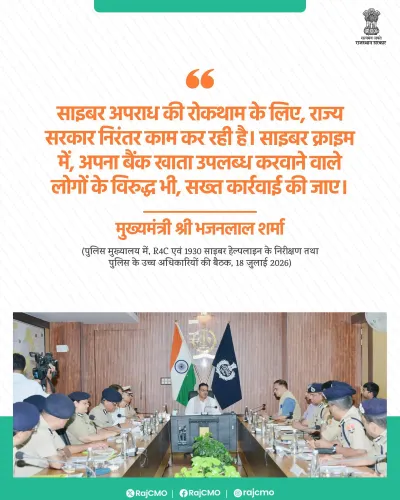
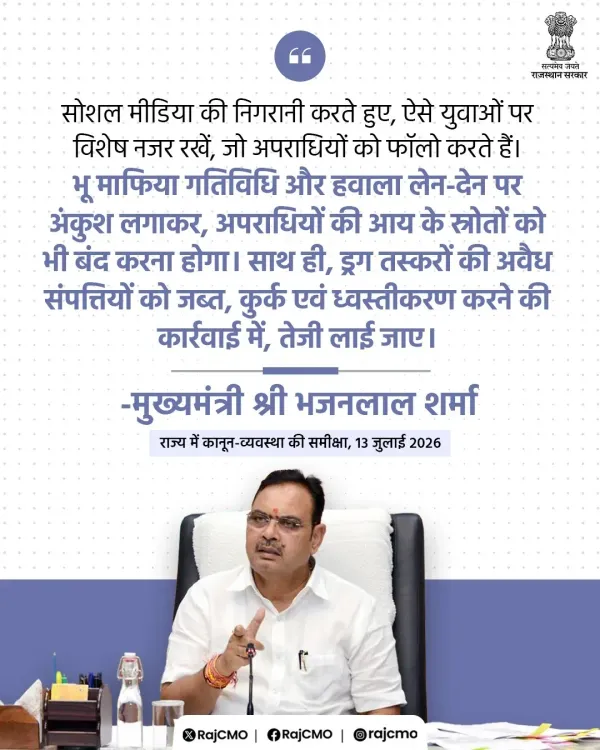
The Rajasthan Chief Minister's Office on 14 July 2026 directed authorities to monitor social media and keep a special watch on youth who follow accounts linked to criminals, signalling a push for digital preventive policing under CM Bhajan Lal Sharma's BJP government.
Key Takeaways
The Rajasthan Chief Minister's Office issued a social-media directive on 14 July 2026 calling for surveillance of youth who follow criminal accounts online.
The instruction was addressed to Chief Minister Bhajan Lal Sharma and posted under the hashtag #आपणो_अग्रणी_राजस्थान ('Our Leading Rajasthan').
Rajasthan Police , particularly its cyber-monitoring units, is the primary agency expected to implement the directive.
The move aligns with the BJP government's stated post-2023 priority of strengthening action against organised crime and cyber-enabled offences.
No specific legal mechanism or institutional framework for the surveillance was outlined in the post.
Follow-up circulars and budget allocations for police modernisation will indicate how far the directive is operationalised.
The Chief Minister's Office of Rajasthan issued a public directive on Tuesday, 14 July 2026, calling on authorities to monitor social media and keep a close watch on young people who follow accounts linked to criminals. The instruction was addressed directly to Chief Minister Bhajan Lal Sharma and posted under the campaign hashtag #आपणो_अग्रणी_राजस्थान (meaning 'Our Leading Rajasthan').
Context
The post, in Hindi, states: 'सोशल मीडिया की निगरानी करते हुए, ऐसे युवाओं पर विशेष नजर रखें, जो अपराधियों को फॉलो करते हैं' — translated as: 'While monitoring social media, keep a special watch on those youth who follow criminals.' The directive signals a proactive posture on digital surveillance as a preventive policing tool, with Rajasthan's law-enforcement agencies as the implied audience.
The message is framed as a governance instruction rather than a legislative announcement, consistent with how the Chief Minister's Office has used its official social-media presence to relay operational priorities to the state machinery.
Policy Backdrop
Since the BJP government assumed office in Rajasthan following the December 2023 assembly elections, law-and-order reform and action against organised crime have been stated priorities. Chief Minister Bhajan Lal Sharma has repeatedly emphasised preventive policing as a cornerstone of the administration's public-safety agenda.
Across several Indian states, administrations have issued instructions to law-enforcement agencies to track social-media activity linked to criminal networks, particularly among younger users. These measures are part of wider state-level efforts to expand preventive policing using digital surveillance tools — a trend that has gained momentum as organised crime increasingly exploits online platforms for recruitment and communication.
Stakeholders and Impact
Rajasthan Police is the primary agency expected to act on this directive, potentially through its cyber-monitoring cells or dedicated social-media intelligence units. The instruction places at-risk youth — defined here as those who engage with or follow accounts associated with criminal figures — at the centre of preventive attention.
Civil-liberties advocates have, in broader national debates, raised questions about the scope and oversight of social-media surveillance targeting young people, underscoring the importance of clear legal frameworks governing such monitoring. The directive does not specify the legal authority or institutional mechanism through which this surveillance would be conducted.
What's Next
Observers will watch for follow-up circulars from Rajasthan Police formalising cyber-monitoring protocols, as well as any reference to expanded digital-surveillance capabilities in the state's next budget or police modernisation proposals. The directive's reach and implementation will depend on the resources and legal guardrails that the state government puts in place in the coming weeks.
If translated into a structured programme, this initiative could set a precedent for how Indian state governments institutionalise social-media intelligence as a preventive crime tool — with implications for both public safety and digital rights.
Point of View
The absence of a stated legal framework raises questions about accountability and the risk of over-broad surveillance. How Rajasthan Police operationalises this guidance will be the real test of whether it becomes a rights-respecting programme or a source of civil-liberties concern.
NationPress
12 Oct 2026
Frequently Asked Questions
What did the Rajasthan CMO direct on 14 July 2026?
The Rajasthan Chief Minister's Office directed authorities to monitor social media and keep a special watch on youth who follow accounts linked to criminals, as part of preventive policing efforts.
Who is Bhajan Lal Sharma?
Bhajan Lal Sharma is the Chief Minister of Rajasthan, in office since December 2023, representing the Bharatiya Janata Party. The CMO's directive was addressed to him publicly on social media.
Which agency will implement Rajasthan's social-media youth surveillance?
Rajasthan Police, likely through its cyber-monitoring cells or social-media intelligence units, is the primary agency expected to act on the Chief Minister's Office directive.
Is social-media surveillance of youth legal in India?
India does not have a single comprehensive law governing state-level social-media surveillance; such monitoring typically draws on provisions of the IT Act and the Code of Criminal Procedure, though civil-liberties experts have called for clearer oversight frameworks.
What is the hashtag #आपणो_अग्रणी_राजस्थान?
The hashtag translates to 'Our Leading Rajasthan' and is used by the Rajasthan government as a campaign tag to highlight governance initiatives under the current BJP administration.