Rajasthan CMO: Yamuna water deal secured for Shekhawati under Modi
Synopsis
The Rajasthan CMO announced on 3 August 2026 that a Yamuna water agreement for the semi-arid Shekhawati region — covering Sikar, Jhunjhunu and Churu — has been secured under PM Modi's guidance, potentially ending decades of water scarcity for farmers in northern Rajasthan.
Key Takeaways
The Rajasthan Chief Minister's Office announced a Yamuna water agreement for the Shekhawati region on 3 August 2026 .
PM Narendra Modi's guidance has been formally credited by the state government for making the agreement possible.
Shekhawati covers the semi-arid districts of Sikar, Jhunjhunu and Churu , historically among Rajasthan's most water-scarce zones.
Yamuna water sharing among five basin states — UP, Haryana, Rajasthan, Delhi and Himachal Pradesh — has been governed by the 1994 MoU and the Upper Yamuna River Board .
The exact water quantum, signing date and distribution mechanism have not yet been publicly disclosed.
Chief Minister Bhajanlal Sharma , in office since December 2023 , stands to gain political capital from the deal in a region where farm distress is a persistent issue.
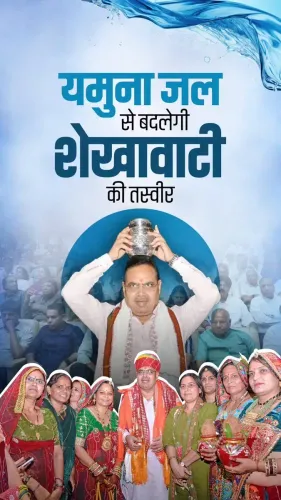
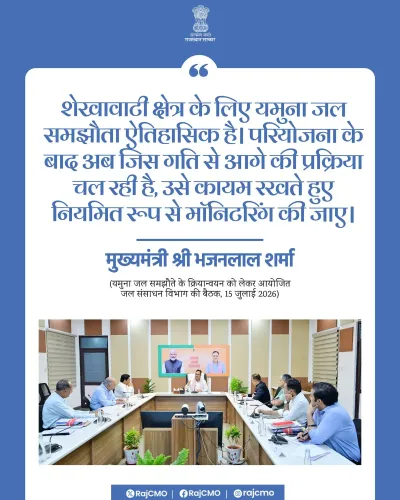
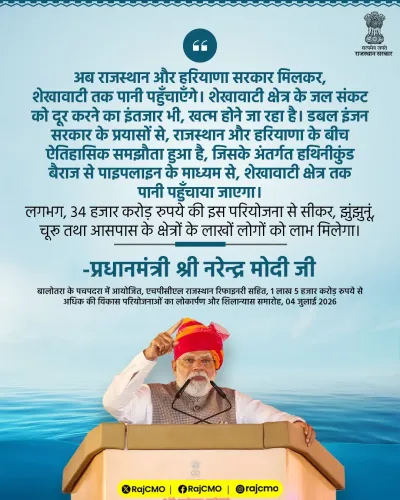
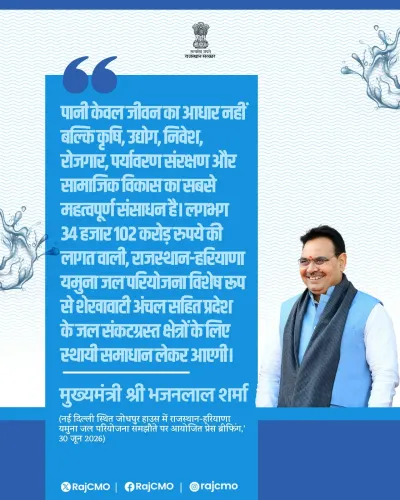
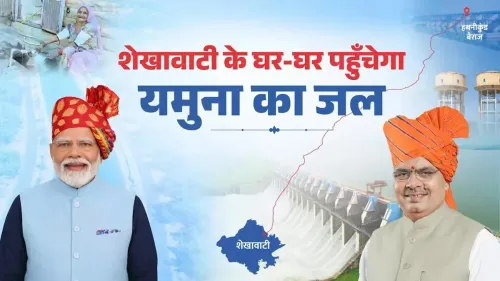
A long-parched corner of Rajasthan just got a lifeline. The Chief Minister's Office of Rajasthan announced on Monday, 3 August 2026 that a Yamuna water agreement for the Shekhawati region has been secured — crediting Prime Minister Narendra Modi's guidance as the force behind the breakthrough.
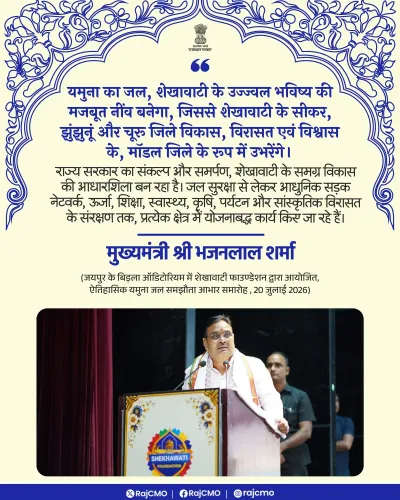
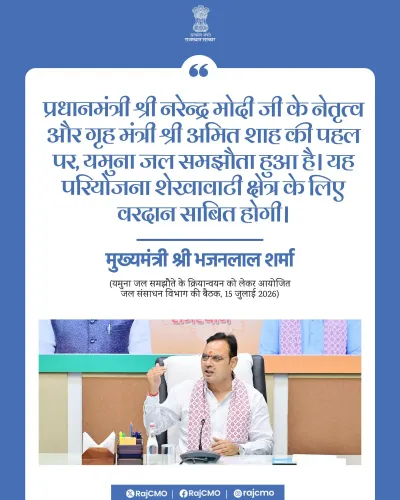
The post, shared from the official Rajasthan CMO handle and tagged to Chief Minister Bhajanlal Sharma, stated: 'Pradhan Mantri Shri Narendra Modi ji ke margdarshan se Shekhawati kshetra ke liye, Yamuna jal samjhauta sambhav ho paya' — 'Under the guidance of Prime Minister Shri Narendra Modi, a Yamuna water agreement for the Shekhawati region has become possible.'
Why Shekhawati has waited decades for this water
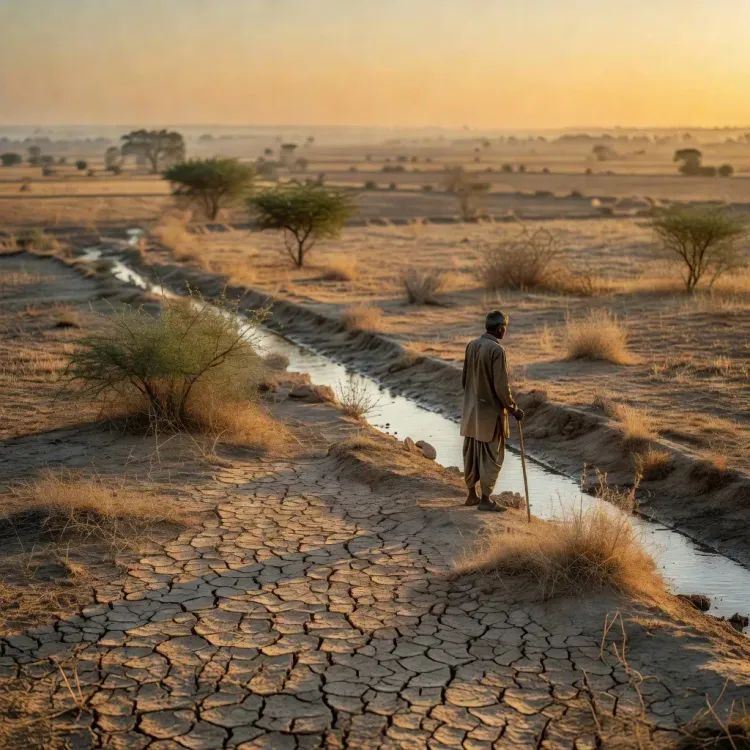
Shekhawati — the semi-arid belt spanning Sikar, Jhunjhunu and Churu districts in northern Rajasthan — has been one of the most water-scarce zones in the state for generations. Agriculture here has long depended on erratic groundwater and seasonal rainfall, with no reliable river supply of its own. Farmers in the region have watched groundwater tables fall steadily, making any allocation from a surface-water system like the Yamuna a consequential shift.The inter-state tangle that needed central hands
Yamuna water sharing has never been a simple bilateral matter. The river's basin touches Uttar Pradesh, Haryana, Rajasthan, Delhi and Himachal Pradesh — five states with competing claims, historically mediated through the Upper Yamuna River Board, established after the 1994 Memorandum of Understanding among the basin states. Rajasthan's share under that framework was limited, and any supplemental allocation requires negotiation across multiple state governments. That is precisely the kind of deadlock where central intervention has historically been decisive — and the CMO's announcement frames Modi's role in exactly those terms.What the announcement means for Bhajanlal Sharma's BJP government
For Chief Minister Bhajanlal Sharma, who took office in December 2023, delivering a water agreement for Shekhawati is a visible early win in a region where agricultural distress has long been a political flashpoint. The CMO's framing — attributing the outcome directly to the Prime Minister — also reflects the standard political architecture of BJP state governments, where Delhi's facilitation is publicly acknowledged as the enabling factor in inter-state deals. The exact quantum of water allocated, the implementation timeline, and the canal or distribution mechanism through which Shekhawati will actually receive Yamuna flows have not yet been detailed. Those specifics — the real measure of whether this agreement translates into water in fields — are what farmers and administrators in Sikar, Jhunjhunu and Churu will be watching for next.Point of View
Reinforcing the Centre-state alignment narrative ahead of electoral cycles. For Shekhawati — a region with significant agrarian voter weight across three districts — a credible water agreement could shift ground-level sentiment meaningfully. The real political test, however, will come when implementation details emerge: quantum, timeline, and delivery infrastructure. A framework agreement that stalls at the canal-construction stage has precedent in India's river-linking history, and Shekhawati's farmers have been promised relief before.
NationPress
3 Aug 2026
Frequently Asked Questions
What is the Yamuna water agreement for Shekhawati?
It is an inter-state arrangement to allocate Yamuna river water to the Shekhawati region of Rajasthan — covering Sikar, Jhunjhunu and Churu districts — announced by the Rajasthan CMO on 3 August 2026 . The exact terms and water quantum have not yet been made public.
Why is Shekhawati so water-scarce?
Shekhawati is a semi-arid belt in northern Rajasthan with no major river of its own, historically dependent on groundwater that has been steadily depleting. Erratic rainfall and limited canal infrastructure have made it one of the state's most drought-prone agricultural zones.
Which states share Yamuna water under the 1994 agreement?
The 1994 Memorandum of Understanding covers Uttar Pradesh, Haryana, Rajasthan, Delhi and Himachal Pradesh , with the Upper Yamuna River Board overseeing allocations among the five basin states.
What is Bhajanlal Sharma's role in this water deal?
Bhajanlal Sharma is the Chief Minister of Rajasthan since December 2023 . The CMO's post is tagged to him, indicating the agreement was pursued under his government, with PM Modi's central facilitation credited for making it possible.
When will Shekhawati actually receive Yamuna water?
No implementation timeline, canal linkage plan or water release schedule has been announced yet. Authorities and farmers in Sikar, Jhunjhunu and Churu are awaiting those operational details.