Rajasthan CMO commits to using Narmada monsoon surplus water
Synopsis
Rajasthan's CMO announced on 27 October 2026 that the Bhajanlal Sharma government is committed to utilising monsoon surplus water under the 1979 Narmada Water Disputes Tribunal award, which granted the state a 0.5 MAF annual allocation.
Key Takeaways
The Rajasthan CMO announced on 27 October 2026 that the state is actively working to use monsoon surplus Narmada water.
The 1979 Narmada Water Disputes Tribunal awarded Rajasthan 0.5 million acre-feet (MAF) annually — the smallest share among the four riparian states.
The tribunal was set up in 1969 to adjudicate water sharing among Rajasthan, Madhya Pradesh, Gujarat and Maharashtra.
Monsoon surplus utilisation requires ready canal, lift and storage infrastructure, which remains the state's key operational challenge.
Southern and south-eastern Rajasthan districts stand to benefit most from improved Narmada water drawdown.
No specific project, volume target or deadline was cited in the announcement.
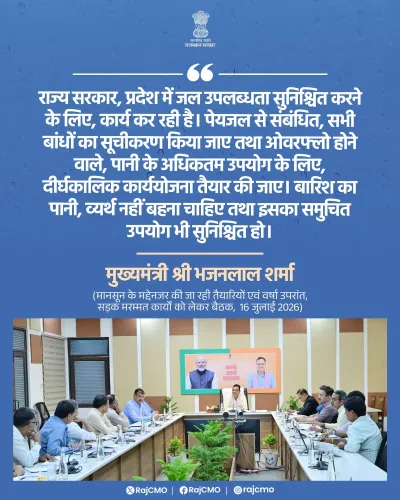
Decades after a landmark tribunal carved up the Narmada's waters, Rajasthan is pressing to claim every drop it is owed. The Chief Minister's Office of Rajasthan announced on Tuesday, 27 October 2026 that the state government is actively working to utilise surplus water available during the monsoon season under the 1979 Narmada Water Disputes Tribunal award.
The post, tagged to Chief Minister Bhajanlal Sharma under the hashtag #आपणो_अग्रणी_राजस्थान ('Our Frontrunner Rajasthan'), read: 'Under the 1979 Narmada Water Disputes Tribunal, the state government is working with commitment to utilise surplus water available during the monsoon period.'What the 1979 tribunal actually gave Rajasthan
The Narmada Water Disputes Tribunal was constituted in 1969 under the Inter-State River Water Disputes Act to arbitrate among Madhya Pradesh, Gujarat, Maharashtra and Rajasthan. Its final award, delivered in December 1979, allocated 0.5 million acre-feet (MAF) of Narmada water annually to Rajasthan — the smallest share among the four states, but critical for its arid southern and south-eastern districts.
That figure of 0.5 MAF has always defined the outer boundary of Rajasthan's entitlement. What the post zeroes in on is the 'surplus' dimension: during peak monsoon flows, the Narmada carries far more water than the four states can store or route under normal operations. Capturing that seasonal excess — within the framework of the tribunal's rules — is where Rajasthan sees room to grow its actual utilisation without triggering inter-state conflict.
The infrastructure challenge behind the commitment
Translating a tribunal allocation into water at the field level requires canals, lift schemes and storage infrastructure. Rajasthan's pipeline from the Narmada runs through geographically demanding terrain in its southern districts, and the state has historically struggled to achieve full drawdown of its entitled share. Seasonal surplus flows present a narrow, time-bound window — essentially the monsoon months — demanding that intake and storage capacity be ready when the river peaks.
The CMO's framing of this as an active, ongoing commitment signals that the Bhajanlal Sharma government sees water-utilisation efficiency — not just entitlement on paper — as a governance benchmark. Southern Rajasthan's farming communities, dependent on irrigation in an otherwise water-scarce landscape, stand to gain most directly if the state can actually lift and store monsoon surplus flows at scale.
Rajasthan's water politics in a wider frame
Inter-state river disputes in India have a long history of awards sitting idle because downstream infrastructure was never built fast enough to absorb allocations. Rajasthan's 0.5 MAF Narmada share, while modest compared to Gujarat's or Madhya Pradesh's allocations, remains strategically important in a state where groundwater depletion is accelerating. Any move to maximise monsoon surplus withdrawals would require close coordination with Gujarat — through whose territory the water flows — and potentially fresh conversations with the Narmada Control Authority.
The CMO's announcement does not cite a specific project, volume target or deadline — making the watch item clear: whether this commitment translates into measurable canal extensions, lift irrigation tenders or bilateral water-sharing protocols in the months ahead.
For a state that markets itself as an 'agrani' — a frontrunner — turning a five-decade-old tribunal award into flowing, productive water remains the most concrete proof of that claim.
Point of View
Particularly in agrarian constituencies. Framing it under the long-settled 1979 tribunal award is a careful political move — it stakes a claim without opening a fresh inter-state dispute. The real test is whether this translates into infrastructure spending and bilateral coordination with Gujarat, or remains a signalling exercise. In a state accelerating toward groundwater stress, the gap between entitlement and actual utilisation has become a political liability the ruling party can no longer afford to ignore.
NationPress
28 Oct 2026
Frequently Asked Questions
What is Rajasthan's share of Narmada water under the 1979 tribunal award?
Rajasthan was allocated 0.5 million acre-feet (MAF) of Narmada water annually under the final award delivered by the Narmada Water Disputes Tribunal in December 1979 .
What is the Narmada Water Disputes Tribunal?
The Narmada Water Disputes Tribunal was set up in 1969 under the Inter-State River Water Disputes Act to adjudicate the sharing of Narmada river waters among Madhya Pradesh, Gujarat, Maharashtra and Rajasthan .
Why is monsoon surplus water important for Rajasthan?
During peak monsoon flows, the Narmada carries far more water than states can normally route. Capturing this seasonal surplus gives Rajasthan an opportunity to maximise its utilisation within its 0.5 MAF entitlement, especially for its arid southern districts.
Which districts of Rajasthan benefit from Narmada water?
The southern and south-eastern districts of Rajasthan are the primary beneficiaries of the state's Narmada water allocation, where the river's water is routed through canal and lift irrigation schemes.
Who is the Chief Minister of Rajasthan in 2026?
Bhajanlal Sharma has been the Chief Minister of Rajasthan since December 2023 , representing the BJP government.