Rajasthan Governor Advocates for 'Jai Jawan, Jai Kisan, Jai Vigyan, and Jai Anusandhan' at Convocation
Synopsis
At the 7th Convocation of Agricultural University in Jodhpur, Rajasthan Governor Haribhau Bagde urged graduates to embrace their educational journey as a commitment to societal service, advocating for innovative agricultural practices and the adoption of a powerful mantra for national growth.
Key Takeaways
Convocation as a Milestone: It signifies a critical transition for students.
Importance of Education: Education empowers individuals for societal contributions.
Agriculture's Role: Agriculture is crucial for India's economic structure.
Innovation in Farming: Emphasis on modern technologies like AI and drones.
Natural Farming: Advocating for sustainable agricultural practices.
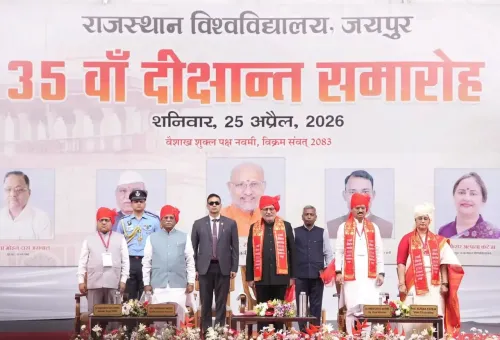
Jaipur, March 20 (NationPress) The Governor of Rajasthan, Haribhau Bagde, emphasized on Friday that a convocation represents more than just the handing out of degrees; it signifies a pivotal moment in students' lives as they transition to new beginnings.
He pointed out that in Indian culture, convocation is referred to as 'Samavartan Sanskar (graduation rite)', a ceremony designed to inspire students to devote themselves to societal service.
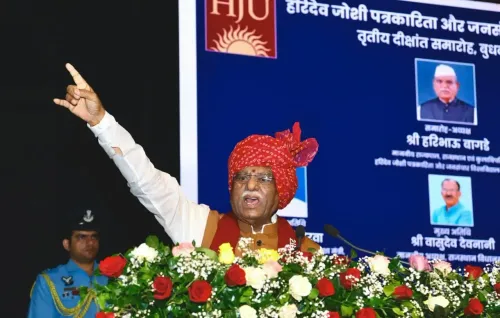
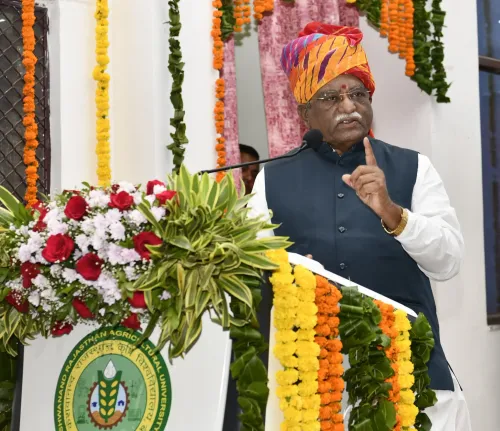
During the 7th Convocation Ceremony of the Agricultural University in Jodhpur, the Governor highlighted that graduates carry the responsibility of sharing the knowledge they acquired at university with all segments of society.
He encouraged them to leverage their education for the advancement of both the nation and society, to establish clear objectives, and to pursue them relentlessly.
Labeling education as the “path of illumination,” he stated that it not only enlightens individuals but also empowers them to make significant contributions to society and the world.
The Governor underscored the vital role of agriculture, describing it as the cornerstone of India's economy with a substantial portion of the population reliant on it.
He expressed optimism that the university would foster research driven by innovation in agriculture and technology, promoting advanced farming methods tailored to local climatic needs.
Stressing the significance of modern technologies, he mentioned that adopting Artificial Intelligence (AI), drones, and robotics is crucial for tackling the challenges emerging in agriculture.
The Governor advocated for the responsible incorporation of AI to increase productivity and improve farmers’ incomes.
He called for embracing the mantra “Jai Jawan, Jai Kisan, Jai Vigyan, aur Jai Anusandhan,” highlighting the necessity of prioritizing research and innovation for sustainable agricultural development.
The Governor also pointed out the importance of natural farming, stressing that the overuse of chemical fertilizers is detrimental to soil health. He urged for greater adoption of natural farming practices and increased awareness of their advantages.
He emphasized the urgent need for water conservation, stating, “saving water is equivalent to producing it.” A sustainable agricultural framework can only be realized through the combination of traditional knowledge, farmers’ practical experiences, and modern scientific progress.
Reflecting on India’s rich agricultural legacy, from the Indus Valley Civilization to Vedic times, he noted that agriculture has always been integral to the country’s cultural and social identity, transcending mere economic considerations.
The Governor congratulated the university for achieving an ‘A’ grade from the Indian Council of Agricultural Research (ICAR). He commended its accomplishments, including the development of enhanced crop varieties, the establishment of an agricultural machinery testing facility, the conservation of indigenous millet varieties, and innovations like a henna harvesting machine. Acknowledging the rising global significance of millets, he called for intensified efforts in this sector.
In his address, Union Minister for Culture and Tourism, Gajendra Singh Shekhawat, described the convocation as a critical moment in a student’s journey—an opportunity to pledge for the future.
He remarked that the ceremony embodies years of dedication, guided by educators and supported by the sacrifices made by parents.
He urged graduates to apply their knowledge to meet their responsibilities toward the nation.
On this occasion, the Governor inaugurated hostels for the College of Dairy and Food Technology and the College of Technology and Agricultural Engineering at Sawant Kuwa (Bawadi).
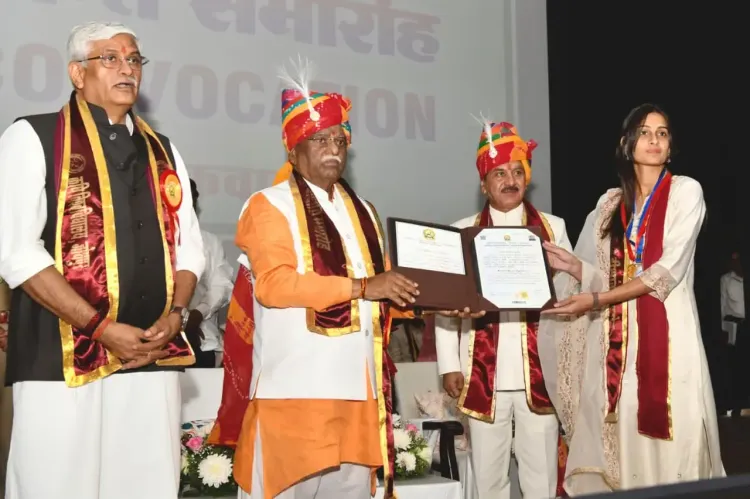
He also launched several university publications. During the ceremony, 403 students were conferred degrees, with 15 students receiving gold medals for exceptional academic achievements.
Frequently Asked Questions
What is the significance of the convocation ceremony?
The convocation ceremony marks a pivotal transition for students as they celebrate their academic achievements and prepare to contribute to society.
What mantra did the Governor advocate for?
The Governor called for the adoption of the mantra 'Jai Jawan, Jai Kisan, Jai Vigyan, aur Jai Anusandhan,' emphasizing the importance of research and innovation.
Why is agriculture emphasized in the Governor's speech?
Agriculture is viewed as the backbone of the Indian economy, and the Governor stressed the need for innovation to address challenges in this sector.
What role does education play according to the Governor?
Education is described as an illuminated path that empowers individuals to contribute meaningfully to society.
How many students received degrees during the ceremony?
A total of 403 students were awarded degrees during the convocation ceremony.