Rajasthan HC launches 3 E-Seva vans for judicial access in remote villages
Synopsis
Rajasthan's rural residents can now attend court proceedings, check case status, and access free legal aid without leaving their villages — the state's High Court has put three technology-equipped E-Seva vans on the road, backed by the Supreme Court's E-Committee and the Ministry of Law and Justice.
Key Takeaways
Rajasthan High Court launched three E-Seva mobile vans on 7 November 2026 in Jaipur .
Chief Justice Sanjay K.
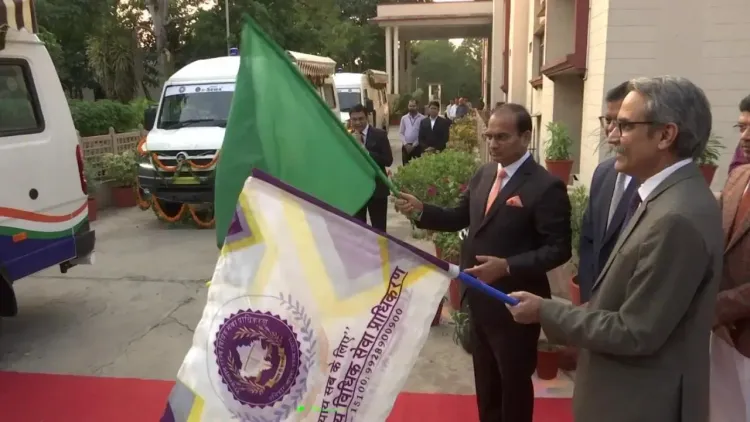
Agrawal flagged off all three vans jointly with the Rajasthan State Legal Services Authority (RSLSA) .
Vans offer video conferencing for court proceedings, case-status checks, court information, and free legal aid in remote villages.
The initiative is backed by the Supreme Court's E-Committee and the Department of Justice under the Ministry of Law and Justice.
Special outreach will target economically weaker sections and communities with limited legal awareness, including sessions at village chaupals.
The Rajasthan High Court on Saturday, 7 November 2026, flagged off three E-Seva mobile vans to carry court-related services directly to remote and underserved villages across the state, dramatically reducing the need for rural residents to travel to district headquarters or court complexes. The initiative is a joint effort between the Rajasthan High Court and the Rajasthan State Legal Services Authority (RSLSA).
What the E-Seva Vans Offer
Chief Justice Sanjay K. Agrawal of the Rajasthan High Court personally flagged off all three vans at the launch ceremony, attended by judges of the Jaipur Bench and senior RSLSA officials. Each van is equipped with modern technology enabling villagers to participate in judicial proceedings via video conferencing, check the status of pending cases, access court-related information, and obtain free legal aid — all without travelling to urban judicial centres.
The vans will also host legal awareness programmes in villages and at community gathering spaces, including local chaupals, educating residents about their legal rights, available government-supported judicial schemes, and free legal aid facilities.
Who Is Behind the Initiative
According to Hari Om Sharma Attri, Member Secretary of RSLSA, the three E-Seva mobile vans have been provisioned under an initiative of the Supreme Court's E-Committee and the Department of Justice under the Ministry of Law and Justice. The Rajasthan High Court and RSLSA will jointly operate and manage the vans to ensure consistent outreach across the state's most remote districts.
Attri stated that access to justice should not be determined by a person's geographical location, financial standing, or lack of resources, adding that this effort marks a concrete step toward extending High Court and Legal Services Authority services to Rajasthan's most distant villages.
Who Stands to Benefit
Special emphasis has been placed on reaching economically weaker sections of the population and individuals with limited prior access to legal assistance. The initiative is expected to be particularly impactful for people who currently forgo routine legal inquiries because of the time and cost involved in travelling to district courts. By deploying technology as an equaliser, the programme directly addresses three key barriers — geographical remoteness, financial constraints, and low awareness of available legal services.
Broader Context
This launch is part of a wider national push to digitise and decentralise judicial access under the Supreme Court's Phase III e-Courts Mission Mode Project. Rajasthan, with a large rural population spread across geographically vast districts, has long faced challenges in ensuring equitable access to justice at the grassroots level. Notably, mobile legal aid vans have been deployed in select other states, but the integration of real-time video conferencing with case-status lookup in a single mobile unit represents a meaningful technological step forward for the state's justice delivery infrastructure.
With three vans now operational and a mandate to cover even the most remote corners of the state, the initiative signals a shift in how Indian courts are thinking about last-mile judicial access — and sets a template other high courts may look to replicate.
Point of View
Not a solution — but the architecture matters. By bundling video conferencing, case tracking, and free legal aid into a single mobile unit under High Court-RSLSA joint operation, the initiative avoids the fragmentation that has hobbled past legal aid drives. The real test will be in scheduling frequency and geographic prioritisation: if the vans cluster around district fringes rather than genuinely remote talukas, the access gap will persist. That the Supreme Court's E-Committee is the funding backbone signals institutional seriousness, and other high courts will be watching Rajasthan's rollout data closely.
NationPress
8 Nov 2026
Frequently Asked Questions
What are the Rajasthan High Court E-Seva mobile vans?
They are three technology-equipped vans launched on 7 November 2026 by the Rajasthan High Court and RSLSA to bring judicial services — including video conferencing for court proceedings, case-status checks, and free legal aid — directly to remote villages. The vans eliminate the need for rural residents to travel to district courts for routine legal assistance.
Who launched the E-Seva mobile vans and who is funding them?
Chief Justice Sanjay K. Agrawal of the Rajasthan High Court flagged off the vans, which are being jointly operated by the High Court and RSLSA. The vans have been provided under an initiative of the Supreme Court's E-Committee and the Department of Justice under the Ministry of Law and Justice.
What services can villagers access through these vans?
Villagers can join court proceedings via video conferencing, check the status of pending cases, obtain court-related information, and avail free legal aid on-site. The vans will also conduct legal awareness sessions at villages and community spaces such as chaupals.
Who is the primary target group for the E-Seva van initiative?
The initiative primarily targets economically weaker sections and people in geographically remote areas who currently cannot afford the time or expense of travelling to district courts. Special focus will be on those with limited awareness of existing legal aid schemes.
How does this fit into India's broader e-courts programme?
The E-Seva vans are part of the Supreme Court's larger Phase III e-Courts Mission Mode Project, which aims to digitise and decentralise judicial access nationwide. Rajasthan's deployment is among the more integrated implementations, combining live court connectivity with case management and legal awareness in a single mobile unit.