CM Bhajanlal Launches Rajasthan GCC Policy-2025
Synopsis
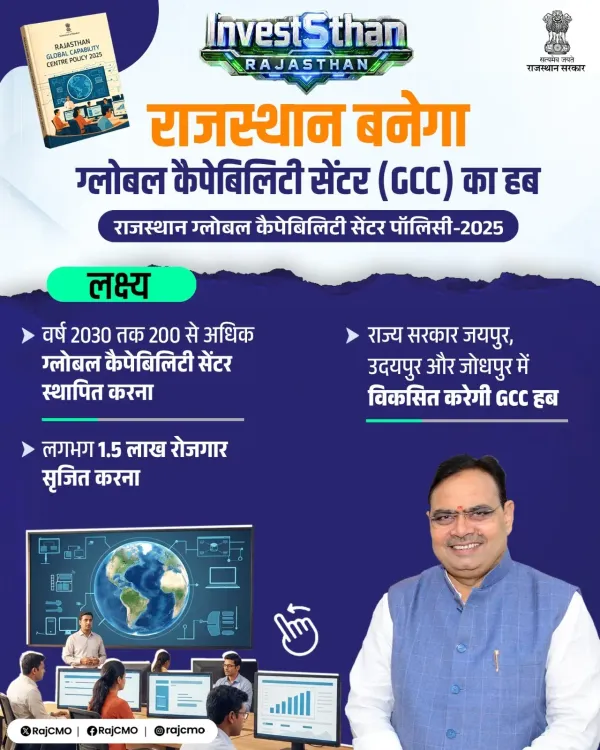
Rajasthan has implemented the GCC Policy-2025 to attract global technology firms and boost high-tech investment, with CM Bhajanlal Sharma's office positioning the state as an emerging hub for innovation and global capital under the #InvestRajasthan drive.
Key Takeaways
The Chief Minister's Office of Rajasthan announced the GCC Policy-2025 on June 2, 2026 .
Chief Minister Bhajanlal Sharma is credited as the driving force behind the policy's implementation.
The policy is designed to incentivise the establishment and expansion of Global Capability Centers in Rajasthan.
The government aims to increase the confidence of global companies and attract greater foreign investment into the state.
Rajasthan joins multiple Indian states that have introduced dedicated GCC policies since 2022 , competing with established hubs like Bengaluru and Hyderabad .
Actual GCC registrations and specific incentive details will be key metrics to watch in the coming months.
The Chief Minister's Office of Rajasthan announced on Tuesday, June 2, 2026, that the state has implemented the Rajasthan Global Capability Center (GCC) Policy-2025, positioning Rajasthan as an emerging hub for global investment, innovation, and high-technology services under the leadership of Chief Minister Bhajanlal Sharma.
Context
The official post states that under CM Bhajanlal Sharma's 'visionary leadership' (दूरदर्शी नेतृत्व), Rajasthan is becoming 'an emerging centre in the areas of global investment, innovation, and high-technology services.' The GCC Policy-2025 has been implemented specifically to advance this goal, with the government asserting it will 'promote investment in the state.' The post further notes that the policy will 'encourage the establishment and expansion of GCCs,' thereby increasing the confidence of global companies and attracting greater investment into Rajasthan.Policy Backdrop
Rajasthan has pursued successive investment promotion frameworks since the 2010s, including ease-of-doing-business reforms and industrial policies aimed at attracting foreign direct investment and IT/ITES projects. The GCC Policy-2025 is the latest in this lineage, tailored to a sector that has expanded rapidly across India following post-pandemic corporate restructuring and cost optimisation by multinationals. Multiple Indian states have introduced dedicated GCC policies since 2022, competing to capture a share of a sector that has historically been concentrated in established technology hubs such as Bengaluru, Hyderabad, and Chennai. Rajasthan's entry into this space reflects a broader pattern of second-tier states offering tailored incentives, talent pools, and infrastructure to diversify their economic base.Stakeholders and Impact
The primary beneficiaries of the policy are expected to be global technology firms seeking cost-competitive, talent-rich locations for their back-end and innovation operations, as well as IT professionals and engineers within Rajasthan. By incentivising the setup and expansion of GCCs — which typically house research, analytics, product development, and shared-services functions for multinational corporations — the policy aims to generate skilled employment and deepen the state's integration with global supply chains. The government's framing emphasises that increased confidence among international companies will translate into larger and more sustained capital inflows into the state.What's Next
Attention will now turn to the specific fiscal incentives, infrastructure commitments, and regulatory provisions contained within the GCC Policy-2025, as well as the pace of actual GCC registrations following the rollout. Investment announcements at state-level summits or through the Invest Rajasthan portal will serve as early indicators of the policy's traction. Whether Rajasthan can meaningfully compete with India's established technology corridors will depend on the depth of its talent pipeline, the quality of its physical and digital infrastructure, and the speed of on-ground implementation — factors that will come into sharper focus in the months ahead.Point of View
Textiles, and mining — and stake a claim in India's high-growth technology services sector. This is consistent with a broader national pattern of non-metro states using targeted policy instruments to compete with Tier-1 technology cities, a race that has intensified since the post-pandemic surge in GCC activity across India. For CM Bhajanlal Sharma, who took office in December 2023, the policy represents a tangible deliverable in an investment-promotion narrative that has been central to his administration's economic messaging. The real test, however, lies in implementation: the gap between policy announcement and measurable GCC registrations will determine whether Rajasthan can convert intent into durable economic diversification.
NationPress
18 Oct 2026
Frequently Asked Questions
What is the Rajasthan GCC Policy-2025?
The Rajasthan GCC Policy-2025 is a state government policy implemented to incentivise the establishment and expansion of Global Capability Centers in Rajasthan, with the aim of attracting global technology companies and boosting high-tech investment and innovation in the state.
What is a Global Capability Center (GCC)?
A Global Capability Center is an offshore unit set up by a multinational corporation to handle functions such as research and development, analytics, product development, and shared services. GCCs allow global firms to leverage local talent at competitive costs while retaining strategic oversight.
Why is Rajasthan launching a GCC policy?
Rajasthan is launching the GCC policy to diversify its economy beyond traditional sectors, attract foreign investment, and create skilled employment in the technology sector, competing with established hubs like Bengaluru and Hyderabad.
Who announced the Rajasthan GCC Policy-2025?
The policy was announced by the Chief Minister's Office of Rajasthan, with Chief Minister Bhajanlal Sharma credited as the driving force behind its implementation.
How does Rajasthan's GCC policy compare with other Indian states?
Multiple Indian states have introduced dedicated GCC policies since 2022 following rapid growth in the sector. Rajasthan's policy follows this trend of second-tier states offering tailored incentives and infrastructure to compete with established technology corridors in southern India.