Rajasthan CM Launches New Youth and Employment Policies
Synopsis
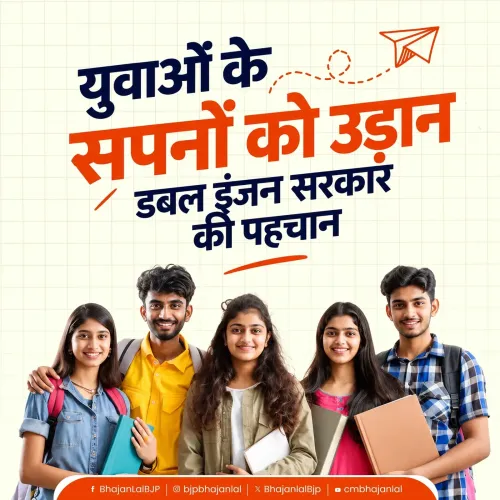
Rajasthan's BJP government, led by CM Bhajanlal Sharma, has announced a new Youth Policy and Employment Policy, framing both as state-level expressions of PM Modi's emphasis on youth empowerment and the party's 'double engine government' model.
Key Takeaways
The Chief Minister's Office of Rajasthan announced a new Youth Policy and a new Employment Policy on November 1, 2026 .
Chief Minister Bhajanlal Sharma , who has governed Rajasthan since December 2023 , is tagged in the post as the driving force behind both policies.
Both policies are framed as state-level implementations of PM Narendra Modi's emphasis on youth empowerment under the BJP's 'double engine government' model.
The announcement aligns with the broader arc of India's National Youth Policy 2014 , which set central goals for youth skilling and employment.
Specific provisions, budget allocations, and measurable targets for the new policies have not yet been publicly detailed.
Rajasthan is betting on its young population. Inspired, the state government says, by Prime Minister Narendra Modi's faith in youth power, the Chief Minister's Office of Rajasthan announced on Sunday, November 1, 2026 that the state has rolled out a new Youth Policy and a new Employment Policy — twin pillars designed to align the state's ambitions with national priorities on skilling and job creation.
The post, shared under the hashtag #आपणो_अग्रणी_राजस्थान ('Our Pioneering Rajasthan'), frames both policies as a direct expression of the BJP's 'double engine government' model — the idea that a BJP-ruled state and a BJP-led Centre move in the same direction, accelerating outcomes for citizens. The message was posted alongside a tag to Chief Minister Bhajanlal Sharma, who has headed the Rajasthan government since December 2023.
The 'Double Engine' Logic Behind the Policies
The 'double engine' framing is not just rhetoric — it carries a specific policy logic. When the same party governs at the Centre and the state, schemes, funding pipelines, and implementation agencies are expected to move in sync rather than at cross-purposes. For Rajasthan, that means the new Youth Policy and Employment Policy are positioned as state-level translations of national priorities, particularly around skilling, education, and employment generation.
India's National Youth Policy of 2014 had set broad goals around youth education, skill development, and livelihood at the central level. The new Rajasthan policies are being presented as building on that foundation — though the specific provisions, launch dates, and measurable targets of both state policies have not yet been detailed in the public record.
Why Rajasthan's Youth Are Central to the Politics
Rajasthan has a large and growing youth demographic — and youth unemployment has historically been one of the sharpest political pressure points in the state. Promises around government jobs, competitive exam reforms, and private-sector employment have driven election outcomes here in ways few other issues have. For the Sharma government, codifying a formal Youth Policy and Employment Policy signals institutional intent: these aren't ad hoc announcements but structured commitments that can be tracked across assembly sessions and annual budget cycles.
What those cycles actually deliver — the budget allocations, enrolment targets, and job numbers — will be the real test. The government has named the instrument; the implementation is what Rajasthan's youth will be watching.
Point of View
The Sharma government reinforces vertical alignment with the Centre while also claiming credit for independent state action. The critical question going forward is whether these policies translate into verifiable targets — job numbers, skilling enrolments, budget lines — or remain aspirational frameworks. Until those details surface in assembly debates or audit reports, the announcement is a signal of intent rather than a measurable policy event.
NationPress
1 Nov 2026
Frequently Asked Questions
What is Rajasthan's new Youth Policy?
The Rajasthan government has announced a new Youth Policy aimed at aligning the state's approach to youth education, skill development, and empowerment with national priorities. The specific provisions and targets have not yet been made fully public.
What is Rajasthan's new Employment Policy?
The new Employment Policy is a state-level initiative introduced by the Bhajanlal Sharma government to boost job creation and employment opportunities in Rajasthan, framed as complementary to the Centre's skilling and livelihood programmes.
What does 'double engine government' mean in Rajasthan?
'Double engine government' is a BJP term describing the benefit of having the same party in power at both the state and central level, enabling aligned policy implementation, faster funding flows, and coordinated governance.
Who is the Chief Minister of Rajasthan in 2026?
Bhajanlal Sharma of the BJP has been the Chief Minister of Rajasthan since December 2023 and continues in office as of November 2026.
How does India's National Youth Policy relate to Rajasthan's new policy?
India's National Youth Policy of 2014 set broad goals around youth education, skilling, and employment at the central level. Rajasthan's new Youth Policy is presented as a state-level framework built on that national foundation.