Rajasthan CMO: Rs 2.24 Lakh Crore Power MoUs Signed
Synopsis
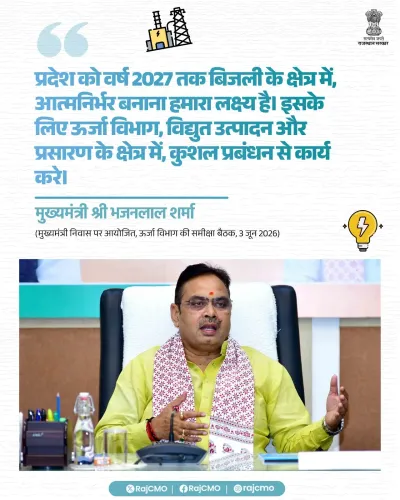
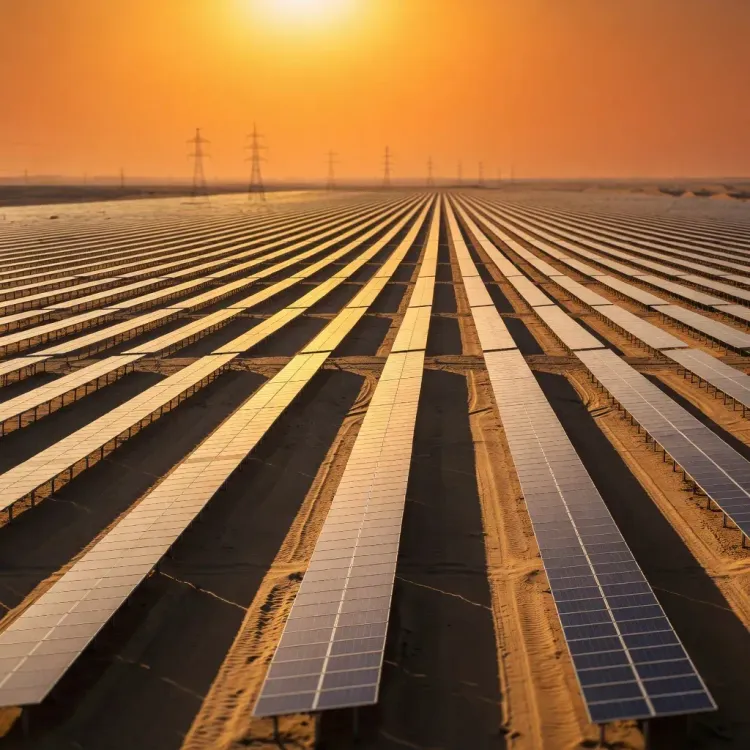
Rajasthan's Chief Minister's Office announced MoUs worth Rs 2.24 lakh crore with public sector undertakings to make the state electricity self-reliant, tagged to CM Bhajanlal Sharma under the 'Aapno Agrani Rajasthan' banner on 3 August 2026.
Key Takeaways
The Chief Minister's Office of Rajasthan announced MoUs worth Rs 2.24 lakh crore with public sector undertakings on 3 August 2026 .
The agreements target electricity atmanirbharta (self-reliance) for Rajasthan, a state historically dependent on power imports.
Central PSUs such as NTPC and Power Grid Corporation are among the entities involved in generation and transmission projects.
The announcement is tagged to Chief Minister Bhajanlal Sharma under the hashtag #आपणो_अग्रणी_राजस्थान .
Rajasthan's Solar Energy Policy 2019 had set a 30 GW renewable capacity target, providing the policy backdrop for these investments.
Actual project progress will be tracked through state budget presentations and central power ministry reviews.
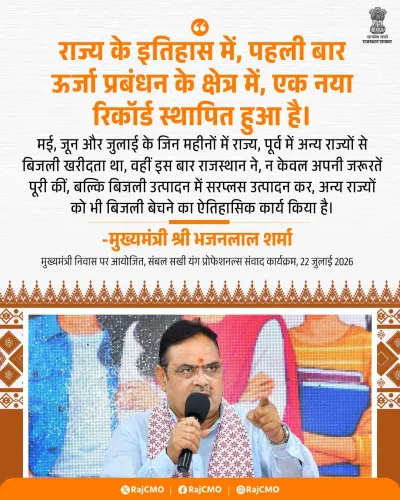
Rajasthan is making a decisive bet on energy self-reliance. The Chief Minister's Office of Rajasthan announced on Monday, 3 August 2026 that the state has signed Memoranda of Understanding worth Rs 2.24 lakh crore with public sector undertakings to make the state power-independent — a single-day commitment that dwarfs most state-level infrastructure announcements.
The post, tagged to Chief Minister Bhajanlal Sharma and carrying the hashtag #आपणो_अग्रणी_राजस्थान ('Our Leading Rajasthan'), frames the MoUs as a structural fix to a long-standing vulnerability: Rajasthan has historically leaned on power imports from other states to meet demand, even as its desert geography gives it some of the country's richest solar and wind resources.
PSUs at the Centre of Rajasthan's Power Pivot
The agreements involve central government-owned public sector undertakings — entities like NTPC and Power Grid Corporation that carry both the financial muscle and the technical mandate to execute large-scale generation and transmission projects. Bringing PSUs into the fold matters: it reduces dependence on private capital alone and signals that the Centre and state are aligned on Rajasthan's energy roadmap. Rajasthan governments have a pattern of using high-profile MoU signings — often anchored to investor summits or sector roadshows — to announce generation and transmission pipelines. The real test, as always, is financial closure and ground-level execution, which will show up in subsequent state budget presentations and power ministry reviews.Atmanirbharta in Electricity — What It Would Mean
Rajasthan's stated goal is atmanirbharta — self-reliance — in the electricity sector. The state had set a target of 30 GW of renewable capacity under its Solar Energy Policy of 2019, a target that aligned with national clean-energy ambitions. An investment commitment at the scale of Rs 2.24 lakh crore, if translated into commissioned capacity, would fundamentally reshape the state's power balance sheet — turning a net importer into a potential surplus generator. For Rajasthan's electricity consumers — households, farmers on agricultural feeders, and industries — the downstream promise is stable supply and reduced tariff pressure. Whether the MoUs convert into megawatts on the grid is the question that will define CM Sharma's energy legacy.Point of View
Reinforcing a cooperative federalism narrative ahead of future electoral cycles. The scale of the commitment, however, invites scrutiny — Rajasthan has a history of large MoU announcements that face slow financial closure, and the gap between ink and installed capacity will define whether this becomes a genuine infrastructure milestone or a recurring headline. Analysts and opposition alike will watch the next state budget for concrete capital allocation against these agreements.
NationPress
17 Sept 2026
Frequently Asked Questions
What is the Rs 2.24 lakh crore MoU signed by Rajasthan?
The Chief Minister's Office of Rajasthan announced on 3 August 2026 that the state has signed MoUs worth Rs 2.24 lakh crore with public sector undertakings to develop electricity generation and transmission infrastructure, with the goal of making Rajasthan self-reliant in power.
Which PSUs are involved in Rajasthan's power MoU?
The MoUs involve central government public sector undertakings active in power generation and transmission. Entities such as NTPC and Power Grid Corporation are among the PSUs typically engaged in such state-level agreements, though the full list of signatories has not been specified in the announcement.
What is Bhajanlal Sharma's energy plan for Rajasthan?
Chief Minister Bhajanlal Sharma's energy plan centres on achieving electricity self-reliance for Rajasthan by attracting large-scale investment from central PSUs, building on the state's existing Solar Energy Policy of 2019 which targeted 30 GW of renewable capacity.
Why is Rajasthan dependent on power imports?
Despite having vast solar and wind potential, Rajasthan has historically faced a gap between in-state generation capacity and peak demand, requiring it to purchase power from other states. The new MoUs aim to close this gap by expanding domestic generation and transmission infrastructure.
What does Aapno Agrani Rajasthan mean?
'Aapno Agrani Rajasthan' translates from Rajasthani as 'Our Leading Rajasthan.' It is a branding hashtag used by the Bhajanlal Sharma government to frame its development and infrastructure initiatives as positioning Rajasthan at the forefront of progress among Indian states.