Rajasthan CM Sharma leads state to top cooperative rankings
Synopsis
The Chief Minister's Office of Rajasthan says the state has claimed first place nationally in grain storage capacity, e-PACS digital transactions, and m-PACS formation, crediting CM Bhajanlal Sharma's leadership and PM Modi's 'Sahkar Se Samriddhi' cooperative vision for the achievement.
Key Takeaways
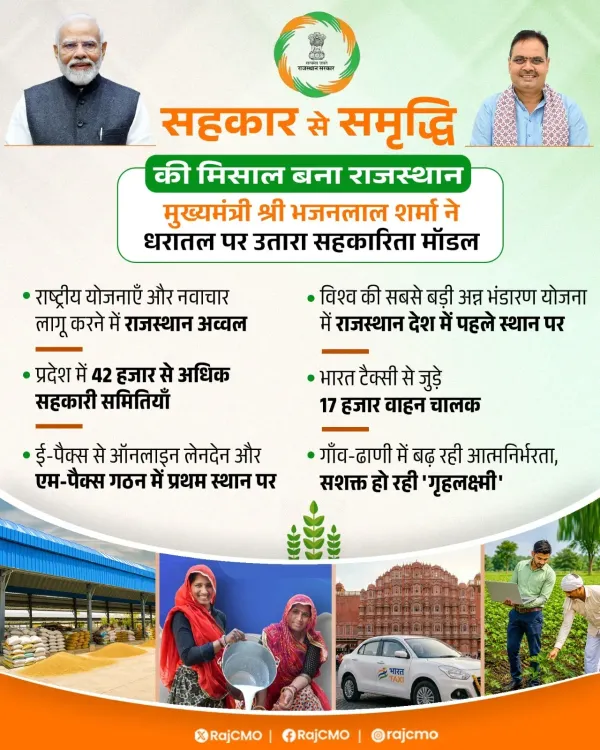
The Chief Minister's Office of Rajasthan announced on 11 July 2026 that the state ranks first nationally in grain storage capacity, e-PACS transactions, and m-PACS formation.
CM Bhajanlal Sharma has been credited with steering the state's cooperative sector to national leadership since taking office in December 2023 .
The achievements are framed as fulfilment of PM Narendra Modi's 'Sahkar Se Samriddhi' (Prosperity Through Cooperation) national vision.
The Ministry of Cooperation , set up in July 2021 , and a 2022 scheme to computerise 63,000 PACS nationwide form the policy backbone behind these rankings. e-PACS and m-PACS upgrades aim to bring digital credit, storage, and multipurpose services directly to Rajasthan's farming households.
Independent verification of the state's claimed rankings is awaited from the Ministry of Cooperation or NABARD .
The Chief Minister's Office of Rajasthan announced on Saturday, 11 July 2026 that the state, under Chief Minister Bhajanlal Sharma, has emerged as a national leader in cooperative sector implementation, claiming first position in grain storage capacity, online transactions through e-PACS, and the formation of m-PACS.
Context
The CMO's post, carrying the hashtag #आपणो_अग्रणी_राजस्थान ('Our Leading Rajasthan'), states that the state government has 'set an example of prosperity by making cooperatives a means' under Sharma's leadership. It credits Prime Minister Narendra Modi's vision of 'Sahkar Se Samriddhi' ('Prosperity Through Cooperation') as the guiding resolve that Rajasthan is actively working to realise. The claim positions the state as a frontrunner among all Indian states in key cooperative metrics.
The post specifically highlights three areas of distinction: food grain storage capacity, online transactions conducted through e-PACS (electronic Primary Agricultural Credit Societies), and the constitution of m-PACS (multipurpose PACS). These are central pillars of the national cooperative digitisation drive.
Policy Backdrop
The Ministry of Cooperation, established in July 2021, was created to provide focused attention to India's cooperative sector after years of fragmented oversight across multiple ministries. A centrally sponsored scheme for the computerisation of 63,000 PACS nationwide was approved in 2022, enabling real-time digital transactions and integration with banking systems.
PACS — Primary Agricultural Credit Societies — are the grassroots units of India's three-tier cooperative credit structure, providing farm credit, input supply, and storage services to rural households. The push to upgrade them digitally and expand their functions into multipurpose entities (m-PACS) is a key plank of Modi's cooperative agenda, designed to strengthen agricultural supply chains from the village level upward.
Stakeholders and Impact
Rajasthan's farming community and rural cooperative societies are the primary beneficiaries of these programmes. Improved grain storage capacity directly reduces post-harvest losses for farmers, while e-PACS digitisation enables faster, transparent credit disbursement and commodity transactions without physical paperwork.
The formation of m-PACS expands the role of local cooperative societies beyond credit into services such as retail, banking correspondents, and agri-input supply — broadening the economic footprint of the cooperative network across Rajasthan's largely agrarian districts.
What's Next
Updated national rankings on PACS computerisation and state-level grain storage capacity are expected from the Ministry of Cooperation or NABARD, which would independently verify the positions claimed by the state government. Such rankings carry political weight for BJP-governed states competing to demonstrate the strongest on-ground delivery of the central cooperative agenda.
With Rajasthan positioning itself as the benchmark for cooperative-led rural development, the state's performance data will be closely watched as a template — and a test — of whether the 'Sahkar Se Samriddhi' vision is translating into measurable outcomes for farmers on the ground.
Point of View
The state government simultaneously showcases local execution and reinforces ideological alignment with New Delhi. The emphasis on quantifiable metrics — storage capacity, e-PACS transactions, m-PACS count — signals a shift from process-based to outcome-based political communication in the cooperative space. Whether independent data corroborates the first-place claims will determine how durable this narrative proves.
NationPress
10 Oct 2026
Frequently Asked Questions
What is 'Sahkar Se Samriddhi' and how is Rajasthan implementing it?
'Sahkar Se Samriddhi' means 'Prosperity Through Cooperation' and is PM Narendra Modi's national vision for using cooperatives to drive rural economic growth. Rajasthan, under CM Bhajanlal Sharma, claims to be implementing it by expanding grain storage, digitising PACS through e-PACS, and forming multipurpose m-PACS across the state.
What are e-PACS and m-PACS?
e-PACS are Primary Agricultural Credit Societies enabled for online transactions through a central computerisation scheme approved in 2022. m-PACS are multipurpose PACS that go beyond farm credit to offer services such as retail, banking correspondent functions, and agri-input supply to rural communities.
Has Rajasthan officially been ranked first in cooperative schemes?
The Chief Minister's Office of Rajasthan has claimed first-place rankings in grain storage capacity, e-PACS transactions, and m-PACS formation as of July 2026. Independent verification from the Ministry of Cooperation or NABARD is yet to be publicly confirmed.
When was the Ministry of Cooperation set up and what does it do?
The Ministry of Cooperation was established in July 2021 to provide dedicated focus to India's cooperative sector. It oversees schemes including the computerisation of 63,000 PACS, grain storage expansion, and the promotion of multipurpose cooperative societies.
How do cooperative improvements benefit Rajasthan farmers?
Better grain storage reduces post-harvest losses, while e-PACS digitisation speeds up credit access and reduces paperwork for farmers. m-PACS expand local cooperative services into retail and banking, giving rural households broader economic support at the village level.