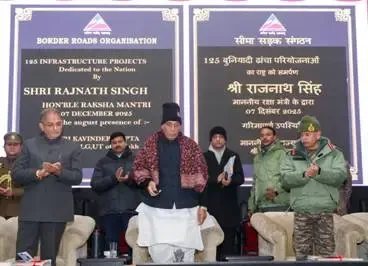
Rajnath Singh Addresses BRO Tech Symposium in New Delhi

Synopsis
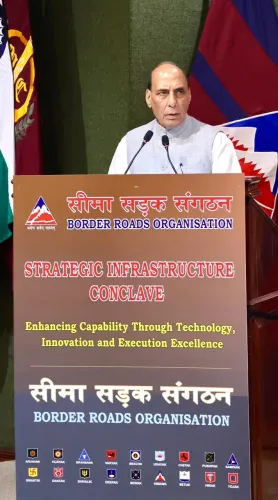
Union Defence Minister Rajnath Singh addressed the BRO Tech Symposium in New Delhi on 16 July 2026. The event focuses on deploying emerging technology in strategic border construction by the Border Roads Organisation, a priority that has intensified since the 2020 Galwan clash accelerated India's LAC infrastructure push.
Key Takeaways
Union Defence Minister Rajnath Singh addressed the BRO Tech Symposium in New Delhi on 16 July 2026 .
The symposium centres on applying emerging technology to the construction and maintenance of strategic border roads, bridges, and tunnels.
The Border Roads Organisation , established in 1960 , has seen sharply higher budgetary allocations and an accelerated project pipeline since the 2020 Galwan Valley clash .
BRO infrastructure serves a dual purpose — military readiness along the Line of Actual Control and civilian connectivity in remote border districts.
Follow-on procurement decisions and pilot project clearances are expected in the weeks following the symposium.
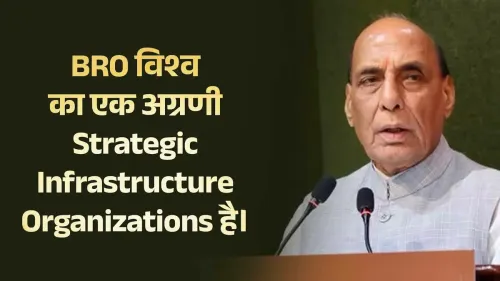
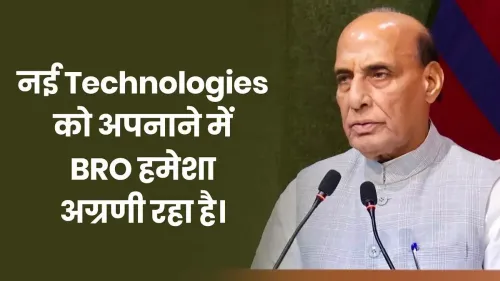
Union Defence Minister Rajnath Singh addressed the BRO Tech Symposium in New Delhi on Thursday, 16 July 2026, engaging with engineers and stakeholders of the Border Roads Organisation (BRO) on the role of emerging technology in strategic border infrastructure.
Context
The BRO Tech Symposium is a dedicated conference that brings together defence engineers, technology partners, and policymakers to explore cutting-edge solutions for constructing and maintaining roads, bridges, and tunnels in some of India's most challenging terrain. The event underscores the government's push to align civil engineering capabilities with modern defence imperatives along India's sensitive border regions.
Singh's presence at the symposium signals the political weight the Ministry of Defence attaches to BRO's evolving mandate — moving beyond conventional construction toward technology-driven project delivery.
Policy Backdrop
The Border Roads Organisation, established in 1960, was created specifically to build strategic connectivity in remote frontier areas where commercial contractors and civilian agencies could not operate effectively. For decades it remained a largely engineering-focused body, but its profile has risen sharply in recent years.
Following the 2020 Galwan Valley clash with China, the government significantly accelerated BRO's project pipeline along the Line of Actual Control (LAC), backed by substantially higher budgetary allocations. The thrust has been on all-weather roads, high-altitude tunnels, and bridges capable of supporting heavy military equipment — assets that compress response times for the armed forces in a crisis.
Successive administrations have recognised that technological upgrades — from drone-assisted surveying to advanced tunnelling equipment — are essential to overcoming the terrain and weather constraints that have historically slowed border construction. The current government's defence modernisation drive has sought to integrate these emerging technologies systematically within BRO's operational framework.
Stakeholders and Impact
BRO engineers and defence contractors are the immediate audience for policy signals emerging from a forum such as this. Announcements or directions from a minister of Singh's seniority at a technical symposium often translate into procurement priorities, pilot project clearances, or revised timelines for ongoing schemes.
For communities in border districts — particularly in Ladakh, Arunachal Pradesh, Sikkim, Himachal Pradesh, and Uttarakhand — improved BRO infrastructure means not only enhanced national security but also better civilian connectivity, access to markets, and disaster-response capacity. The dual-use nature of border roads makes BRO projects politically and strategically significant well beyond their military utility.
India-China boundary tensions have shown no sign of full resolution despite corps-commander-level disengagement talks, keeping the pressure on the government to sustain the pace of infrastructure build-up along the LAC.
What's Next
Observers will watch for follow-on procurement decisions or pilot project announcements that typically emerge in the weeks after a high-profile symposium. Parliamentary standing committee reports on border infrastructure and the next defence budget cycle are the natural venues where the priorities discussed at events like this are formally institutionalised.
With Rajnath Singh personally presiding over the symposium, any directional guidance he offered to BRO leadership is likely to carry immediate operational weight, reinforcing the government's stated commitment to technology-led border connectivity as a pillar of national security strategy.
Point of View
Not merely an administrative one. Coming against the backdrop of unresolved India-China boundary tensions, the event fits a pattern of the government visibly reinforcing its LAC build-up credentials. For BRO, ministerial attention at this level typically accelerates internal decision-making on technology adoption and procurement. The symposium also positions India's border infrastructure push as a knowledge-driven enterprise, shifting the narrative from brute construction capacity to technological sophistication.
NationPress
15 Oct 2026
Frequently Asked Questions
What is the BRO Tech Symposium?
The BRO Tech Symposium is a conference organised around the Border Roads Organisation that brings together engineers, defence contractors, and policymakers to explore technological solutions for building and maintaining strategic roads, bridges, and tunnels in India's border regions.
Why did Rajnath Singh attend the BRO Tech Symposium?
As Union Defence Minister, Rajnath Singh oversees the Border Roads Organisation and attended the symposium to engage with stakeholders on technology-driven approaches to border infrastructure, a key national security priority for the government.
What is the Border Roads Organisation and what does it do?
The Border Roads Organisation, established in 1960, is a Ministry of Defence agency responsible for constructing and maintaining strategic roads, bridges, and tunnels in India's remote and sensitive border areas, supporting both military logistics and civilian connectivity.
How has India's border infrastructure changed after the Galwan clash?
After the June 2020 Galwan Valley clash with China, the Indian government significantly accelerated BRO projects along the Line of Actual Control with higher budgetary allocations, prioritising all-weather roads, high-altitude tunnels, and bridges capable of supporting heavy military equipment.
Which border states benefit from BRO infrastructure projects?
BRO projects primarily benefit border districts in Ladakh, Arunachal Pradesh, Sikkim, Himachal Pradesh, and Uttarakhand, providing both military readiness and improved civilian access to markets and emergency services.