Rajnath Singh: India is 'Vishwa Bandhu' but has BrahMos too
Synopsis
Defence Minister Rajnath Singh declared on June 12, 2026, that India is the world's most trusted crisis partner but warned enemies not to confuse its goodwill for weakness — invoking both Vaccine Maitri and BrahMos to capture India's dual track of soft power and hard deterrence.
Key Takeaways
Union Defence Minister Rajnath Singh posted a foreign-policy statement on June 12, 2026 , asserting India's role as the world's most trusted partner in crises over the past 12 years .
Singh described India's global identity as 'Vishwa Bandhu' (Friend of the World), citing its record of being first to respond to disasters abroad.
He explicitly warned adversaries not to mistake India's peace efforts, tolerance, and goodwill for weakness.
The post invoked Vaccine Maitri — India's programme that supplied vaccines to over 90 countries — alongside the BrahMos supersonic cruise missile as twin symbols of India's dual-track global posture.
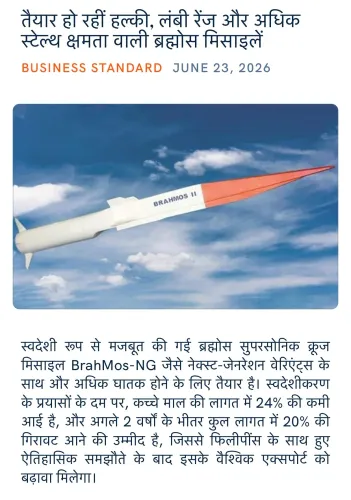
BrahMos , a joint venture with Russia formalised in 1998 , has become India's flagship defence-export product with expanding international deployments.
The statement reflects India's broader post- 2014 messaging: proactive humanitarian engagement combined with credible military deterrence and strategic autonomy.
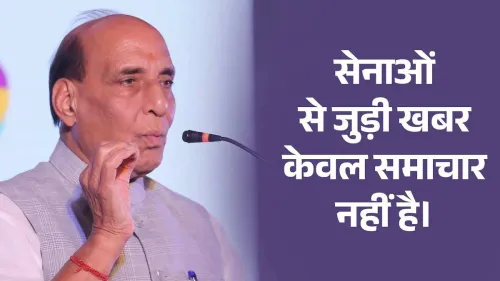
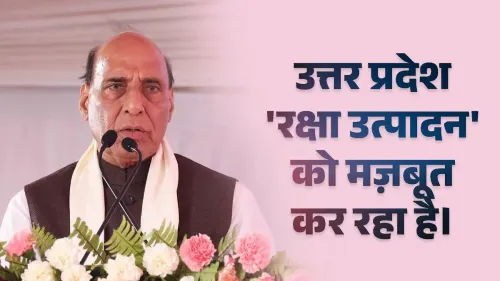
Union Defence Minister Rajnath Singh on Friday, June 12, 2026, posted a sharp foreign-policy statement on X, declaring that India has emerged as the world's most trusted partner in times of crisis over the last 12 years — but warned adversaries not to mistake the country's goodwill for weakness, invoking both the Vaccine Maitri initiative and the BrahMos missile in the same breath.
Context
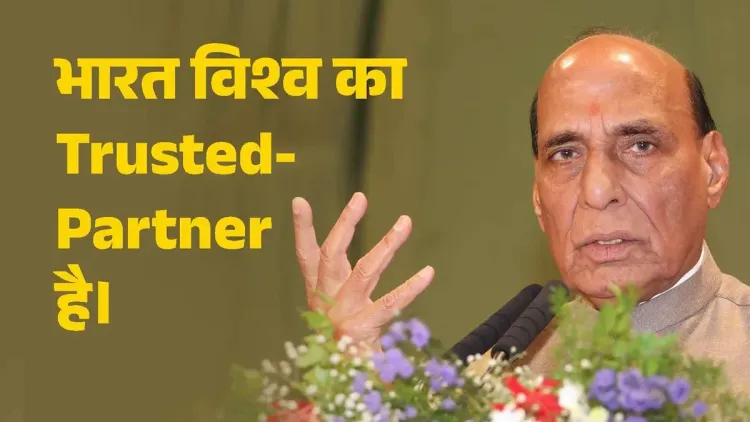
In his post, Singh wrote: 'विश्व बंधु के पास अगर Vaccine है, तो BrahMos भी है' — ('If the Vishwa Bandhu has a Vaccine, it also has BrahMos'). The statement distils India's current foreign-policy posture into a single, striking formulation: proactive humanitarian partner abroad, credible military power at home.
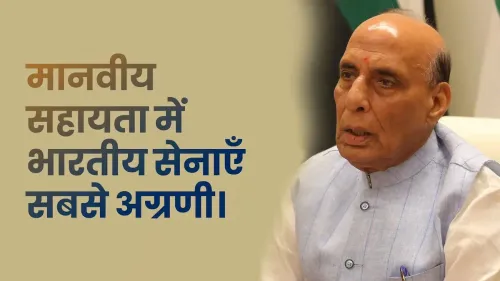
Singh described India's identity in the world today as that of a 'Vishwa Bandhu' — a 'Friend of the World' — noting that whenever a disaster strikes anywhere, India is the first to arrive with assistance. He cautioned, however, that India's peace efforts, tolerance, and goodwill should not be read by any adversary as a sign of weakness.
Policy Backdrop
The twin symbols Singh invoked carry substantial weight. The Vaccine Maitri programme, launched in January 2021, saw India supply vaccines to over 90 countries during the COVID-19 pandemic, cementing New Delhi's image as a first-responder in global health emergencies. It became one of the most cited examples of India's soft-power outreach in the post-2014 era.
On the other end of the spectrum sits the BrahMos supersonic cruise missile — a joint venture with Russia formalised in 1998, with operational deployments expanding significantly after 2010. BrahMos has since become a flagship defence-export product, with several countries acquiring or negotiating the system. Together, the two programmes encapsulate what analysts describe as India's 'dual-track' global engagement: generous in aid, unambiguous in deterrence.
Singh's remarks fit squarely within the broader messaging framework that has characterised India's external communications since 2014 — combining proactive humanitarian assistance with a parallel emphasis on indigenous weapons systems and strategic autonomy.
Stakeholders and Impact
The statement is directed at multiple audiences simultaneously. For India's defence forces and domestic audiences, it reinforces the government's position that military modernisation and humanitarian outreach are complementary, not contradictory. For diplomatic partners in the Global South, it reaffirms India's self-image as a reliable crisis partner with no hegemonic ambitions.
For adversaries — the post uses the word 'dushman' (enemies) explicitly — the message is a direct deterrence signal. By placing BrahMos in the same sentence as humanitarian vaccine diplomacy, Singh signals that India's strategic patience has defined limits. The framing is notable for its bluntness, coming from a senior Cabinet minister rather than a military spokesperson.
What's Next
India's defence export pipeline, which includes BrahMos negotiations with multiple nations, and its continued participation in multilateral humanitarian frameworks will be the practical tests of the doctrine Singh articulated. As India deepens both its aid commitments and its arms-export footprint, the 'Vaccine and BrahMos' formulation may well become a recurring shorthand in official foreign-policy discourse — a compact statement of the country's intention to remain both indispensable and undeterrable on the world stage.
Point of View
He frames soft power and hard power not as competing impulses but as two sides of the same strategic identity. The choice of the phrase 'Vishwa Bandhu' — a term that has gained currency in official discourse since 2014 — suggests this is doctrine, not improvisation. Coming from the Defence Minister rather than a diplomatic channel, the bluntness of the warning marks a deliberate escalation in rhetorical register.
NationPress
19 Sept 2026
Frequently Asked Questions
What did Rajnath Singh say about India and BrahMos?
Rajnath Singh said that while India is recognised worldwide as a 'Vishwa Bandhu' (Friend of the World) and a trusted crisis partner, adversaries should not mistake its goodwill for weakness — adding that 'if the Vishwa Bandhu has a Vaccine, it also has BrahMos.'
What is Vaccine Maitri and why did Rajnath Singh mention it?
Vaccine Maitri was India's initiative launched in January 2021 to supply COVID-19 vaccines to over 90 countries, symbolising India's humanitarian soft power. Singh cited it alongside BrahMos to illustrate that India's global engagement combines both generosity and military deterrence.
What is BrahMos and why is it significant?
BrahMos is a supersonic cruise missile developed through an Indo-Russian joint venture formalised in 1998. It is one of India's most advanced and exported defence platforms, symbolising the country's indigenous military capability and growing arms-export ambitions.
What does 'Vishwa Bandhu' mean in Indian foreign policy?
'Vishwa Bandhu' translates to 'Friend of the World' and has been used in official Indian discourse since 2014 to describe India's self-image as a proactive, benevolent global partner — especially in disaster relief and humanitarian assistance.
Who is Rajnath Singh?
Rajnath Singh is India's Union Minister of Defence and a senior leader of the Bharatiya Janata Party (BJP). He previously served as Chief Minister of Uttar Pradesh and as Union Home Minister before taking charge of the Defence Ministry.