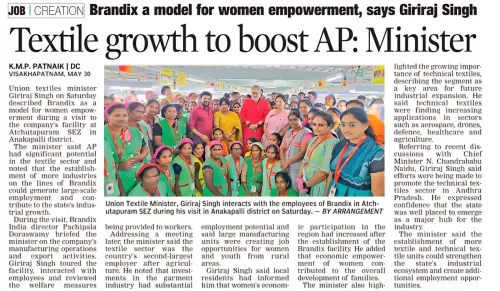
Giriraj Singh flags next-gen BrahMos missile upgrades
Synopsis
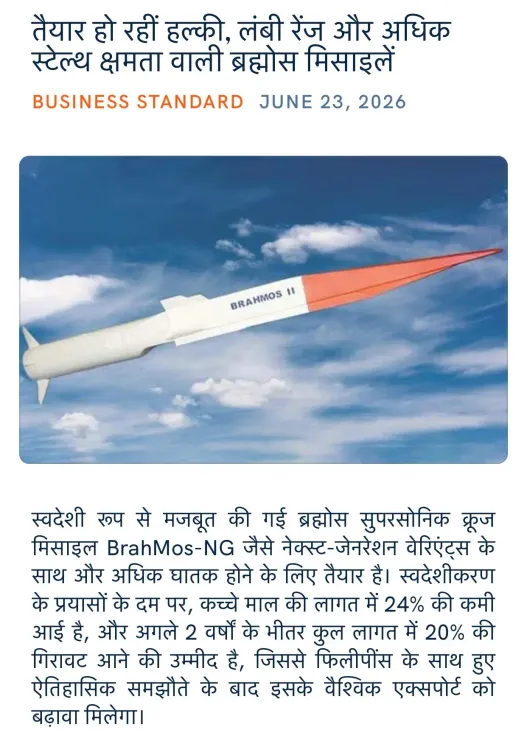
Union Textiles Minister Giriraj Singh shared a report on June 23, 2026 flagging that lighter, longer-range, and stealthier BrahMos supersonic cruise missile variants are under development, spotlighting India's ongoing precision-strike modernisation and the enduring Indo-Russian defence partnership.
Key Takeaways
Giriraj Singh amplified a report on June 23, 2026 about next-generation BrahMos missile development via the NaMo App.
The reported upgrades focus on reduced weight, extended range, and enhanced stealth capability for the BrahMos platform.
BrahMos is an Indo-Russian joint venture operational since 2001 , now inducting across Army, Navy, and Air Force.
India's 2016 entry into the MTCR removed range restrictions, enabling approval of 450 km-plus BrahMos variants.
DRDO and the Indo-Russian joint venture are driving iterative upgrades as part of India's broader force modernisation.
Formal testing timelines and induction schedules from the Ministry of Defence are awaited.
Union Textiles Minister Giriraj Singh on Tuesday, June 23, 2026 shared a report highlighting that lighter, longer-range, and stealthier variants of the BrahMos supersonic cruise missile are currently under development, signalling continued momentum in India's precision-strike modernisation drive.
Context
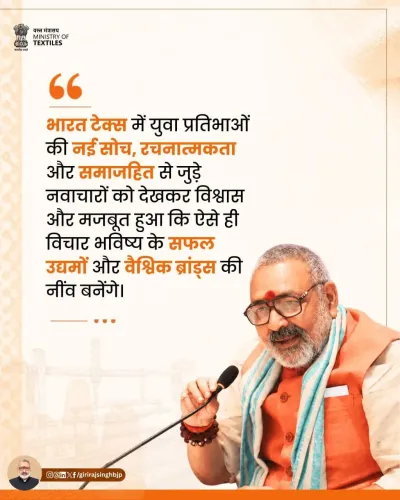
Singh shared the report via the NaMo App, drawing attention to what the post describes as 'हल्की, लंबी रेंज और अधिक स्टेल्थ क्षमता वाली ब्रह्मोस मिसाइलें' — lighter, longer-range, and higher-stealth-capability BrahMos missiles — on the anvil. While Singh holds the portfolio of Textiles, senior BJP leaders routinely amplify defence and national-security developments on social media as part of the party's broader communication strategy.
The BrahMos programme is a joint venture between India and Russia, initiated in 1998 through a partnership with NPO Mashinostroyeniya. The missile conducted its first test flight in 2001 and was inducted into the Indian Navy in 2005, with land-based and air-launched variants following in subsequent years.
Policy Backdrop
A pivotal shift came in 2016 when India joined the Missile Technology Control Regime (MTCR), removing prior international restrictions on cruise-missile range. This opened the door for the government to approve extended-range BrahMos versions capable of striking targets at 450 km and beyond, compared to the original 290 km ceiling.
Since the mid-2010s, work has progressed on lighter air-launched and submarine-launched configurations of BrahMos, aimed at expanding the missile's utility across all three services — Army, Navy, and Air Force. DRDO, India's primary defence research agency, has been central to these incremental upgrade efforts alongside the Indo-Russian joint venture structure.
The reported next-generation improvements — reduced weight, extended range, and enhanced stealth — align with a well-established pattern of iterative upgrades to the BrahMos platform that successive Indian governments have pursued as part of conventional force modernisation.
Stakeholders and Impact
The Indian Army, Navy, and Air Force are the primary end-users of BrahMos variants and stand to benefit most directly from lighter, longer-range missiles that are harder to detect on radar. A lower airframe weight is particularly significant for the Air Force, which has sought BrahMos integration on a wider range of fighter platforms beyond the Su-30MKI.
For India's domestic defence industry, upgrades to BrahMos also carry industrial implications, as the government has pushed for increasing the share of indigenous components in the missile system. Russian partners remain stakeholders in the joint venture, even as India diversifies its broader defence-supplier base.
What's Next
Formal announcements on prototype testing timelines and service-induction schedules for upgraded BrahMos variants are expected from the Ministry of Defence and DRDO. As India continues to expand its precision-strike inventory, the next-generation BrahMos programme will remain a closely watched indicator of the country's indigenous defence capability and the durability of its strategic partnership with Russia.
Point of View
Linking indigenous capability-building with strategic deterrence. At the same time, the programme's continued dependence on the Indo-Russian joint-venture structure raises questions about how far indigenisation has actually advanced. Watchers will look to DRDO and the Ministry of Defence for concrete timelines before treating the reported upgrades as imminent operational additions.
NationPress
22 Sept 2026
Frequently Asked Questions
What are the new BrahMos missile upgrades being developed?
Reports indicate that next-generation BrahMos variants with lighter airframes, extended range beyond current limits, and improved stealth characteristics are under development, though official timelines have not yet been announced.
Why did Textiles Minister Giriraj Singh post about a defence topic?
Senior BJP leaders routinely share national-security developments on social media as part of the party's broader communication strategy, regardless of their specific ministerial portfolio.
What is the current range of the BrahMos missile?
After India joined the MTCR in 2016, extended-range BrahMos versions capable of striking targets at 450 km and beyond were approved, up from the original 290 km ceiling.
Who develops the BrahMos missile?
BrahMos is developed through a joint venture between India and Russia, established in 1998 with NPO Mashinostroyeniya, with DRDO playing a central role on the Indian side.
Which Indian armed forces use the BrahMos missile?
All three services — the Indian Army, Navy, and Air Force — operate BrahMos variants, with the Navy being the first to induct the missile in 2005.