Giriraj Singh Hails Brandix as Model for Women's Empowerment
Synopsis
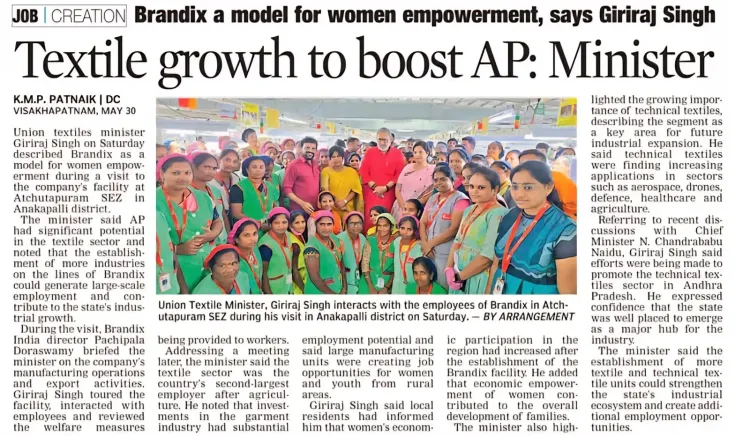
Union Textiles Minister Giriraj Singh on 31 May 2026 highlighted Brandix's integrated manufacturing model as proof that the textile sector drives women's empowerment, rural employment, and inclusive growth — not just industrial output — under the Atmanirbhar Bharat framework.
Key Takeaways
Union Textiles Minister Giriraj Singh praised Brandix on 31 May 2026 as a model combining industrial scale with women's empowerment.
He stated that large textile units provide dignified employment, self-reliance, and better life opportunities to a large number of women.
The post invokes the Atmanirbhar Bharat framework, linking women's workforce participation to national economic progress.
The PLI scheme for textiles , notified in 2021 , underpins government efforts to attract investment and generate employment in apparel manufacturing.
Growing female participation in textile clusters is seen as strengthening both local economies and India's export competitiveness.
Employment data from textile parks and new state-level MoUs for women-centric units are key metrics to watch going forward.
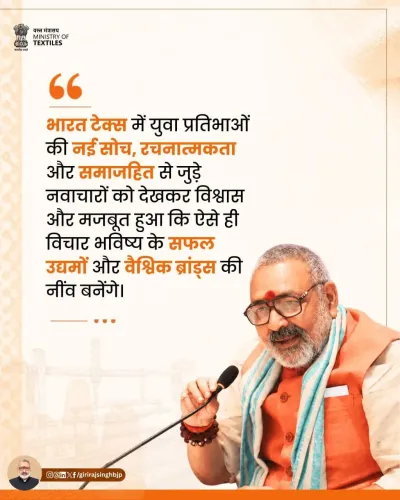
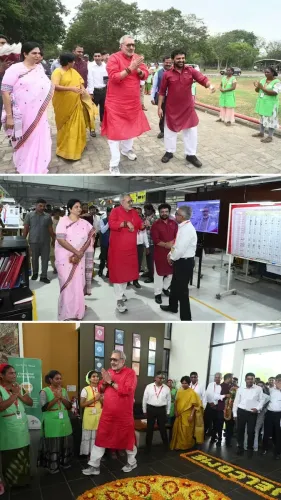
Union Textiles Minister Giriraj Singh on Sunday, 31 May 2026 praised large-scale textile manufacturing operations like those of Brandix, calling them powerful instruments of women's empowerment, rural employment, and inclusive growth — not merely production facilities.
Context
Posting on X, the Minister wrote in Hindi that 'Brandix jaise bade vastra vinirman model yeh darshate hain ki textile udyog kewal utpadan ka madhyam nahin' — ('Large textile manufacturing models like Brandix demonstrate that the textile industry is not merely a medium of production') but also an effective tool for women's empowerment, rural employment, and inclusive development. He added that by providing dignified employment, self-reliance, and better life opportunities to a large number of women, such industries contribute significantly to the holistic development of families and society.
The Minister further noted that the growing participation of women strengthens not only the local economy but also imparts fresh momentum to national progress, using the hashtags #WomenEmpowerment, #Brandix, #NariShakti, and #AtmanirbharBharat.
Policy Backdrop
Brandix is a Sri Lanka-headquartered integrated apparel manufacturer that operates large-scale garment units in India. The company has been associated with high-density, women-centric employment models in textile clusters, making it a recurring reference point in official discourse on industry-led social development.
The post aligns with the Central Government's Atmanirbhar Bharat framework, launched in 2020, which positioned domestic manufacturing — especially textiles — as a pillar of economic self-reliance. The Production Linked Incentive (PLI) scheme for textiles, notified in 2021, was specifically designed to attract investment and generate employment in apparel and technical textiles, with women's workforce participation as a stated social objective.
Discussions around a National Textile Policy have been ongoing since 2015, consistently framing the sector as a key driver of female labour-force participation in rural and semi-urban areas.
Stakeholders and Impact
The primary beneficiaries highlighted by the Minister are women workers in textile manufacturing units, particularly in rural districts where alternative formal employment is scarce. Large integrated facilities provide not just wages but structured career pathways, which official communications have linked to reductions in household poverty and improvements in children's education outcomes.
Textile exporters and rural households are the other key stakeholder groups. For exporters, a stable, skilled, and growing female workforce is a competitive advantage in global supply chains. For rural households, a second income — especially one earned by women — has documented multiplier effects on local consumption and savings.
Successive central governments have framed integrated textile manufacturing clusters as instruments that simultaneously serve export growth targets and social goals, a dual mandate that Minister Singh's post reinforces explicitly.
What's Next
The Ministry of Textiles is expected to track employment data from textile parks and integrated manufacturing zones as a key performance indicator for both the PLI scheme and the broader Atmanirbhar Bharat agenda. Fresh state-level Memoranda of Understanding for women-centric garment units remain a space to watch, particularly in states with large rural labour surpluses.
The Minister's public endorsement of the Brandix model signals that integrated, women-first manufacturing facilities could increasingly serve as the benchmark against which new textile investments are evaluated — shaping both policy incentives and the terms of future industrial partnerships.
Point of View
He reinforces the government's narrative that industrial policy and gender equity are mutually reinforcing goals under Atmanirbhar Bharat. The invocation of 'NariShakti' alongside a corporate name signals an intent to build political capital around employment outcomes in the textile sector ahead of what is likely a period of heightened scrutiny on job creation data. This also follows a well-worn pattern in Indian industrial communication: large integrated units are held up as proof-of-concept to justify continued incentive architecture, particularly the PLI scheme. The broader arc suggests the Ministry is positioning women-centric textile manufacturing as a flagship social dividend of its economic policy, not merely a labour-market statistic.
NationPress
16 Oct 2026
Frequently Asked Questions
What did Giriraj Singh say about Brandix?
Union Textiles Minister Giriraj Singh said that large textile manufacturing models like Brandix demonstrate that the industry is not just a production vehicle but an effective tool for women's empowerment, rural employment, and inclusive development.
What is Brandix and why is it significant in India's textile sector?
Brandix is a Sri Lanka-headquartered integrated apparel manufacturer that operates large-scale garment units in India. It is frequently cited in official discourse for its women-centric employment model and its role in combining industrial scale with social development outcomes.
How does the PLI scheme for textiles support women's employment?
The Production Linked Incentive scheme for textiles, notified in 2021, offers financial incentives to attract investment in apparel and technical textiles, with women's workforce participation as a stated social objective alongside export growth targets.
What is Atmanirbhar Bharat's role in the textile sector?
Atmanirbhar Bharat, launched in 2020, is the Central Government's self-reliant India policy framework. In textiles, it has been used to justify incentive schemes and cluster development aimed at boosting domestic manufacturing, reducing import dependence, and generating rural employment.
Why does women's participation in textile manufacturing matter for India's economy?
Women workers form the backbone of India's garment and apparel industry. Their participation strengthens local economies through household income gains, improves export competitiveness, and has documented multiplier effects on rural consumption, savings, and social indicators.