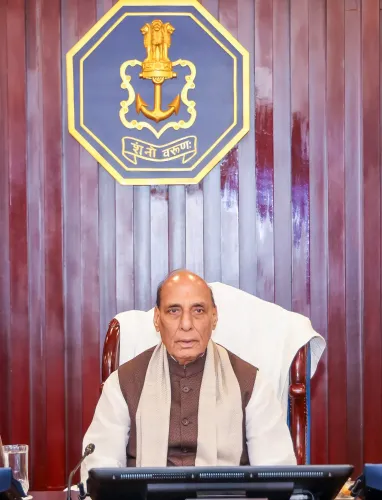
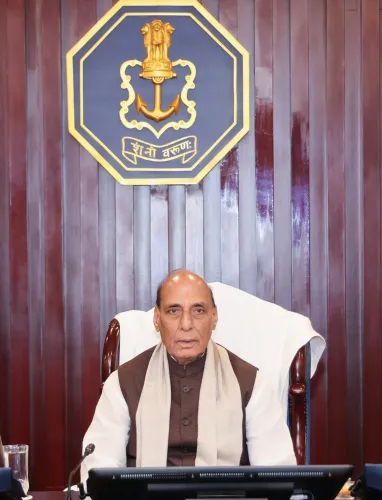
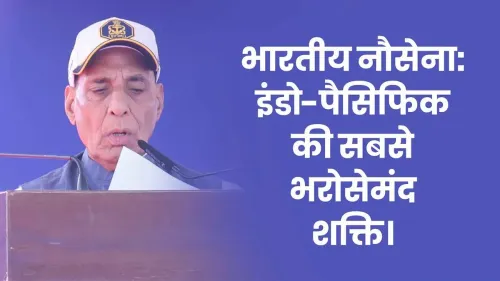
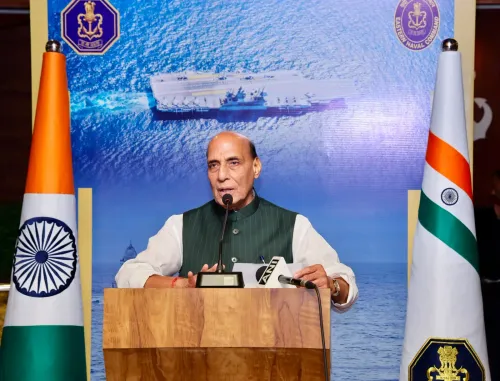
Rajnath Singh at Eastern Naval Command Barakhana, hails Navy's Indo-Pacific strength
Synopsis
Defence Minister Rajnath Singh's visit to the Eastern Naval Command Barakhana was more than a ceremonial lunch — it was a pointed signal of India's maritime ambitions. Invoking Operation Trident and championing indigenous carriers and nuclear submarines, Singh positioned the Navy as the centrepiece of India's Indo-Pacific strategy and self-reliance doctrine.
Key Takeaways
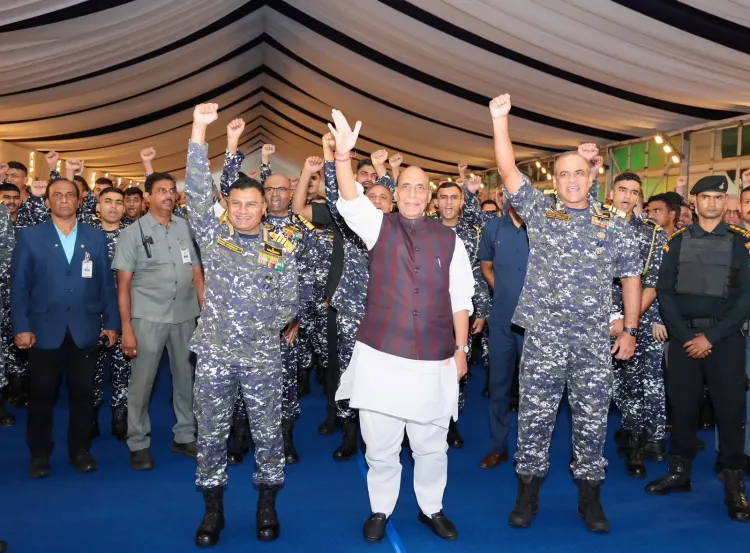
Defence Minister Rajnath Singh attended the Eastern Naval Command (ENC) Barakhana in Visakhapatnam on 5 October 2026 .
Singh praised the Indian Navy's recognition across the Indo-Pacific and its induction of indigenous platforms including aircraft carriers , nuclear-powered submarines , and Scorpene-class submarines .
He recalled the Navy's role in the 1971 War , specifically Operation Trident , which targeted Karachi harbour .
Singh called on India to view oceans as avenues for economic development and strategic influence , not just maritime boundaries.
He described naval personnel and their families as a 'valuable national asset' and reaffirmed the government's support for them.
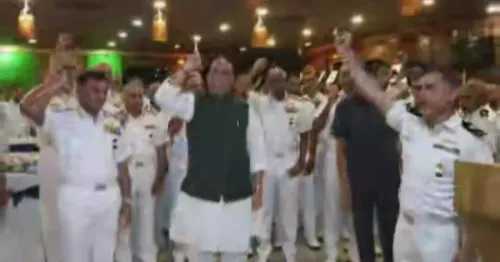
Defence Minister Rajnath Singh on 5 October 2026 attended a Barakhana — a traditional community meal — hosted by the Eastern Naval Command (ENC) in Visakhapatnam, where he interacted with Indian Navy personnel and their families and reaffirmed the government's appreciation for their service.
Honouring Naval Commitment
Singh commended naval personnel for their 'unwavering commitment' to safeguarding India's maritime interests and specifically acknowledged the sacrifices of their families. 'The Barakhana provided an opportunity to interact with the naval fraternity and reaffirm the government's appreciation of the dedicated service rendered by naval personnel,' the Defence Minister said.
He conveyed his continued support to personnel and their families and described their service as a 'valuable national asset,' noting that families shoulder critical responsibilities at home while sailors remain deployed at sea.
India's Growing Maritime Power
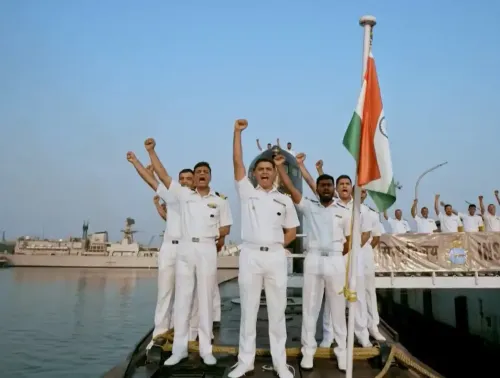
Singh highlighted the Indian Navy's emergence as a formidable maritime force whose capabilities are 'recognised across the Indo-Pacific.' He noted that India has developed and inducted a range of advanced indigenous platforms, including indigenous aircraft carriers, nuclear-powered submarines, stealth frigates, and Scorpene-class submarines.
The Defence Minister emphasised that the Navy's true strength rests not solely on hardware but on the 'professionalism, patriotism, courage and commitment' of its personnel. He stressed that India's waters must reflect the nation's maritime strength and that naval operations should embody the country's growing self-reliance.
Operation Trident and Historical Valour
Singh invoked the Navy's distinguished wartime record, citing its decisive role during the 1971 War — particularly Operation Trident, in which Indian naval forces struck Karachi harbour. He said the operation demonstrated the Navy's ability not only to defend India's maritime frontiers but also to project power and undertake offensive operations when required, a legacy that continues to inspire future generations.
A Broader Maritime Vision
Calling for a forward-looking maritime philosophy, Singh urged India to 'move forward from the seas towards prosperity and power.' He argued that oceans should be viewed not merely as boundaries requiring protection, but as avenues for economic development, strategic influence, and national prosperity — a framing that aligns with India's broader Indo-Pacific engagement strategy.
Singh described the Barakhana itself as a symbol of fraternity between defence personnel, their families, and national leadership, saying such occasions strengthen the bond that forms India's 'one larger defence family.' He expressed confidence that the Navy's continued dedication would contribute significantly to India's emergence as a stronger, more prosperous, and self-reliant nation.
Point of View
But the content was strategic messaging. Invoking Operation Trident alongside indigenous aircraft carriers and nuclear submarines signals that India is no longer content with a defensive maritime posture. The Indo-Pacific framing echoes the Quad's vocabulary and suggests the Navy is being positioned as a primary instrument of India's geopolitical projection — a notable elevation for a force historically overshadowed in public discourse by the Army. Whether the indigenisation rhetoric translates into accelerated platform inductions and reduced import dependence remains the harder test.
NationPress
6 Oct 2026
Frequently Asked Questions
What is a Barakhana and why did Rajnath Singh attend one?
A Barakhana is a traditional community meal shared between defence personnel, their families, and senior leadership, symbolising camaraderie and solidarity within the armed forces. Defence Minister Rajnath Singh attended the Eastern Naval Command's Barakhana in Visakhapatnam on 5 October to interact with Navy personnel and their families and to reaffirm the government's appreciation for their service.
What did Rajnath Singh say about the Indian Navy's capabilities?
Singh described the Indian Navy as a powerful maritime force whose capabilities are recognised across the Indo-Pacific. He highlighted the induction of indigenous platforms including aircraft carriers, nuclear-powered submarines, stealth frigates, and Scorpene-class submarines, and said India's naval operations reflect the country's growing self-reliance.
Why did Rajnath Singh mention Operation Trident?
Singh invoked Operation Trident — the 1971 War naval strike on Karachi harbour — to underline the Indian Navy's historical ability to project offensive power beyond India's own waters. He said the operation demonstrated that the Navy can both defend maritime frontiers and undertake decisive offensive operations when required.
What is India's broader maritime vision as outlined by Rajnath Singh?
Singh called on India to adopt a philosophy of advancing 'from the seas towards prosperity and power,' urging that oceans be viewed as avenues for economic development and strategic influence, not merely as boundaries requiring protection. The vision aligns with India's active engagement in the Indo-Pacific strategic framework.
What recognition did Singh give to the families of naval personnel?
Singh specifically acknowledged the sacrifices made by the families of naval personnel, noting that they manage responsibilities at home while sailors remain deployed at sea. He described this collective service as a 'valuable national asset' and conveyed the government's continued support to both personnel and their families.