Rajnath Singh hails India's first hydrogen train milestone
Synopsis
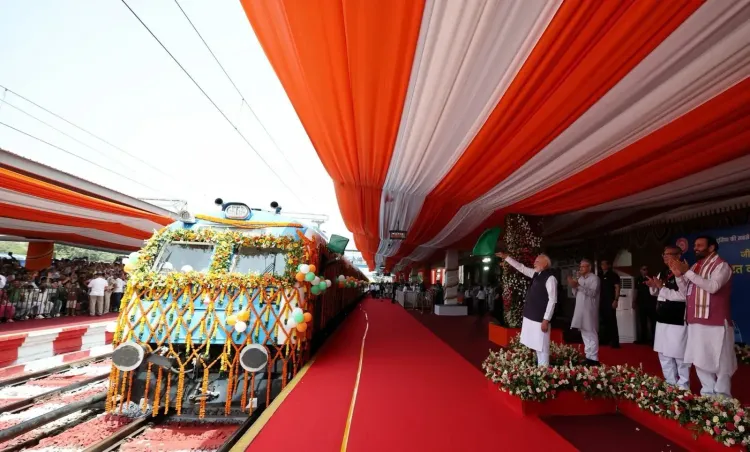
Union Defence Minister Rajnath Singh has hailed the flagging off of India's first hydrogen-powered train — designed, engineered and manufactured indigenously — as a landmark step in the country's pursuit of clean mobility and a net-zero future under PM Modi's leadership.
Key Takeaways
India's first hydrogen-powered train has been flagged off, marking a major milestone in clean and sustainable mobility.
The train was designed, engineered and manufactured entirely in India using indigenous technology, reflecting Atmanirbhar Bharat principles.
Indian Railways targets net-zero emissions by 2030 , well ahead of India's national 2070 net-zero goal announced at COP26.
The project is backed by the National Green Hydrogen Mission , launched in 2021 to scale domestic hydrogen production and use.
The initiative positions India alongside Germany and China as nations that have operationalised hydrogen-powered rail.
Fleet expansion decisions and route trials are expected to feature in upcoming Railway Budgets and Mission progress reports.
Union Defence Minister Rajnath Singh on Friday, July 17, 2026, celebrated the flagging off of India's first hydrogen-powered train, calling it a major milestone in the country's journey toward clean and sustainable mobility. The minister credited the achievement to the visionary leadership of Prime Minister Narendra Modi and highlighted the train's fully indigenous design, engineering, and manufacture.
Context
In his post, Rajnath Singh described the hydrogen train as a reflection of 'the growing strength of Indian engineering and the country's expanding capabilities in advanced railway systems.' He underscored that the project was 'designed, engineered and manufactured in India using indigenous technology,' placing it squarely within the Atmanirbhar Bharat framework that Prime Minister Modi has championed since 2020. The minister also linked the achievement to India's commitment to a net-zero future and world-class infrastructure driven by innovation and self-reliance.
Policy Backdrop
Indian Railways, the world's fourth-largest rail network, has set an ambitious target of achieving net-zero emissions by 2030 — a full four decades ahead of India's national 2070 net-zero pledge that Prime Minister Modi announced at COP26 in 2021. The hydrogen train initiative sits within a broader ecosystem of green transport investments that include electric locomotives and biofuel blending programmes across the rail network. Underpinning the push is the National Green Hydrogen Mission, launched in 2021, which aims to scale domestic hydrogen production and accelerate its deployment across strategic sectors.
The emphasis on fully indigenous development mirrors parallel efforts in defence manufacturing and semiconductor fabrication, where India has similarly sought to reduce import dependence and build sovereign technological capability. Hydrogen-powered rail is seen as particularly significant because it offers zero direct emissions while eliminating the need for costly overhead electrification on routes where laying electric infrastructure remains economically challenging.
Stakeholders and Impact
Railway passengers across India's vast network stand to benefit from cleaner, quieter travel as hydrogen technology is progressively scaled. Domestic clean-energy manufacturers — spanning electrolyser makers, fuel-cell developers, and specialised component suppliers — are positioned to grow alongside the programme, reinforcing the industrial dimension of the Make in India initiative. The project also sends a signal to global investors and multilateral climate bodies that India is translating its climate commitments into operational infrastructure rather than keeping them confined to policy documents.
For Indian Railways, a successful hydrogen prototype opens the door to fleet expansion decisions that could feature in upcoming Railway Budgets, potentially reshaping procurement and maintenance ecosystems worth thousands of crore of rupees over the coming decade.
What's Next
The immediate focus will be on route trials to validate the hydrogen train's performance under real operating conditions across different terrains and weather patterns. Progress reports under the National Green Hydrogen Mission and forthcoming Railway Budget allocations will be closely watched for signals on fleet expansion timelines and hydrogen fuelling infrastructure rollout. A successful scale-up would position India among a small group of nations — alongside Germany and China — that have operationalised hydrogen rail, lending fresh credibility to the country's broader clean-energy ambitions on the global stage.
Point of View
Sovereign-built infrastructure. By emphasising indigenous design and manufacturing, the government reinforces the Atmanirbhar Bharat narrative at a time when green technology supply chains are becoming a geopolitical battleground. Rajnath Singh's amplification of the event signals that the ruling establishment views clean-energy milestones as politically significant achievements, not merely technical ones. The real test, however, will come in the Railway Budget allocations and route-trial outcomes that determine whether this prototype becomes a fleet or a one-off showcase.
NationPress
17 Jul 2026
Frequently Asked Questions
What is India's first hydrogen-powered train?
India's first hydrogen-powered train is an indigenously designed, engineered and manufactured locomotive that runs on hydrogen fuel cells, producing zero direct emissions. It was flagged off in July 2026 as part of Indian Railways' push toward net-zero operations.
Who flagged off India's first hydrogen train?
The flagging off was celebrated by Union Defence Minister Rajnath Singh, who credited Prime Minister Narendra Modi's leadership for the milestone. The event marks a significant step in India's clean mobility journey.
What is the National Green Hydrogen Mission?
The National Green Hydrogen Mission was launched by India in 2021 to scale up domestic production and use of green hydrogen across strategic sectors, including transport, industry and energy storage.
When does Indian Railways plan to achieve net-zero emissions?
Indian Railways has set a target of achieving net-zero emissions by 2030, which is significantly ahead of India's national net-zero goal of 2070 announced by PM Modi at COP26 in 2021.
How does the hydrogen train fit into Make in India?
The hydrogen train was designed, engineered and manufactured entirely within India using indigenous technology, making it a flagship example of the Make in India and Atmanirbhar Bharat programmes applied to advanced green transport.