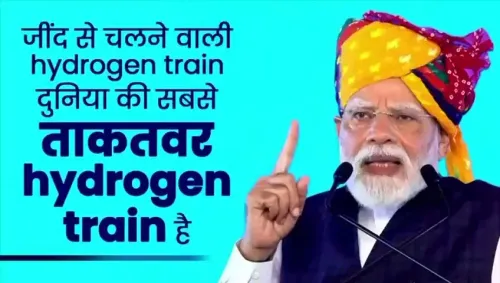
CM Samrat Choudhary Hails India's Hydrogen Train as World's Most Powerful
Synopsis
Bihar Chief Minister Samrat Choudhary amplified Prime Minister Modi's remarks on 17 July 2026, highlighting India's hydrogen train on the Jind–Sonipat corridor as the world's most powerful at 3,200 HP and its longest, positioning the milestone within India's green energy and self-reliance agenda.
Key Takeaways
Bihar CM Samrat Choudhary shared PM Modi's statement on India's hydrogen train on 17 July 2026 .
The hydrogen train operates on the Jind–Sonipat corridor in Haryana .
The train is described as rated at 3,200 horsepower , claimed to be the world's most powerful hydrogen train.
It is also described as the world's longest hydrogen train.
Only a small number of countries currently operate hydrogen trains; India joins this group under the National Green Hydrogen Mission .
The project aligns with the 'Hydrogen for Heritage' initiative announced by the Ministry of Railways in 2023 .
Bihar Chief Minister Samrat Choudhary on Friday, 17 July 2026, shared remarks by Prime Minister Narendra Modi celebrating India's hydrogen-powered train, calling it the world's most powerful and longest hydrogen train, operating on the Jind–Sonipat corridor in Haryana.
Context
Quoting Prime Minister Modi directly, CM Choudhary relayed the message: 'Hydrogen train abhi-abhi astitva mein aayi hai' ('The hydrogen train has just come into existence'). The Prime Minister noted that only a handful of countries in the world currently possess the capability to run hydrogen trains, and that India's entry into this league should make 'every Hindustani proud.'
According to the post, the train running from Jind to Sonipat is rated at 3,200 horsepower, described as both the most powerful and the longest hydrogen train in the world.
Policy Backdrop
India's push toward hydrogen-powered rail is rooted in the National Green Hydrogen Mission, approved in 2023, which explicitly includes mobility applications such as rail transport. The Ministry of Railways also outlined the introduction of hydrogen-powered trains under the 'Hydrogen for Heritage' initiative as part of the Union Budget that year.
Indian Railways, the state-owned network and one of the largest in the world, has been pursuing decarbonisation by developing alternative-fuel locomotives to reduce dependence on diesel imports. Germany became a notable early mover in this space, having placed hydrogen trains in commercial service since 2018; India's stated ambition is to field indigenously designed units with higher capacity.
Stakeholders and Impact
The Jind–Sonipat rail corridor in Haryana stands at the centre of this milestone, with railway passengers on that route among the first to benefit from zero-emission hydrogen traction. The clean energy sector — particularly domestic green hydrogen producers — stands to gain from demonstrated rail applications that could open larger procurement pipelines.
The development also carries significance for India's broader self-reliance narrative in strategic technology. An indigenously developed, high-capacity hydrogen locomotive, if the specifications are borne out in service, would mark a considerable step beyond the smaller-capacity units seen in early European deployments.
What's Next
Attention will now turn to the official commissioning timeline for additional hydrogen train rakes, performance data from extended trials on the Jind–Sonipat route, and any parliamentary or audit assessments of operational costs and reliability. Scaling the technology across Indian Railways' vast network will require sustained investment under the National Green Hydrogen Mission and coordinated policy between the railway ministry and the energy sector.
Point of View
Reinforcing the BJP's 'Viksit Bharat' and self-reliance messaging ahead of what is likely an active policy cycle. By quoting PM Modi verbatim and attaching the hydrogen train to national pride, the post frames a technical achievement in explicitly emotional, nationalist terms — a well-worn but effective political communication template. The choice of the Jind–Sonipat corridor, located in Haryana, is also geographically deliberate, signalling infrastructure attention to a politically significant state. Whether the 3,200 HP and 'world's longest' claims withstand independent technical scrutiny will determine how durable this narrative proves.
NationPress
16 Oct 2026
Frequently Asked Questions
What is India's hydrogen train and where does it run?
India's hydrogen train is a fuel-cell-powered locomotive currently associated with the Jind–Sonipat corridor in Haryana . It was highlighted by PM Modi and amplified by Bihar CM Samrat Choudhary in July 2026 as a major green transport milestone.
Is India's hydrogen train the most powerful in the world?
PM Modi , as quoted by CM Choudhary , described the Jind–Sonipat hydrogen train as the world's most powerful at 3,200 horsepower and also the world's longest hydrogen train. These claims have not yet been independently verified.
Which countries have hydrogen trains?
Only a small number of countries currently operate hydrogen trains. Germany was among the earliest, placing hydrogen trains in commercial service from 2018 . India is now positioning itself in this group with its indigenously developed unit.
What is the National Green Hydrogen Mission?
The National Green Hydrogen Mission is a central government programme approved in 2023 to scale the production and use of green hydrogen across transport, industry, and other sectors, including rail applications.
What is the 'Hydrogen for Heritage' initiative?
The 'Hydrogen for Heritage' initiative was outlined by the Ministry of Railways in 2023 as part of the Union Budget, aiming to introduce hydrogen-powered trains on select Indian rail routes as part of the network's decarbonisation drive.