Rajnath Singh links Gita's karma philosophy to India's space ambitions
Synopsis
Union Defence Minister Rajnath Singh invoked the Gita's 'Yogah karmasu kaushalam' to argue that Chandrayaan, Gaganyaan and India's startups embody an ego-free, fear-free national will — framing scientific self-reliance as both a philosophical and strategic imperative.
Key Takeaways
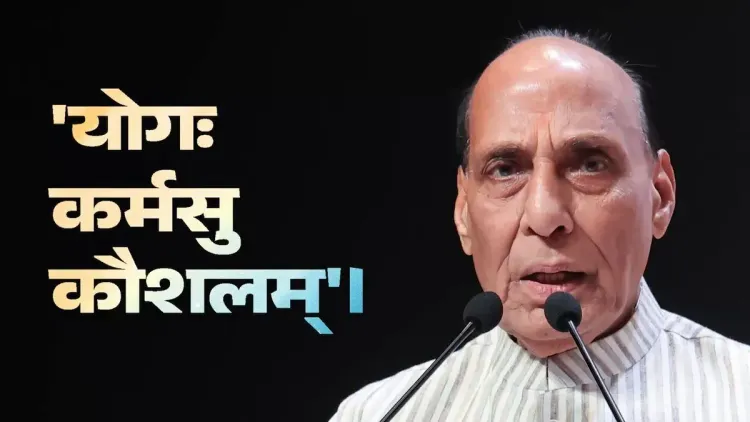
Rajnath Singh cited the Bhagavad Gita verse 'Yogah karmasu kaushalam' — excellence in action is yoga — as a guiding principle for national development.
He named Chandrayaan , Gaganyaan , and India's startup ecosystem as concrete symbols of positive national thinking and capability.
Chandrayaan-3 achieved a historic soft landing near the lunar south pole in August 2023 ; Gaganyaan , India's first crewed spaceflight programme, was approved in December 2018 .
Singh explicitly warned against 'criticism, distrust and fear' as negative tendencies that hinder nation-building.
Defence leadership views India's space achievements as carrying dual-use strategic value alongside their civilian scientific significance.
The post continues a broader government pattern of linking classical Indian philosophy with technological self-reliance narratives.
From a Sanskrit verse in the Bhagavad Gita to a rocket aimed at the stars — Union Defence Minister Rajnath Singh drew a sharp philosophical arc on Sunday, 27 September 2026, invoking ancient wisdom to frame India's most consequential scientific endeavours as expressions of a collective, ego-free national will.
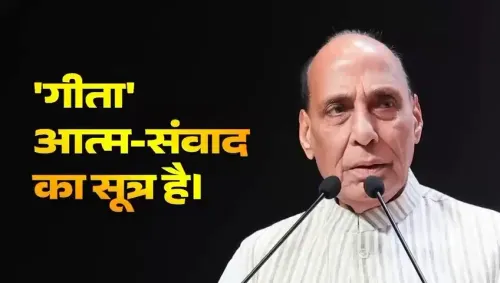
Quoting the Gita's celebrated line 'Yogah karmasu kaushalam' — 'excellence in action is yoga' — Singh argued that when work is freed from ego and attachment to results, the mind attains stillness. He then named Chandrayaan, Gaganyaan, and India's startup ecosystem as living proof of that principle at a national scale: 'Today Chandrayaan, Gaganyaan and our startups are symbols of India's positive national thinking and capability,' he wrote. The warning embedded in the message was equally pointed — the nation must move forward by guarding against 'negative tendencies such as criticism, distrust and fear.'
Why a Defence Minister is talking about ISRO and startups
The connection is less metaphorical than it first appears. India's space programme carries unmistakable dual-use significance: the same launch vehicles and satellite technologies that power Chandrayaan-3's August 2023 lunar touchdown and the upcoming crewed Gaganyaan flights feed directly into reconnaissance, communications, and strategic deterrence capabilities that the Ministry of Defence watches closely. Defence leadership has consistently framed ISRO's achievements within a national-security and indigenisation narrative, and Singh's post sits squarely in that tradition.
Gaganyaan, approved by the Union Cabinet in December 2018, remains India's most ambitious human spaceflight undertaking — an orbital mission designed to demonstrate a crewed capability that only a handful of nations possess. Chandrayaan-3 already placed India in exclusive company as the first country to land near the lunar south pole. The Startup India initiative, launched in 2016, anchors the civilian innovation arc Singh references, building an ecosystem that now feeds into defence manufacturing under the broader indigenisation drive.
Civilisational confidence as a strategic posture
Singh's framing is part of a recognisable pattern in which scientific achievement is woven together with classical Indian thought to project what could be called 'civilisational confidence' — the idea that technological self-reliance and cultural heritage are not in tension but mutually reinforcing. The invocation of the Gita here is deliberate: it reframes achievement not as the product of individual ambition but of disciplined, selfless collective action — a frame that sits comfortably alongside the government's broader 'Viksit Bharat' and 'Atmanirbhar Bharat' messaging.
The explicit caution against 'ninda, avishvas aur bhay' — criticism, distrust and fear — adds a pointed political texture. At a moment when debates around India's space timelines and startup valuations can generate sharp public disagreement, Singh's message reads as a call for national cohesion over adversarial noise — framed, crucially, in the language of karma rather than politics.
The next concrete milestone to watch: crew selection and flight-test timelines for Gaganyaan, and how defence indigenisation roadmaps continue to integrate space-sector advances. Singh has now signalled publicly that he sees those milestones as inseparable from the philosophical and strategic posture he is urging the country to adopt.
Point of View
He sidesteps the language of electoral competition entirely, projecting a stance above the fray. The implicit rebuke of 'ninda aur avishvas' — criticism and distrust — is a familiar political move: framing dissent as a national-character defect rather than a legitimate debate. For the defence establishment, the subtext is equally clear: space capability is strategic capability, and the minister is publicly reinforcing that frame.
NationPress
28 Sept 2026
Frequently Asked Questions
What did Rajnath Singh say about the Bhagavad Gita and India's development?
Rajnath Singh quoted the Gita's 'Yogah karmasu kaushalam' — meaning excellence in action is yoga — to argue that work done free of ego and attachment to results leads to a stable mind, and that India's achievements in Chandrayaan, Gaganyaan and startups reflect that spirit.
What is Gaganyaan and when was it approved?
Gaganyaan is India's first human spaceflight programme, designed to demonstrate a crewed orbital capability. It was approved by the Union Cabinet in December 2018.
What was the significance of Chandrayaan-3?
Chandrayaan-3 achieved a successful soft landing near the Moon's south pole in August 2023, making India the first country in the world to land a spacecraft in that region.
Why does India's Defence Minister comment on space programmes?
India's space technology has significant dual-use implications for national security — including satellite reconnaissance and strategic communications — so defence leadership closely tracks and publicly champions ISRO's achievements as part of the indigenisation and self-reliance narrative.
What is the Startup India initiative Rajnath Singh referenced?
Startup India was launched in 2016 to promote innovation and entrepreneurship across India. Singh cited it alongside Chandrayaan and Gaganyaan as a symbol of the country's positive national thinking and growing capability.