Rajnath Singh Cites Article 370, Ram Temple, Triple Talaq as BJP Promises Kept
Synopsis
Union Defence Minister Rajnath Singh invoked three landmark 2019 decisions — the abrogation of Article 370, Ram Temple construction in Ayodhya, and the triple talaq ban — to argue that the Modi government has consistently translated electoral promises into policy action.
Key Takeaways
Defence Minister Rajnath Singh posted on 14 June 2026 asserting that PM Modi always delivers on stated commitments.
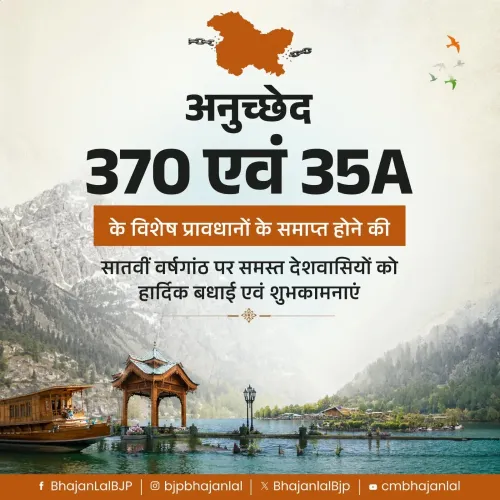
Article 370 was abrogated by Parliament on 5 August 2019 , reorganising Jammu and Kashmir into two union territories.
The Muslim Women (Protection of Rights on Marriage) Act , passed in July 2019 , criminalised instant triple talaq.
The Supreme Court verdict of 9 November 2019 paved the way for Ram Temple construction in Ayodhya .
Singh stated that for the government, 'the people of the country are paramount and national interest comes first.' The post aligns with a broader BJP pattern of consolidating its implementation record ahead of legislative or electoral activity.
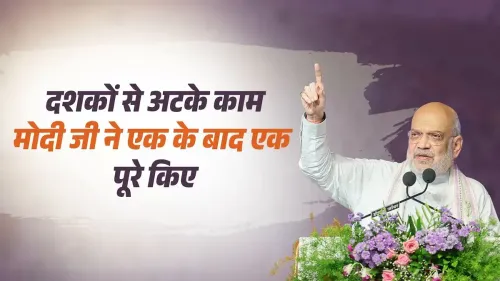
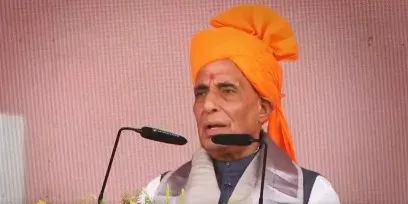
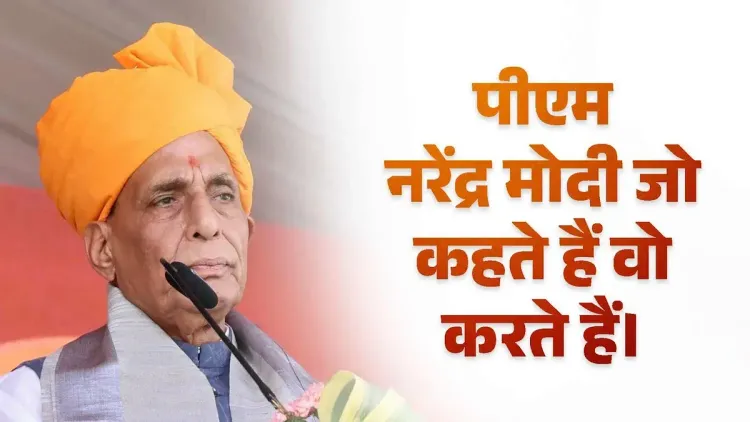
Union Defence Minister Rajnath Singh on Sunday, 14 June 2026 took to X to assert that the BJP-led government under Prime Minister Narendra Modi has consistently delivered on its core electoral commitments, citing three landmark decisions from 2019 as evidence of a governance philosophy that places national interest above political calculation.
Posting in Hindi, Singh wrote: 'प्रधानमंत्री @narendramodi जो कहते हैं, उसे करके दिखाते हैं' — 'Prime Minister Modi says what he means and does what he says.' He listed the abrogation of Article 370 in Jammu and Kashmir, the construction of the Ram Temple in Ayodhya, and the abolition of the practice of triple talaq as proof that 'there is no gap between our words and our actions.'
Context
The post frames three of the BJP's most prominent manifesto commitments as fulfilled promises rather than political aspirations. Singh stated plainly: 'For us, the people of the country are paramount, and national interest — not politics — comes first.' The statement is a direct articulation of the party's self-described governance doctrine ahead of what observers note is a politically active period.
The three decisions referenced all occurred in 2019, a year that proved pivotal for the Modi government's second term. Each carried significant constitutional, legal, or social weight and generated sustained public debate at the time of their passage.
Policy Backdrop
Article 370, which granted Jammu and Kashmir a special autonomous status, was abrogated by Parliament on 5 August 2019. The state was simultaneously reorganised into two union territories — Jammu and Kashmir and Ladakh — a move the government described as completing national integration.
On 9 November 2019, the Supreme Court of India delivered its judgment allocating the disputed site in Ayodhya for the construction of a Ram Temple. Construction followed, and the temple has since become a central symbol in the BJP's narrative of cultural restoration. Separately, the Muslim Women (Protection of Rights on Marriage) Act, passed in July 2019, criminalised the practice of instant triple talaq, a form of unilateral divorce that had long been contested by women's rights advocates.
Stakeholders and Impact
The abrogation of Article 370 directly affected residents of Jammu and Kashmir, altering the constitutional framework governing land rights, employment, and political representation in the region. Supporters argued it would accelerate development; critics raised concerns about democratic processes and local sentiment.
The ban on triple talaq was welcomed by a significant section of Muslim women and women's rights organisations, who had campaigned against the practice for decades. The Ram Temple in Ayodhya holds deep religious significance for Hindu devotees across the country and the diaspora. Singh's post implicitly addresses all three constituencies simultaneously, presenting the government's record as one of broad, cross-cutting delivery.
What's Next
The messaging fits a recognisable pattern in which senior BJP leaders periodically consolidate the party's implementation record, often in anticipation of legislative sessions or electoral cycles. Policy watchers will look for further administrative measures in Jammu and Kashmir — including statehood-related developments — as well as any movement on a Uniform Civil Code, which remains a stated long-term objective of the party. Singh's framing of 'national interest above politics' signals that such future moves, if announced, will likely be presented within the same promise-and-delivery framework he outlined on 14 June 2026.
Point of View
Ayodhya, and triple talaq — framed not as retrospective pride but as a forward-looking credibility claim. By invoking 'national interest above politics,' Singh is implicitly positioning the party against opposition narratives that characterise these decisions as divisive electoral manoeuvres. The timing and tone suggest the BJP is preparing the ground for the next phase of its reform agenda, possibly including Uniform Civil Code discussions or administrative developments in Jammu and Kashmir. For a senior leader of Singh's stature, such messaging also reinforces internal party discipline around a unified delivery narrative.
NationPress
13 Sept 2026
Frequently Asked Questions
What did Rajnath Singh say about PM Modi on 14 June 2026?
Rajnath Singh posted on X asserting that PM Narendra Modi always delivers on his promises, citing the abrogation of Article 370, Ram Temple construction in Ayodhya, and the ban on triple talaq as examples of the BJP government fulfilling its commitments.
When was Article 370 abrogated and what did it mean?
Article 370 was abrogated by Parliament on 5 August 2019. The provision had granted Jammu and Kashmir special autonomous status; its removal reorganised the state into two union territories — Jammu and Kashmir, and Ladakh.
What is the triple talaq law that Rajnath Singh mentioned?
The Muslim Women (Protection of Rights on Marriage) Act, passed in July 2019, criminalised the practice of instant triple talaq, a form of unilateral divorce. It was a long-standing demand of Muslim women's rights advocates.
What is the significance of the Ram Temple in Ayodhya for BJP?
The Ram Temple in Ayodhya is one of the BJP's most prominent manifesto commitments. Construction followed a Supreme Court verdict on 9 November 2019 that allocated the disputed site for the temple, and it has become a central symbol in the party's cultural and political narrative.
What is Rajnath Singh's role in the BJP government?
Rajnath Singh is the Union Minister of Defence and one of the BJP's most senior leaders. He has previously served as Chief Minister of Uttar Pradesh and as Union Home Minister, making him one of the party's most experienced figures in governance.