CM Sawant hails Modi's 12 years: Article 370, terror, Ram Mandir
Synopsis
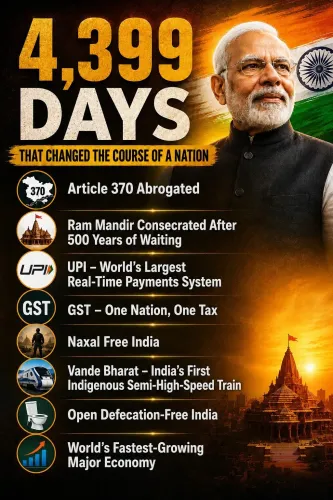
Goa Chief Minister Pramod Sawant praised PM Narendra Modi for three defining achievements of the BJP government: abrogating Article 370 in 2019, maintaining a firm anti-terror and anti-Naxal stance, and delivering the Ram Mandir in Ayodhya, calling them milestones that have reshaped India's national trajectory.
Key Takeaways
CM Pramod Sawant on 12 June 2026 publicly credited PM Narendra Modi with three landmark governance achievements.
Article 370 was abrogated by Parliament in August 2019 , reorganising Jammu and Kashmir into two Union Territories.
The Supreme Court cleared the path for the Ram Mandir in November 2019 ; the temple was inaugurated in January 2024 .
The central government intensified anti-Naxal and counter-terror operations after 2014 , reporting a sustained decline in extremist incidents.
The post was tagged #LongestServingElectedPMModi and #12YearsOfNariShakti , placing it within a BJP anniversary campaign.
Similar messaging from BJP state leaders around political anniversaries reflects a coordinated national party communication strategy.
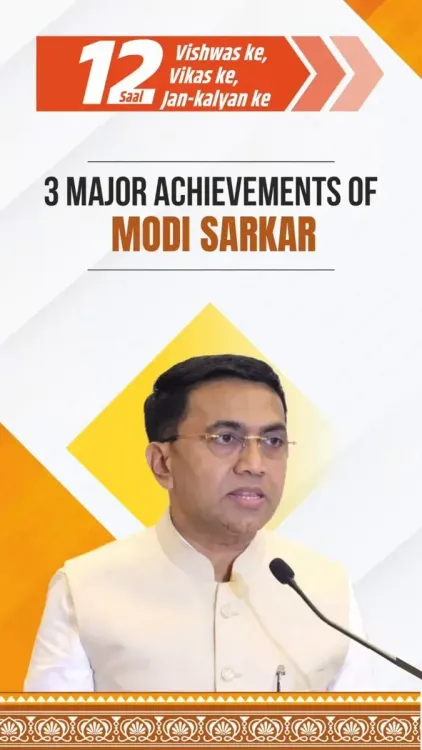
Goa Chief Minister Pramod Sawant on Friday, 12 June 2026 credited Prime Minister Narendra Modi with three landmark achievements — the abrogation of Article 370, a firm stand against terrorism and Naxalism, and the construction of the Ram Mandir — calling them historic developments that have reshaped India's trajectory.
Context
In a post on X, CM Sawant wrote that under Modi's 'visionary leadership', Bharat has witnessed 'three historic developments': the revocation of Article 370, an 'uncompromising stand against terrorism and Naxalism', and the 'realization of the long-cherished dream of the Ram Mandir.' The post carried the hashtags #LongestServingElectedPMModi and #12YearsOfNariShakti, situating the message within a broader BJP campaign marking 12 years of the Modi government.
The framing reflects a pattern seen across BJP-governed states, where chief ministers periodically amplify the central government's signature policy record, particularly around political anniversaries and campaign cycles.
Policy Backdrop
Article 370, which granted special constitutional status to Jammu and Kashmir, was abrogated by Parliament in August 2019. The state was simultaneously reorganised into two Union Territories — Jammu and Kashmir and Ladakh. The move was among the most consequential constitutional changes in independent India's history and remains a defining marker of the BJP's governance record.
On the Ram Mandir, the Supreme Court delivered its final verdict on the Ayodhya title dispute in November 2019, clearing the path for temple construction. The temple was inaugurated in January 2024, fulfilling a commitment the BJP had carried in its manifestos for decades. On internal security, the central government intensified coordinated anti-Naxal and counter-terror operations after 2014, including doctrinal shifts in how security forces engage in conflict zones.
Stakeholders and Impact
Residents of Jammu and Kashmir have seen significant administrative and developmental changes since the reorganisation, including direct central governance, altered land and domicile laws, and increased infrastructure investment. Security forces across Chhattisgarh, Jharkhand, and other Left Wing Extremism-affected states have operated under a more aggressive anti-Naxal posture, with the government reporting a steady decline in Naxal-related incidents over the past decade.
For Ayodhya and the broader Hindu community, the Ram Mandir's completion represented a cultural and religious milestone that drew millions of pilgrims. Critics and opposition parties have consistently challenged both the Article 370 abrogation and the temple's political symbolism, viewing them as moves that alter India's secular constitutional fabric.
What's Next
The BJP's messaging around these three achievements is expected to intensify as the party consolidates its political narrative heading into future electoral cycles. Further rollout of development and statehood-related legislation for Jammu and Kashmir remains on the parliamentary radar, as does any residual security legislation tied to the anti-Naxal campaign. CM Sawant's post signals that state-level BJP leaders will continue to anchor their public communication to the central government's record, reinforcing a unified party narrative on national integration and security.
Point of View
A security posture, and a religious-cultural project — into a single 'historic' frame, the messaging attempts to consolidate Hindu nationalist, nationalist, and security-conscious voter blocs simultaneously. The 12-year milestone framing is significant: it positions Modi not merely as a term-serving prime minister but as a transformative, long-tenure leader, a contrast the BJP draws sharply against the preceding decade. For Goa specifically, where the BJP holds power, such posts serve a dual function — local political signalling and national party solidarity.
NationPress
29 Jul 2026
Frequently Asked Questions
What are the three achievements CM Sawant credited to PM Modi?
CM Sawant credited PM Modi with the abrogation of Article 370 in August 2019, a firm stand against terrorism and Naxalism, and the construction and inauguration of the Ram Mandir in Ayodhya in January 2024.
When was Article 370 abrogated?
Article 370 was abrogated by Parliament in August 2019, after which Jammu and Kashmir was reorganised into two Union Territories — Jammu and Kashmir, and Ladakh.
When was the Ram Mandir inaugurated?
The Ram Mandir in Ayodhya was inaugurated in January 2024, following the Supreme Court's title verdict in November 2019 that cleared the way for its construction.
Why is CM Sawant posting about Modi's achievements?
The post is tagged with BJP anniversary hashtags marking 12 years of the Modi government, reflecting a coordinated party communication effort where state leaders amplify the Centre's policy record.
What is the BJP's stance on Naxalism and terrorism under Modi?
The BJP-led central government intensified coordinated anti-Naxal and counter-terror operations after 2014, including doctrinal changes in security policy, and has consistently presented this as a defining governance achievement.