CM Bhajan Lal marks 7 years of Article 370 abrogation
Synopsis
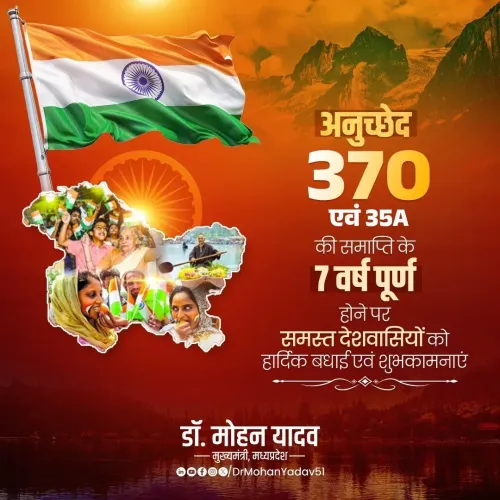
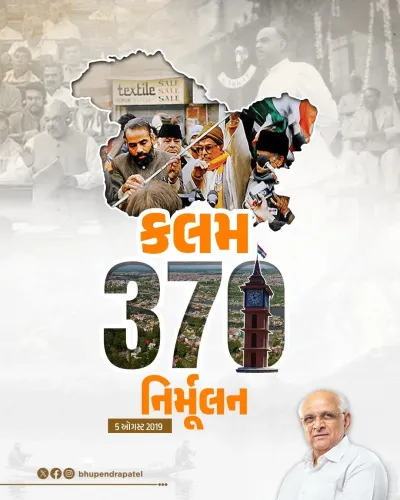
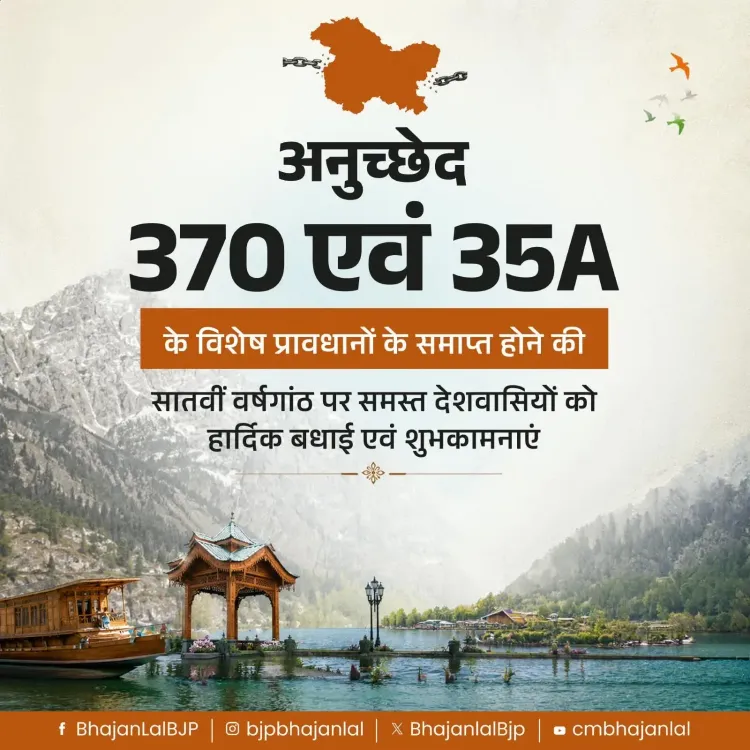
Rajasthan Chief Minister Bhajan Lal Sharma marked the seventh anniversary of the abrogation of Articles 370 and 35A on 5 August 2026, hailing PM Modi and Home Minister Amit Shah for the 2019 decision that bifurcated Jammu and Kashmir into two Union Territories.
Key Takeaways
5 August 2026 marks seven years since the abrogation of Articles 370 and 35A of the Indian Constitution.
Rajasthan CM Bhajan Lal Sharma credited PM Narendra Modi and Home Minister Amit Shah for the 2019 decision.
The Jammu and Kashmir Reorganisation Act, 2019 bifurcated the former state into two Union Territories: Jammu and Kashmir and Ladakh .
Abrogation of Article 370 had been a stated commitment in the BJP's 2014 and 2019 election manifestos.
Sharma framed the decision as foundational to good governance, development, peace, and equal rights in the region.
Seven years ago today, a single parliamentary decision redrew the constitutional map of India's northernmost frontier — and Rajasthan Chief Minister Bhajan Lal Sharma marked the anniversary on 5 August 2026 by saluting the architects of that moment.
In his post, Sharma credited Prime Minister Narendra Modi's 'visionary leadership' and Union Home Minister Amit Shah's 'firm resolve' for the abrogation of Articles 370 and 35A on 5 August 2019 — a decision he called the foundation of 'a new era of good governance, development, peace, and equal rights' in Jammu and Kashmir and Ladakh. He extended congratulations to all citizens on the completion of seven years of what he termed a historic verdict for national unity, integrity, and sovereignty.
What the 2019 decision actually changed
Article 370 had granted Jammu and Kashmir a distinct constitutional status since 1949 — its own constitution, a separate flag, and limits on how central laws applied within its borders. Article 35A, inserted by a presidential order in 1954, gave the state legislature the power to define 'permanent residents' and restrict property rights and government jobs for outsiders. Both provisions had been a fixture of BJP election manifestos since 2014.
On 5 August 2019, the Union government moved a presidential order to render Article 370 inoperative, followed immediately by the Jammu and Kashmir Reorganisation Act, 2019, which Parliament passed to bifurcate the state into two Union Territories: Jammu and Kashmir (with a legislature) and Ladakh (without one). The move brought both territories under the direct application of Indian law and central administrative oversight.
Six years of governance under the new framework
The reorganisation ushered in direct central rule over a region that had long been governed through special arrangements. Development schemes, infrastructure investment, and local body elections in the two Union Territories have since become the primary yardstick by which the government measures the decision's impact. The broader policy rationale — applying a uniform constitutional framework across all states and Union Territories — remains the BJP's stated argument for the move.
Anniversaries of the abrogation have become a regular moment for BJP leaders across the country to reaffirm the party's position on national integration. Sharma's post fits that pattern, linking the constitutional act to the larger themes of sovereignty and equal rights that the party has consistently foregrounded since 2019.
Seven years on, the question is no longer whether the change happened — it is what it has delivered on the ground in Srinagar, Jammu, and Leh.
Point of View
Not just a constitutional argument — and that record is increasingly the terrain on which the decision's legacy will be contested.
NationPress
19 Sept 2026
Frequently Asked Questions
What happened on 5 August 2019 in India?
On 5 August 2019 , the Indian government revoked the special constitutional status of Jammu and Kashmir by rendering Article 370 inoperative and abrogating Article 35A , then passed the Jammu and Kashmir Reorganisation Act to split the state into two Union Territories.
What was Article 370 and why was it removed?
Article 370 granted Jammu and Kashmir a special autonomous status, including its own constitution and limits on how central laws applied there. The BJP government removed it to apply a uniform constitutional framework across India, an objective the party had included in its election manifestos since 2014 .
What is Article 35A?
Article 35A , inserted via a presidential order in 1954 , empowered the Jammu and Kashmir legislature to define 'permanent residents' and restrict outsiders from buying property or holding government jobs. It was abrogated alongside Article 370 in August 2019 .
What did Bhajan Lal Sharma say about Article 370 anniversary?
Rajasthan CM Bhajan Lal Sharma posted on 5 August 2026 marking seven years of the abrogation, crediting PM Modi's visionary leadership and Amit Shah's resolve, and calling the decision the foundation of good governance, development, and equal rights in Jammu and Kashmir and Ladakh .
How many Union Territories were created after Article 370 was removed?
Two Union Territories were created: Jammu and Kashmir (with a legislature) and Ladakh (without a legislature), both carved out from the former state of Jammu and Kashmir under the Jammu and Kashmir Reorganisation Act, 2019 .