CM Mohan Yadav marks 7 years of Article 370 abrogation
Synopsis
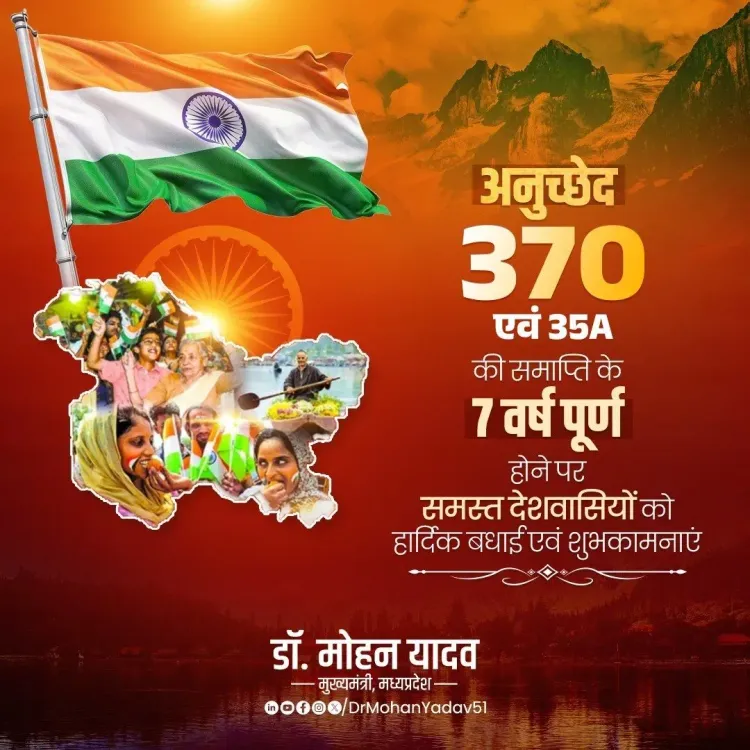
On the seventh anniversary of Article 370's abrogation, Madhya Pradesh CM Dr. Mohan Yadav praised PM Modi's 2019 decision to end J&K's special status, arguing it cemented constitutional equality and brought the region into India's mainstream development story.
Key Takeaways
August 5, 2026 marks the seventh anniversary of the abrogation of Article 370 and Article 35-A .
Mohan Yadav invoked the slogan 'Ek Vidhan, Ek Nishan, Ek Pradhan' to frame the decision as a milestone in national unity.
Article 370 had been a part of the Indian Constitution since 1950 as a temporary provision granting Jammu and Kashmir special status.
The 2019 abrogation reorganised the former state into two union territories: Jammu and Kashmir and Ladakh .
Yadav linked the decision to the BJP's 'Viksit Bharat' development agenda, citing J&K and Ladakh's integration into national schemes.
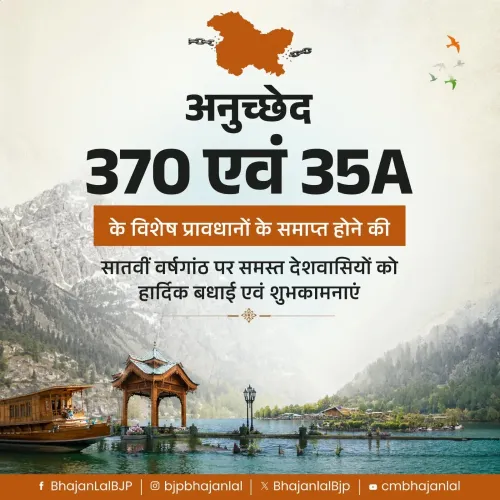
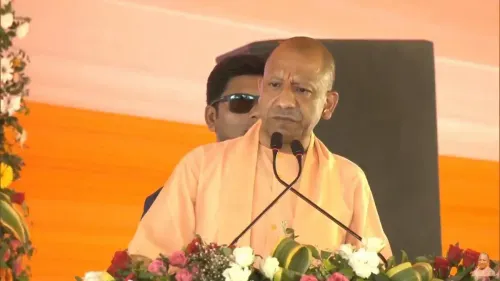
Seven years ago today, a constitutional provision that had defined Jammu and Kashmir's relationship with India for nearly seven decades was struck from the books — and Madhya Pradesh Chief Minister Dr. Mohan Yadav marked the anniversary on Wednesday, August 5, 2026, with a pointed tribute to the decision and its architect.
Invoking the slogan 'Ek Vidhan, Ek Nishan, Ek Pradhan' ('One Constitution, One Flag, One Prime Minister'), Dr. Yadav credited Prime Minister Narendra Modi's 'visionary leadership' for ending what he called the 'divisive arrangement' of Article 370 and Article 35-A on August 5, 2019. The move, he wrote, 'strengthened India's unity, integrity, and constitutional equality.'
What Article 370 actually did — and why its removal mattered
Article 370 had been embedded in the Indian Constitution since 1950 as a temporary provision, granting Jammu and Kashmir a distinct constitutional status: its own flag, a separate penal code, and restrictions on property ownership by outsiders. Article 35-A, inserted by a presidential order in 1954, further empowered the state legislature to define 'permanent residents' and reserve rights for them.
The Modi government's August 2019 move dissolved both provisions in a single parliamentary motion, simultaneously reorganising the former state into two centrally administered union territories — Jammu and Kashmir (with a legislature) and Ladakh (without one). The stated goal: uniform application of Indian law and direct federal oversight of development spending.
J&K and Ladakh in the 'Viksit Bharat' frame
Dr. Yadav's post situates the two union territories squarely inside the BJP's signature 'Viksit Bharat' ('Developed India') narrative, arguing that Jammu and Kashmir and Ladakh are now contributing 'with full capability and momentum' to national development. The framing is deliberate: it ties a landmark political decision to a forward-looking economic promise, not merely a historical milestone.
The assembly election in Jammu and Kashmir — the first since the reorganisation — has already been held, restoring an elected government to the territory. Implementation of centrally sponsored schemes and the pace of infrastructure investment in Ladakh remain closely watched benchmarks for whether the promise of 'mainstream development' is translating on the ground.
Six years on from the abrogation, the anniversary has become a fixed point in the BJP's political calendar — a moment to restate the argument that constitutional uniformity is inseparable from national integration. Dr. Yadav's tribute is one note in that annual chorus, but the real verdict is still being written in the valleys and high-altitude deserts of the two union territories.
Point of View
Framed around constitutional equality rather than security, signals the party's preferred register — developmental, not defensive. With an elected government now functioning in Jammu and Kashmir, the political argument has shifted from the act of abrogation to its fruits, placing governance delivery at the centre of the next phase of contestation. How the union territories perform on investment, employment, and democratic participation will increasingly determine whether the 2019 decision is remembered as transformation or transition.
NationPress
19 Sept 2026
Frequently Asked Questions
Why is August 5 significant for Jammu and Kashmir?
August 5, 2019 is the date the Indian Parliament abrogated Article 370 and Article 35-A , ending Jammu and Kashmir's special constitutional status and reorganising it into two union territories.
What was Article 370?
Article 370 was a temporary provision in the Indian Constitution, in place since 1950 , that granted Jammu and Kashmir a distinct status including its own constitution, flag, and restrictions on property ownership by non-residents.
What is Article 35-A?
Article 35-A was inserted into the Constitution by a presidential order in 1954 , empowering the Jammu and Kashmir legislature to define permanent residents and reserve certain rights exclusively for them. It was removed alongside Article 370 in 2019.
What happened to Jammu and Kashmir after Article 370 was removed?
The former state was bifurcated into two centrally administered union territories — Jammu and Kashmir , which has a legislature, and Ladakh , which is governed directly by the Centre without a legislature.
What did CM Mohan Yadav say about Article 370 abrogation?
Madhya Pradesh CM Dr. Mohan Yadav called the 2019 decision a historic step that strengthened India's unity, integrity, and constitutional equality, and said J&K and Ladakh are now contributing to the 'Viksit Bharat' vision with full momentum.