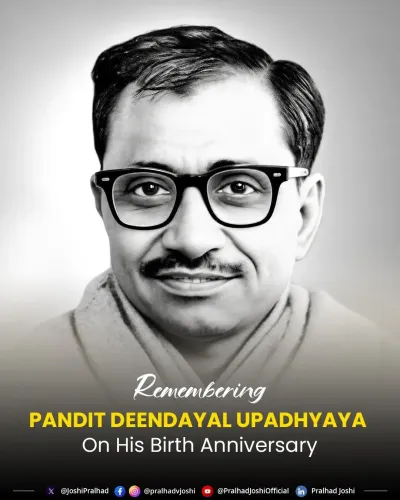
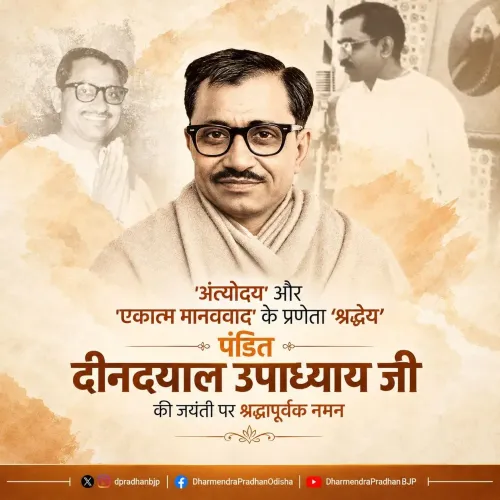
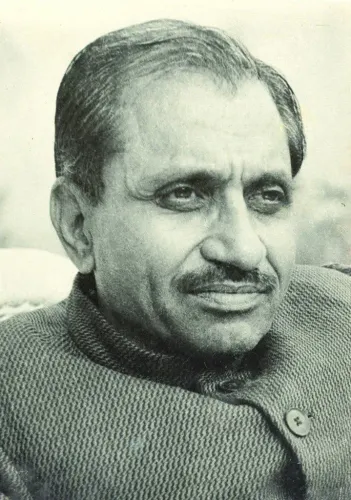
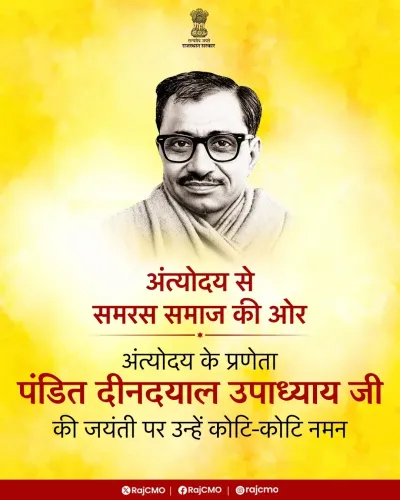
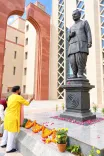
Rajnath Singh pays tribute to Deendayal Upadhyay on birth anniversary
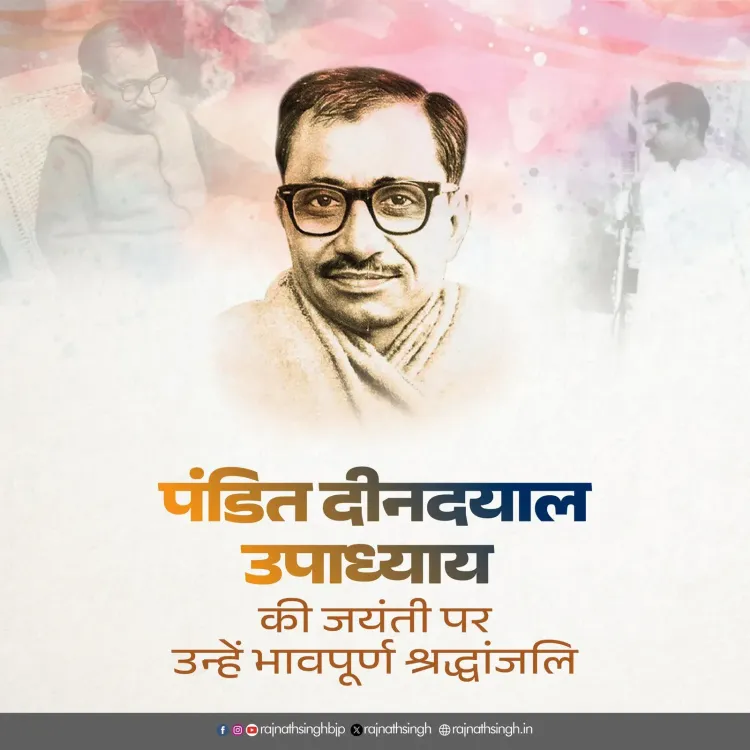
Synopsis
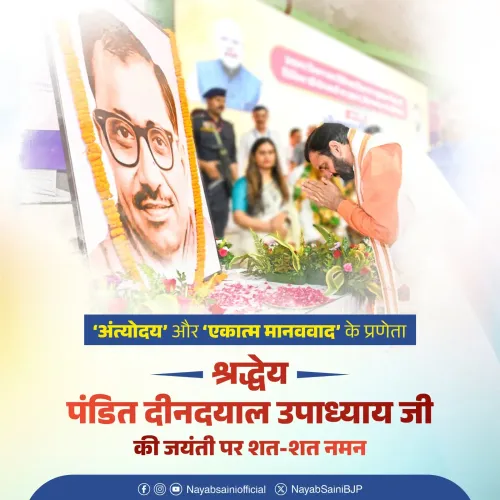
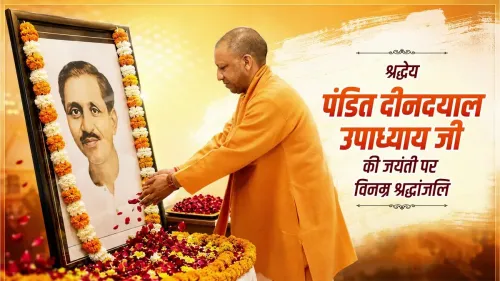
Union Defence Minister Rajnath Singh marked Pandit Deendayal Upadhyay's birth anniversary on 25 September 2026, paying tribute to the BJP's ideological founding figure and renewing commitment to his principles of Antyodaya and Integral Humanism.
Key Takeaways
Rajnath Singh posted a Hindi tribute to Pandit Deendayal Upadhyay on his birth anniversary, 25 September 2026 .
Upadhyay was co-founder of the Bharatiya Jana Sangh (founded 1951) , the ideological precursor to the BJP (founded 1980) .
Singh highlighted Upadhyay's twin philosophical pillars: Antyodaya (uplift of the last person in society) and Ekātma Mānavavāda (Integral Humanism).
The tribute described Upadhyay's life as an inspiring example of national service, simplicity, purity, and principled commitment.
Singh called on people to renew pledges of Antyodaya , national interest, and social service by internalising Upadhyay's ideals.
BJP leaders routinely mark 25 September to reaffirm the party's ideological connection to Upadhyay's foundational ideas.
On the birth anniversary of Pandit Deendayal Upadhyay, Union Defence Minister Rajnath Singh offered a respectful tribute on Friday, 25 September 2026, saluting the co-founder of the Bharatiya Jana Sangh as an enduring moral compass for the nation — and renewing a pledge to live by his principles of Antyodaya (uplift of the last person) and Ekātma Mānavavāda (Integral Humanism).
Singh's post, written in Hindi, opens with a bow of reverence — 'sādar naman' — before distilling what he called the defining pillars of Upadhyay's life: 'national service, simplicity, purity, and principled commitment.' The tribute frames Upadhyay not as a historical figure to be archived, but as a living instruction for how governance should feel — beginning, always, from the bottom up.
Antyodaya: the philosophy that still shapes BJP's welfare vocabulary
Pandit Deendayal Upadhyay was among the most consequential organisers and thinkers in post-independence Indian politics. He was a central force in the founding of the Bharatiya Jana Sangh in 1951, the party that would later transform into the Bharatiya Janata Party in 1980. The BJP formally adopted his concept of Integral Humanism as its core philosophy — a framework that argues for a distinctly Indian path to development, one that refuses to reduce the human being to either a unit of labour or a cog in an ideological machine.
His concept of Antyodaya — literally, 'rise of the last one' — insists that true development is only meaningful when it reaches the person standing at the very end of the social queue. Singh's tribute echoed that precise formulation: Upadhyay 'showed the way to carry development, opportunity, and dignity to the person standing on the last rung of society.'
A ritual of reaffirmation — and what it signals
BJP leaders mark 25 September each year with tributes that deliberately tie contemporary governance to Upadhyay's ideological foundations. The anniversary functions as a moment of ideological recalibration — a reminder to the party's vast cadre of the philosophical sources from which its welfare and social-justice arguments are drawn.
Singh closed his tribute with an explicit call to action: on this anniversary, let us 'resolve to further strengthen the commitment to Antyodaya, national interest, and social service by internalising his ideas and ideals.' That framing — tribute as a living pledge, not a museum visit — is characteristic of how the BJP uses Upadhyay's legacy as both a moral anchor and a forward-facing agenda.
Seven decades after he first mapped an alternative vision for India's development, Pandit Deendayal Upadhyay's ideas remain the language in which the ruling party articulates its most fundamental claims about who governance is ultimately for.
Point of View
Reminding the cadre and the public of the philosophical architecture that underpins the party's welfare language. By invoking Antyodaya specifically, Singh signals continuity between a 1950s thinker and contemporary schemes targeting marginalised communities, framing government welfare not as charity but as fulfilment of a founding moral contract. The consistency of this messaging across BJP's senior leadership over decades suggests Upadhyay's legacy functions as the party's most durable bridge between cultural nationalism and social-justice politics — a combination that remains electorally potent.
NationPress
25 Sept 2026
Frequently Asked Questions
Who is Pandit Deendayal Upadhyay and why is he important to the BJP?
Pandit Deendayal Upadhyay was a co-founder of the Bharatiya Jana Sangh in 1951 and the originator of 'Integral Humanism' and 'Antyodaya' — philosophies the BJP formally adopted as its core ideology when the party was founded in 1980. He is regarded as the BJP's foremost ideological mentor.
What is Antyodaya and who introduced the concept?
Antyodaya, meaning 'rise of the last one,' is a philosophy introduced by Pandit Deendayal Upadhyay that holds true development must begin with and reach the most marginalised person in society. It has since been used to frame multiple government welfare programmes.
What is Integral Humanism as propounded by Deendayal Upadhyay?
Integral Humanism is a philosophical framework articulated by Deendayal Upadhyay that advocates for a distinctly Indian model of development — one that balances the individual, society, nature, and the cosmos, rejecting both Western capitalism and Marxist materialism in favour of a holistic, culturally rooted approach.
When is Deendayal Upadhyay Jayanti celebrated?
Deendayal Upadhyay Jayanti is observed on 25 September each year, marking the birth anniversary of the BJP's founding ideological figure. BJP leaders and cadres across India mark the day with tributes and reaffirmations of his principles.
What did Rajnath Singh say about Deendayal Upadhyay on his 2026 birth anniversary?
Rajnath Singh paid tribute to Upadhyay as an inspiring example of national service, simplicity, purity, and principled commitment. He highlighted the concepts of Antyodaya and Integral Humanism, and called on people to renew their commitment to these ideals on the occasion.