Rajnath Singh: National Security Now Covers Cyber, Drones, Disinformation
Synopsis
Union Defence Minister Rajnath Singh declared on September 24, 2026 that national security in the 21st century extends beyond borders to cover cyber attacks, drones, disinformation, and economic and energy threats, committing to a holistic approach to make India's Armed Forces future-ready.
Key Takeaways
Defence Minister Rajnath Singh stated on September 24, 2026 that national security is no longer limited to border protection.
He identified cyber attacks, drones, disinformation, and economic and energy security as evolving, fluid threats demanding a new framework.
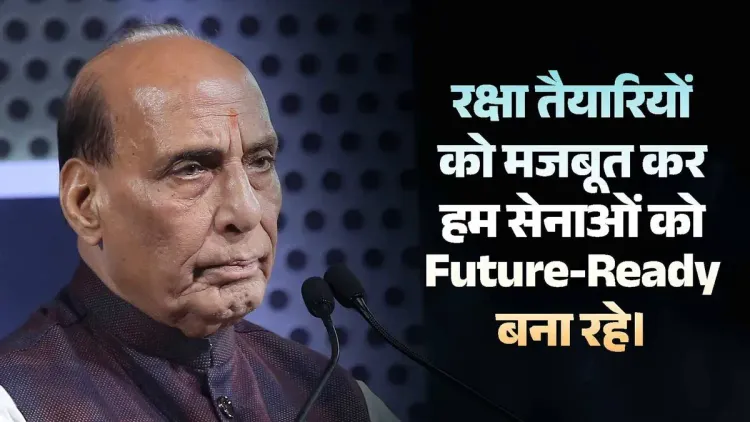
Singh said India is pursuing a holistic approach to defence preparedness to make the Armed Forces future-ready .
The Chief of Defence Staff post, created in December 2019 , and the Defence Cyber Agency represent earlier institutional steps toward multi-domain integration.
India's defence doctrine has been progressively expanding its security vocabulary beyond conventional warfare since at least 2018 .
Upcoming parliamentary debates on the defence budget and progress on theatre command integration will be key milestones to watch.
Borders are fixed — but threats are not. Union Defence Minister Rajnath Singh made that distinction sharply on Thursday, September 24, 2026, arguing that India's security calculus in the 21st century must stretch far beyond the physical frontier to encompass cyber warfare, drones, disinformation, and economic and energy vulnerabilities.
Posting in a blend of Hindi and English, Singh wrote: '21वीं सदी में नेशनल सिक्योरिटी का दायरा केवल सीमाओं की सुरक्षा तक सीमित नहीं है' — 'In the 21st century, the scope of national security is not limited to the protection of borders alone.' He added that threats linked to cyber attacks, drones, disinformation, and economic and energy security 'are constantly taking new forms,' and captured the essential tension in a single line: 'Borders are fixed, but the boundary of threats is now fluid.'
From a Single Line of Control to a Multi-Domain Battlespace
Singh's framing reflects a doctrinal shift that has been building inside India's defence establishment for nearly a decade. Successive defence budgets and policy statements since 2018 have pushed the language of 'technology absorption' and 'future-ready' force modernisation into official parlance. The creation of the Chief of Defence Staff post in December 2019 was a structural acknowledgment of that shift — a move designed to force greater jointness and integration across the Army, Navy, and Air Force as multi-domain operations become the norm rather than the exception. Around the same time, the Defence Cyber Agency was raised under the Integrated Defence Staff specifically to address threats to military networks — an early institutional signal that the government regarded cyberspace as a genuine battleground, not a peripheral concern.Why 'Fluid Threats' Demand a Holistic Doctrine
The minister's use of the phrase 'holistic approach' (holistik approach) is deliberately broad. Energy security and economic security — both cited explicitly in his post — sit at the intersection of foreign policy, trade, and military planning in ways that traditional defence doctrine rarely addressed. A disrupted energy supply chain or a targeted economic sanction can degrade a nation's warfighting capacity without a single shot fired. Singh's public articulation of these domains as security concerns signals that India's formal defence planning vocabulary is catching up with a reality that adversaries have long exploited. Drones, singled out alongside cyber attacks and disinformation, have moved from a surveillance curiosity to a decisive battlefield instrument — a lesson driven home by conflicts across multiple theatres in recent years. India's own experience along its northern borders has accelerated procurement and counter-drone doctrine development.Armed Forces and the 'Future-Ready' Mandate
Singh concluded his post with a direct statement of intent: the government is strengthening defence preparedness with a holistic approach and making the Armed Forces 'future-ready.' That phrase, repeated across ministerial statements and budget documents, now carries specific institutional weight — linked to theatre command integration, indigenous weapons development under Atmanirbhar Bharat defence goals, and the push to reduce import dependence in critical platforms. The next parliamentary debate on the defence budget and any formal rollout of integrated theatre commands will be the clearest test of whether this doctrinal vocabulary translates into structural and budgetary reality. In a world where a power grid can be brought down by code and public opinion shaped by algorithm, Singh's message is unambiguous: India's sentinels now stand watch on frontiers that have no coordinates on any map.Point of View
He is broadening the mandate under which the defence ministry can claim jurisdiction and resources. The timing matters: theatre command integration has faced institutional friction, and publicly anchoring the case for deeper reform in the language of 'fluid threats' builds political cover for difficult structural decisions. Whether the rhetoric is matched by concrete budget allocations or formal doctrinal updates will determine its lasting significance.
NationPress
24 Sept 2026
Frequently Asked Questions
What did Rajnath Singh say about national security in 2026?
Rajnath Singh stated that 21st-century national security extends beyond border protection to include cyber attacks, drones, disinformation, and economic and energy threats, saying threat boundaries are now 'fluid' even as physical borders remain fixed.
What is India's Defence Cyber Agency?
The Defence Cyber Agency was established in 2019 under the Integrated Defence Staff to counter cyber threats targeting Indian military networks, marking one of India's earliest formal institutional responses to cyber warfare.
What does 'future-ready Armed Forces' mean in India's defence policy?
'Future-ready Armed Forces' refers to India's goal of modernising military capabilities through technology absorption, indigenisation under Atmanirbhar Bharat, and eventual integration under theatre commands to conduct multi-domain operations.
Why did India create the Chief of Defence Staff post?
India created the Chief of Defence Staff post in December 2019 to improve jointness and integration across the Army, Navy, and Air Force, enabling a more coordinated response to both conventional and emerging multi-domain threats.
How has India's national security definition changed over time?
Since around 2018, India has progressively expanded its official security vocabulary beyond conventional border defence to include cyber, information, economic, and energy domains, reflected in successive defence budgets and doctrinal statements.