Rajnath Singh: Terrain, Tech & Thinking Drive Modern War
Synopsis
Defence Minister Rajnath Singh invoked the Three 'T' framework — Terrain, Technology, Thinking — to articulate India's expanding military posture across cyber, space, drone, and AI domains, signalling an accelerating multi-domain modernisation drive.
Key Takeaways
Three 'T' doctrine : Rajnath Singh articulated Terrain, Technology, and Thinking as the pillars of modern warfare on 24 September 2026 .
Singh named cyber and space as new frontlines alongside drone warfare and AI-based defence technology.
India established the Defence Cyber Agency and Defence Space Agency around 2018–2019 to address emerging-domain operations.
Indigenous drone and AI programmes form a core part of India's Aatmanirbhar Bharat defence self-reliance push.
The statement signals ongoing, accelerating capability-building ahead of future defence budget cycles and tri-service exercises.
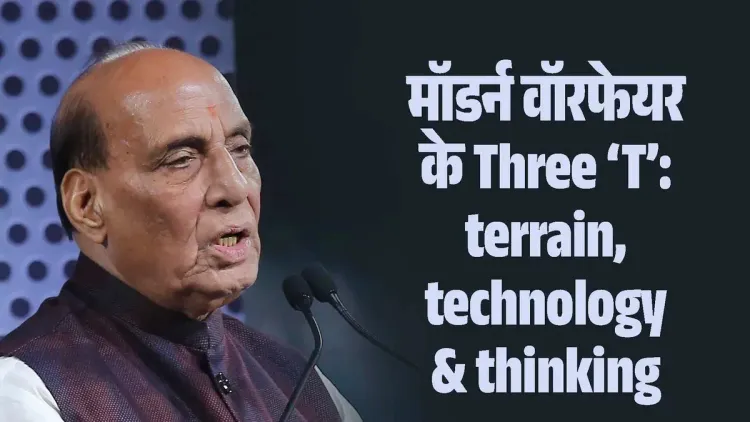
The battlefield has changed — and Union Defence Minister Rajnath Singh wants every Indian to understand exactly how. On Thursday, 24 September 2026, Singh posted a pointed doctrinal statement on X, framing India's military modernisation around what he called the Three 'T's of modern warfare: Terrain, Technology aur Thinking — Terrain, Technology, and Thinking.
The Three 'T' Framework Singh Is Pushing
Singh's formulation is not rhetoric — it is a doctrinal shorthand for how India's security establishment is recalibrating for the era of multi-domain conflict. Terrain, in the modern sense, now extends well beyond mountains and coastlines. Cyber and space are the new high ground, and Singh named both explicitly. Technology bridges the physical and digital — from precision drones to AI-based defence platforms. And Thinking points to the doctrinal agility that ties the two together.
The post states plainly: 'From new frontlines like cyber and space to drone warfare and AI-based defence technology, India is continuously strengthening its strategic capabilities.' Three domains. One sentence. A quiet signal that the transformation is already underway.
From Defence Cyber Agency to AI-Driven Platforms
The institutional foundations for this shift were laid years earlier. India stood up the Defence Cyber Agency and the Defence Space Agency around 2018–2019, carving out dedicated commands for domains that traditional service structures were never built to handle. Those agencies gave the armed forces a standing capability — and a mandate to grow it.
Drone warfare has since emerged as the sharpest edge of that mandate. Conflicts across the world have demonstrated how low-cost unmanned systems can reshape battlefield outcomes, and India's defence industry has accelerated indigenous development programmes in direct response. AI-driven logistics, surveillance analytics, and autonomous targeting decision-support are no longer distant ambitions — they are active acquisition and research priorities.
Why Singh's Signal Matters Right Now
A Defence Minister does not invoke a three-part doctrinal formula in a casual post. The emphasis on 'niranter mazboot' — continuously strengthening — frames modernisation as an ongoing, accelerating process, not a completed project. With upcoming defence budget cycles and tri-service exercises on the horizon, observers will watch closely for new programme announcements in AI, drone swarms, and expanded cyber-space command structures that operationalise exactly what Singh described.
India's broader strategic posture — managing a two-front neighbourhood while deepening defence-industrial self-reliance under the Aatmanirbhar Bharat push — makes the Three 'T' framing more than a slogan. It is the conceptual architecture for how the world's most populous democracy intends to fight, deter, and prevail in the conflicts that define the next decade.
Three T's. One direction. The clock is running.
Point of View
Behind-the-scenes transformation of India's armed forces. By naming cyber and space in the same breath as drones and AI, Singh aligns India rhetorically with the multi-domain operations concepts that major militaries have been racing to operationalise. The timing matters: articulating doctrine publicly builds domestic political support for defence spending and reinforces deterrence messaging to external audiences. Whether the institutional bandwidth — procurement pipelines, trained personnel, inter-agency coordination — matches the ambition is the test that the next budget cycle will begin to answer.
NationPress
25 Sept 2026
Frequently Asked Questions
What are the Three 'T's of modern warfare according to Rajnath Singh?
Rajnath Singh defined the Three 'T's as Terrain, Technology, and Thinking — a framework for understanding how modern warfare has evolved beyond conventional battlefields to include cyber, space, drones, and AI-driven systems.
What is India's Defence Cyber Agency?
The Defence Cyber Agency is a tri-service command established by India around 2018–2019 to conduct and coordinate cyber operations across the armed forces, representing India's first dedicated military cyber unit.
Is India developing its own drones for the military?
Yes. India has active indigenous drone development programmes under its Aatmanirbhar Bharat defence self-reliance push, accelerated by lessons from global conflicts that demonstrated the battlefield impact of unmanned systems.
How is AI being used in Indian defence?
India is integrating AI into areas such as surveillance analytics, logistics optimisation, and decision-support systems, with the Defence Space Agency and allied research bodies driving adoption alongside private and public sector defence manufacturers.
What is India's Defence Space Agency?
The Defence Space Agency, established around 2018–2019, is India's military body tasked with leveraging space assets for operational military purposes and protecting space-based capabilities from adversarial interference.