Rajnath Singh Links Maharana Pratap's Values to Modi's Vision
Synopsis
Union Defence Minister Rajnath Singh on 14 June 2026 honoured Maharana Pratap, praising the 16th-century Mewar ruler's caste-blind social cohesion and drawing a direct parallel to PM Narendra Modi's governing mantra of 'Sabka Saath, Sabka Vikas, Sabka Vishwas, Sabka Prayas.'
Key Takeaways
Union Defence Minister Rajnath Singh posted a tribute to Maharana Pratap on 14 June 2026 , praising his legacy of social unity.
Singh stated Maharana Pratap 'never discriminated on the basis of caste or creed' and worked to bind society together.
He drew an explicit parallel between Maharana Pratap's values and PM Narendra Modi 's four-part mantra: 'Sabka Saath, Sabka Vikas, Sabka Vishwas, Sabka Prayas.' The slogan was first introduced during the 2014 general election and expanded in subsequent years to include 'Sabka Vishwas' and 'Sabka Prayas.' BJP leaders have consistently cited Maharana Pratap as a symbol of inclusive nationalism and resistance to external domination since 2014 .
The tribute aligns with commemorative observances around Maharana Pratap Jayanti , which falls in the Hindu month of Jyeshtha.
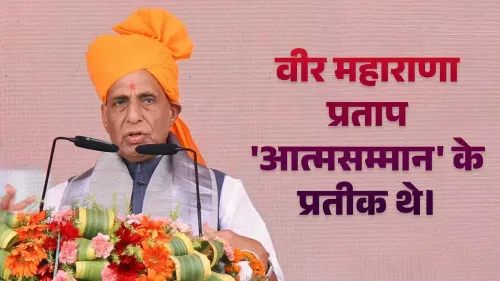
Union Defence Minister Rajnath Singh on Sunday, 14 June 2026, paid tribute to Maharana Pratap, drawing a direct line between the 16th-century Mewar ruler's ethos of social cohesion and Prime Minister Narendra Modi's governing philosophy of inclusive development.
What Singh Said
Posting in Hindi on X, Singh wrote that Maharana Pratap 'worked to bind society into a single thread' and 'never discriminated on the basis of caste or creed.' He added: 'उनके प्रति हमारी गहरी श्रद्धा है' ('We hold deep reverence for him.')
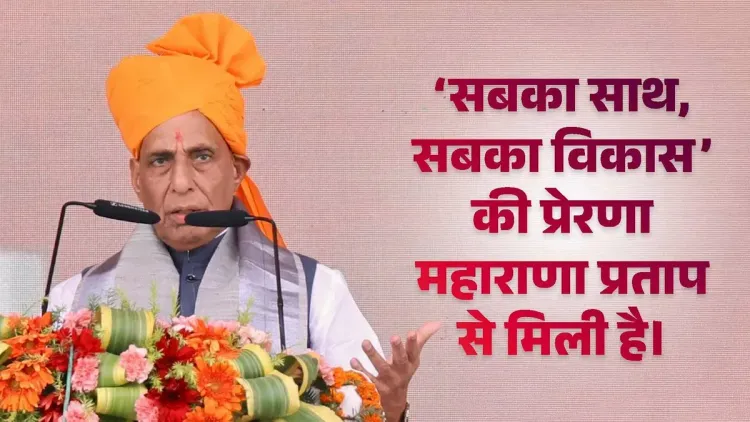
Singh then connected the medieval ruler's legacy to the present, saying that in Prime Minister Modi's mantra of 'Sabka Saath, Sabka Vikas, Sabka Vishwas, Sabka Prayas' (Together with all, development for all, trust of all, effort of all), 'we see the same harmony and inclusivity that is inspired by the life and values of Maharana Pratap.'
Context
Maharana Pratap, the 16th-century Rajput ruler of Mewar, is remembered in Indian historical tradition for his prolonged military resistance against Mughal forces and for governance that, according to traditional accounts, cut across caste and sectarian lines. He remains a towering symbol of valour and social solidarity in popular memory, particularly in Rajasthan and among Rajput communities across India.
Commemorative observances around Maharana Pratap Jayanti — his birth anniversary on the third day of the Hindu month of Jyeshtha — typically draw tributes from political leaders across the spectrum.
Policy Backdrop
The slogan 'Sabka Saath, Sabka Vikas' was introduced by Narendra Modi during the 2014 general-election campaign as the centrepiece of the BJP's inclusive-development messaging. It was subsequently expanded to 'Sabka Vishwas' in 2019 and 'Sabka Prayas' ahead of the 2021 Union Budget, forming a four-part governing mantra that the party consistently invokes to signal outreach beyond its traditional support base.
BJP leaders have routinely cited pre-modern martial figures such as Maharana Pratap to illustrate themes of social cohesion and resistance to external domination — a rhetorical pattern visible in public messaging since 2014 that seeks to project an inclusive national narrative while countering caste-centric political mobilisation.
Stakeholders and Impact
Singh's framing is directed at a broad audience: socially diverse communities across India who look to historical icons for identity anchoring, as well as voters in states such as Rajasthan and Uttar Pradesh where Maharana Pratap's legacy carries significant political resonance. By weaving together a medieval ruler's values and a contemporary governance slogan, the message reinforces the BJP's long-standing effort to position itself as the inheritor of an inclusive, civilisational nationalism.
What's Next
Commemorative events around Maharana Pratap Jayanti are likely to be accompanied by state-level programmes on social harmony and welfare, and similar tributes from BJP leaders at the national and state levels are expected. Singh's post signals that the party intends to keep the Maharana Pratap legacy central to its inclusive-nationalism narrative as it approaches future electoral cycles.
Point of View
Singh reinforces the party's effort to occupy the ideological space of social harmony without conceding ground to caste-based opposition narratives. The timing around Maharana Pratap Jayanti ensures maximum resonance in electorally significant states like Rajasthan and Uttar Pradesh. It is a carefully calibrated message that is simultaneously historical tribute, ideological positioning, and electoral outreach.
NationPress
15 Sept 2026
Frequently Asked Questions
Why did Rajnath Singh post about Maharana Pratap?
Rajnath Singh posted a tribute to Maharana Pratap on 14 June 2026, likely in connection with commemorative observances around Maharana Pratap Jayanti, praising the ruler's legacy of social cohesion and linking it to PM Modi's inclusive-development mantra.
What is the 'Sabka Saath, Sabka Vikas' mantra?
'Sabka Saath, Sabka Vikas' means 'Together with all, development for all.' Introduced by PM Narendra Modi during the 2014 election campaign, it was later expanded to include 'Sabka Vishwas' (trust of all) and 'Sabka Prayas' (effort of all) to form the BJP government's four-part governing philosophy.
Who was Maharana Pratap?
Maharana Pratap was a 16th-century Rajput ruler of Mewar, remembered for his military resistance against Mughal forces and for governance that traditional accounts describe as transcending caste and sectarian divisions. He is a revered historical figure, especially in Rajasthan.
What is Maharana Pratap Jayanti?
Maharana Pratap Jayanti is the birth anniversary of Maharana Pratap, observed on the third day of the Hindu month of Jyeshtha. It is marked by tributes and commemorative events across India, particularly in Rajasthan and Uttar Pradesh.
How does the BJP use Maharana Pratap in its political messaging?
BJP leaders have consistently cited Maharana Pratap since 2014 to illustrate themes of social cohesion, inclusive nationalism, and resistance to external domination, using his legacy to project the party as the inheritor of a civilisational, caste-transcending tradition.