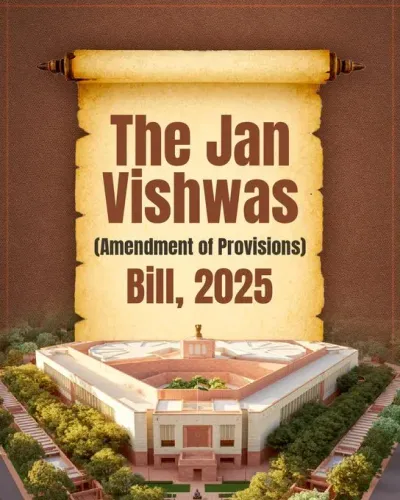
Rajya Sabha Approves Jan Vishwas Bill; Women's Reservation Act to be Discussed on April 16
Synopsis
In a landmark decision, the Rajya Sabha has passed the Jan Vishwas Bill aimed at simplifying regulations in India. The upcoming session on April 16 will focus on the Women’s Reservation Act, highlighting the government's commitment to women's empowerment.
Key Takeaways
Jan Vishwas Bill passed by Rajya Sabha to simplify legal frameworks.
Seeks to amend 79 central Acts for better governance.
Focus on decriminalising 717 provisions to ease citizen burdens.
Women’s Reservation Act discussion scheduled for April 16.
Government aims for 33% reservation for women in politics.
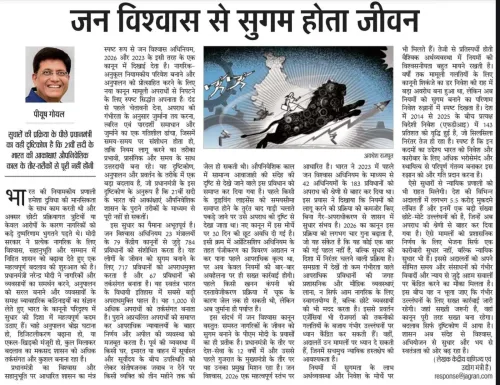
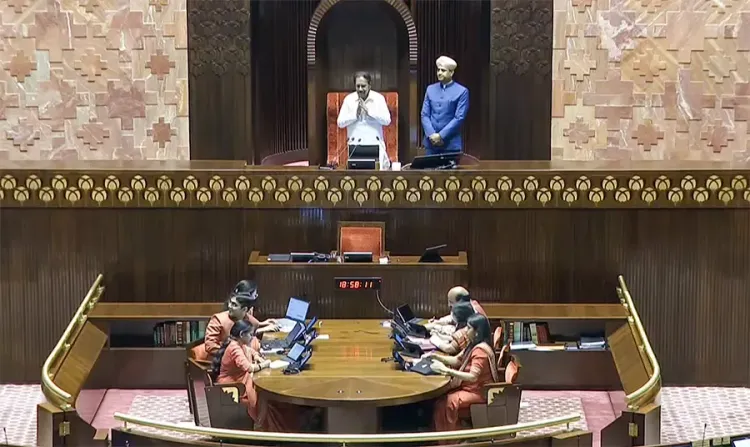
New Delhi, April 2 (NationPress) In a pivotal move for Indian legislation, the Rajya Sabha on Thursday approved the Jan Vishwas (Amendment of Provisions) Bill, 2026, through a voice vote, representing a significant advancement in the simplification of regulations aimed at enhancing both the ease of doing business and the quality of life for citizens in India.
This legislative proposal aims to modify 79 central Acts overseen by 23 Ministries. Of the 784 provisions slated for revision, 717 will be decriminalised, alleviating unnecessary criminal liabilities on individuals and businesses, while 67 provisions will be altered to enhance ease of living.
The Bill also strives to streamline over 1,000 offences by eliminating outdated and unnecessary regulations, thus fostering a more business-friendly and citizen-focused regulatory landscape.
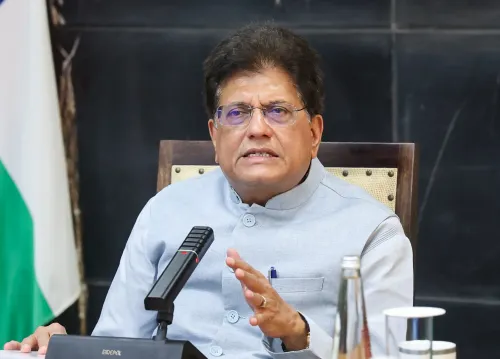
During the debate, Union Minister Piyush Goyal passionately defended the legislation. “This Bill will benefit the general populace, Micro, Small, and Medium Enterprises (MSMEs), and sectors like animal husbandry,” he asserted.
Goyal articulated that the government is addressing flaws in the previous version. “The penalties in the earlier draft were unjust in several instances. We have sought to rectify this by adjusting them where necessary.”
He further noted, “Historically, the mindset was to punish indiscriminately. In Indian culture, governance should be founded on trust, not suspicion. This Bill transitions from dand (punishment) to nyay (justice). Minor errors should not warrant criminal prosecution.”
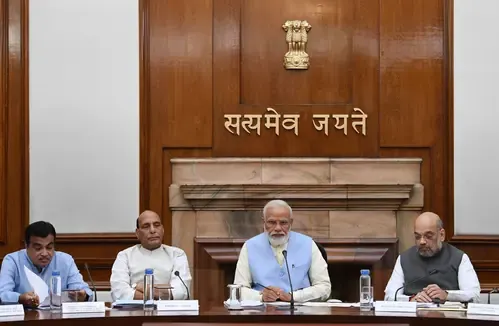
The approval of the Jan Vishwas Bill arrived on the concluding scheduled day of the Budget Session. Nevertheless, the government has decided to keep the House in session.
Parliamentary Affairs Minister Kiren Rijiju announced that the Rajya Sabha will reconvene on April 16, 2026, for a brief but vital session.
The primary focus during this reconvened session will be to deliberate on proposed amendments to the Women’s Reservation Act, 2023 (Nari Shakti Vandan Adhiniyam), formally known as the Constitution (One Hundred and Sixth Amendment) Act.
The government aspires to hasten the implementation of the groundbreaking 33 percent reservation for women in the Lok Sabha and State Assemblies.
Opposition parties, such as Congress and AITC, have accused the government of expediting this process for electoral advantage. AITC MP Mohammad Nadimul Haque criticized the Jan Vishwas Bill during the debate, stating, “One-fourth of India's population survives on less than Rs 171 per day. Who does this Jan Vishwas Bill truly serve? If the government wishes to learn about fostering a business-friendly environment, we invite them to Bengal.”
Haque showcased West Bengal’s accomplishments: “In the past 14 years, registered companies have surged by 83 percent. Approximately 93 lakh MSMEs thrive in Bengal. Over one-third of female entrepreneurs in India hail from Bengal.”
Congress leaders have also voiced concerns that substituting imprisonment with fines in numerous provisions could undermine accountability.
One senior Congress MP remarked during the debate, “By replacing criminal liability with fines, the government is crafting a system where violations can simply be financially settled, diminishing judicial oversight.”
However, the government contends that the Bill introduces tiered penalties, offers warnings for first-time offences, and adopts a trust-based approach without compromising on serious violations.
The forthcoming discussion regarding the amendments to the Women’s Reservation Act is anticipated to be vigorous, with opposition parties requesting an all-party meeting following the conclusion of the ongoing Assembly elections. The government has already consulted nearly 80 percent of political parties.
With the Jan Vishwas Bill now approved by both Houses, it awaits the President’s assent. The reconvening of Parliament on April 16 reflects the government’s urgency to propel essential reforms in women’s empowerment and regulatory simplification ahead of the next major electoral cycle.
Frequently Asked Questions
What is the Jan Vishwas Bill?
The Jan Vishwas Bill aims to amend 79 central Acts to simplify regulations and reduce unnecessary criminal liability on citizens and businesses.
When will the Rajya Sabha reconvene?
The Rajya Sabha will reconvene on April 16, 2026, to discuss proposed amendments to the Women’s Reservation Act.
What are the implications of the Women’s Reservation Act?
The Women’s Reservation Act aims to provide 33 percent reservation for women in the Lok Sabha and State Assemblies, enhancing women's political participation.
What criticisms have been raised about the Jan Vishwas Bill?
Opposition parties have criticized the Bill for potentially compromising accountability by replacing imprisonment with fines.
What is the government's response to the criticisms?
The government argues that the Bill introduces graded penalties and a trust-based approach without diluting serious offences.