Rijiju backs Pralhad Joshi on 70% university growth since 2014
Synopsis
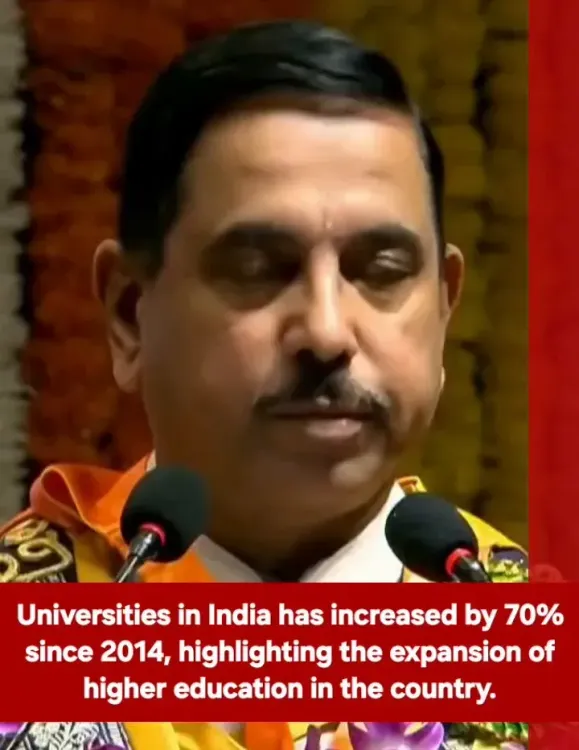
Union Minister Kiren Rijiju amplified Education Minister Pralhad Joshi's statement on August 8, 2026, citing a 70% rise in Indian universities since 2014 — a figure the government presents as evidence of higher education expansion under the NEP 2020 framework.
Key Takeaways
Union Parliamentary Affairs Minister Kiren Rijiju shared a post on August 8, 2026 backing Education Minister Pralhad Joshi .
The government claims a 70% increase in the number of universities in India since 2014 .
Joshi's statement was framed as a clarification, suggesting it was a rebuttal to criticism of the government's education record.
The National Education Policy 2020 targets a Gross Enrolment Ratio of 50% in higher education by 2035 , with institutional expansion as a key lever.
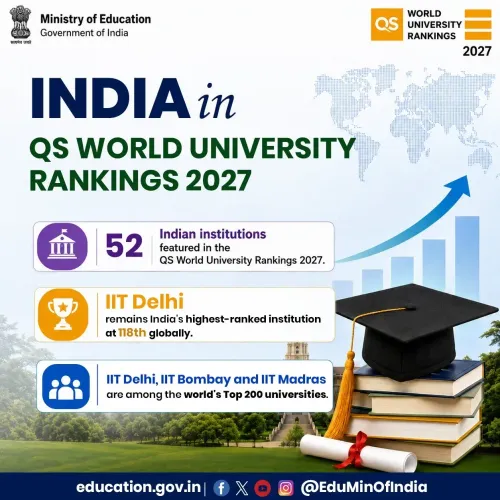
University quality, faculty strength, and accreditation remain open questions beyond the raw count of institutions.
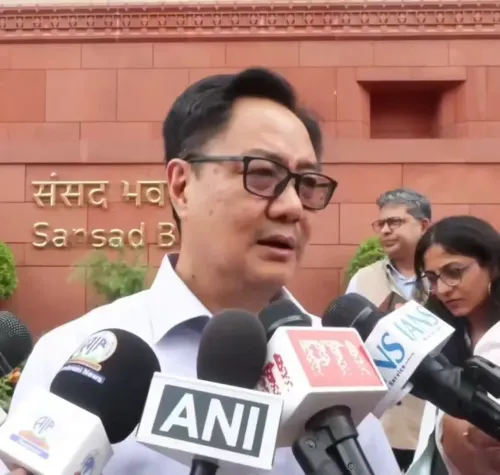
India's higher education landscape has been reshaped dramatically over the past decade — and Union Parliamentary Affairs Minister Kiren Rijiju wants that story told clearly. On Saturday, August 8, 2026, Rijiju took to X to amplify a clarification from Education Minister Pralhad Joshi, pointing to a 70% increase in the number of universities across India since 2014.
Rijiju's post was direct: 'Education Minister Pralhad Joshi Ji made the record straight. The number of Universities in India has increased by 70% since 2014, highlighting the expansion of higher education in the country.'
What a 70% rise in universities actually means
A 70% jump in university count over roughly a decade is not a routine administrative footnote — it represents hundreds of new institutions, spanning central universities, state universities, deemed universities, and private universities. For millions of students, particularly those from smaller towns and rural districts, proximity to a university is often the single biggest determinant of whether they pursue higher education at all. More campuses, in principle, means more access. The figure also feeds into a metric the government has consistently spotlighted: the Gross Enrolment Ratio (GER) in higher education, which the National Education Policy 2020 set an ambitious target to raise to 50% by 2035. Expanding the physical infrastructure of universities is one of the foundational steps toward that goal.Pralhad Joshi's clarification and the political context
The framing — 'made the record straight' — signals that Joshi's statement was a rebuttal, likely in response to opposition claims or media scrutiny questioning the government's education record. Rijiju, by amplifying it, is lending the weight of the parliamentary affairs portfolio to the defence of that record. This is a well-worn pattern in the BJP's communication playbook: senior ministers cross-amplify data points to reinforce a unified narrative of governance delivery since 2014 — the year the party came to power under Prime Minister Narendra Modi. Education expansion, alongside infrastructure and welfare schemes, is a pillar of that narrative heading into any political cycle. The University Grants Commission (UGC) and the Ministry of Education periodically publish data on institutional growth, and parliamentary questions on university numbers have become a regular feature of budget and winter sessions — making Joshi's clarification likely a response to one such exchange. The real test of that 70% figure, however, lies not just in the count of institutions but in their quality, faculty strength, research output, and accreditation status — dimensions that a single statistic cannot capture, and that opposition benches and education researchers are certain to press on next.Point of View
Not just promoting. Framing it as 'setting the record straight' suggests the opposition has succeeded in putting the government on the back foot on education metrics, prompting a coordinated ministerial response. The 70% figure, if substantiated by UGC data, is a genuinely significant infrastructure milestone; the political challenge for the government is that quantity alone does not satisfy an electorate increasingly focused on employability and institutional quality. How the opposition responds — and whether they contest the raw number or shift to quality metrics — will define the next round of this debate.
NationPress
23 Sept 2026
Frequently Asked Questions
How many universities are there in India in 2026?
The government claims India's university count has risen by 70% since 2014, though the exact current figure would be confirmed in the latest UGC or Ministry of Education annual report.
What did Pralhad Joshi say about universities in India?
Education Minister Pralhad Joshi stated that the number of universities in India increased by 70% since 2014, presenting it as evidence of the government's expansion of higher education infrastructure.
Why did Kiren Rijiju post about university growth?
Rijiju shared Pralhad Joshi's clarification to amplify the government's record on higher education expansion, framing it as correcting the narrative on India's university growth since 2014.
What is India's target for higher education enrolment?
The National Education Policy 2020 sets a target of achieving a Gross Enrolment Ratio of 50% in higher education by 2035, with institutional expansion being a key part of the strategy.
Has the number of universities in India really increased by 70% since 2014?
The 70% figure was cited by Education Minister Pralhad Joshi and amplified by Minister Kiren Rijiju; the authoritative source for verification is the UGC's published institutional data and Ministry of Education annual reports.