Rijiju: Lok Sabha passes exam paper leak amendment bill
Synopsis
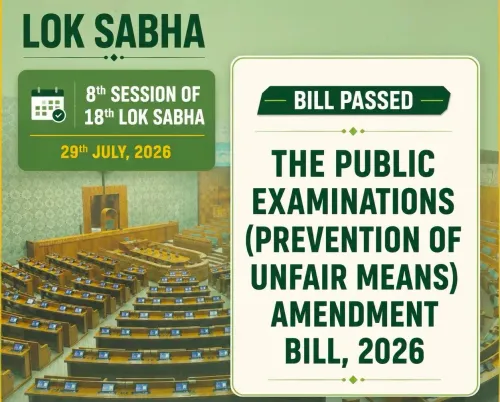
The Lok Sabha has passed the Public Examinations (Prevention of Unfair Means) Amendment Bill, 2026, introducing Special Fast-Track Courts, time-bound investigations, and an expedited appellate mechanism to combat paper leak syndicates. Union Minister Kiren Rijiju called it an iron-clad assurance to millions of competitive exam aspirants.
Key Takeaways
The Lok Sabha passed the Public Examinations (Prevention of Unfair Means) Amendment Bill, 2026 on 30 July 2026 .
The bill introduces Special Fast-Track Courts exclusively for public examination fraud cases.
It mandates time-bound investigations and an expedited appellate mechanism to prevent procedural delays.
The legislation amends the Public Examinations (Prevention of Unfair Means) Act, 2024 , which was enacted after the NEET and UGC-NET paper leak controversies.
The bill must still pass the Rajya Sabha before it becomes law.
Union Minister Kiren Rijiju said the government guarantees that 'your future will not be held hostage to fraud.'
Millions of students who have sat through all-night preparation sessions — only to watch their futures derailed by organised paper leak syndicates — got a direct message from Parliament on Thursday, 30 July 2026. Union Parliamentary Affairs Minister Kiren Rijiju announced that the Lok Sabha has passed the Public Examinations (Prevention of Unfair Means) Amendment Bill, 2026, promising swift justice and no refuge for those who profit by stealing students' futures.
What the amendment adds to the 2024 law
The original Public Examinations (Prevention of Unfair Means) Act, 2024 was Parliament's first direct legislative response to a cascade of paper leak scandals — including controversies surrounding NEET and UGC-NET — that shook public confidence in merit-based selection. The 2026 amendment sharpens that framework with three concrete mechanisms: Special Fast-Track Courts dedicated to exam fraud cases, time-bound investigations to prevent cases from languishing, and an expedited appellate mechanism so that even the appeals process cannot be weaponised as a delay tactic.
Rijiju framed the legislation in unambiguous terms: 'Those who attempt to profit by stealing the future of our students will be identified, investigated and brought to justice. There will be no refuge for those who undermine merit and betray the trust of millions of young aspirants.'
The paper leak crisis that made this bill necessary
The urgency behind the amendment is rooted in a damaging pattern that peaked through 2024. High-stakes examinations — the gateway to government jobs and coveted professional seats for crores of aspirants — were repeatedly compromised by organised syndicates that obtained and sold question papers before exam day. The fallout was not merely administrative; it triggered nationwide student protests and a crisis of faith in the very idea that hard work translates into results. The 2024 Act introduced stringent penalties, but critics and affected students argued that enforcement machinery — fast courts, defined investigation timelines — remained the missing piece.
The 2026 amendment is Parliament's answer to that gap, pairing the punitive power of the existing law with institutional speed.
Rijiju's assurance and what comes next
Invoking Prime Minister Narendra Modi's leadership, Rijiju delivered what he called 'a strong assurance to every young aspirant: your hard work will be protected, your merit will be respected and your future will not be held hostage to fraud.' The bill now moves to the Rajya Sabha, where its passage will be the next critical test. After that, the pace at which the government designates and operationalises the Special Fast-Track Courts will determine whether the law's promise translates into felt accountability on the ground.
For the student sitting her next competitive exam, that clock has already started.
Point of View
The government is betting that visible procedural speed will do what penalty clauses alone could not: rebuild aspirant trust before the next election cycle. For the BJP, which absorbed significant political damage from the NEET controversy, this is also a reputational repair exercise dressed as reform. The Rajya Sabha passage and the actual operationalisation of designated courts will be the real test of whether the legislative momentum survives contact with implementation.
NationPress
30 Jul 2026
Frequently Asked Questions
What is the Public Examinations Amendment Bill 2026?
It is an amendment to the Public Examinations (Prevention of Unfair Means) Act, 2024, passed by the Lok Sabha on 30 July 2026. It adds Special Fast-Track Courts, time-bound investigations, and an expedited appellate mechanism to tackle paper leak syndicates more swiftly.
What are Special Fast-Track Courts for exam fraud?
These are dedicated courts proposed under the 2026 amendment to hear cases of public examination fraud exclusively, ensuring that trials and appeals are completed within defined timelines rather than dragging on for years.
What was the original Public Examinations Act 2024 about?
The Public Examinations (Prevention of Unfair Means) Act, 2024 was Parliament's first standalone law targeting malpractice in public exams such as NEET and UGC-NET. It introduced criminal penalties for paper leaks and organised cheating syndicates.
Has the exam paper leak bill become law yet?
Not yet. The Lok Sabha passed the bill on 30 July 2026, but it must also clear the Rajya Sabha and receive Presidential assent before it becomes enforceable law.
What exams does the paper leak law cover?
The law covers public examinations conducted by central recruitment and examination bodies, which includes competitive entrance tests and government job recruitment exams such as NEET, UGC-NET, and similar high-stakes national exams.