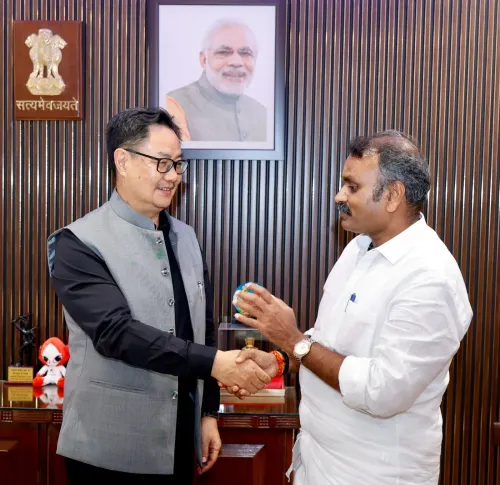
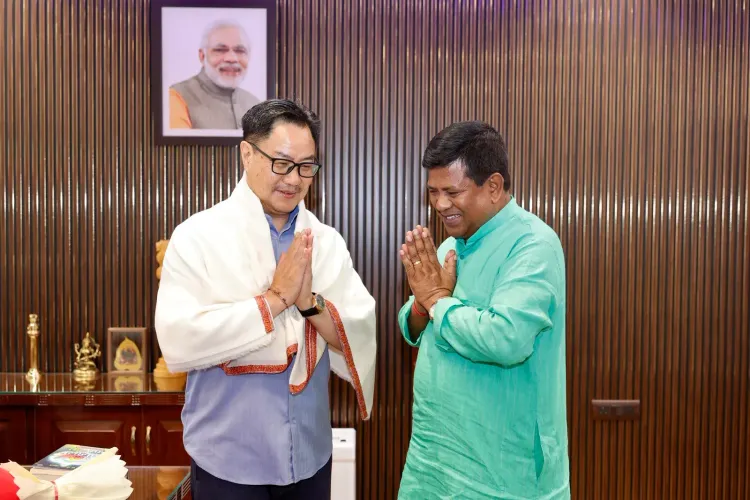
Rijiju meets West Bengal Assembly Speaker in New Delhi
Synopsis
Union Parliamentary Affairs Minister Kiren Rijiju hosted the Speaker and Principal Secretary of the West Bengal Legislative Assembly at his New Delhi residence on June 7, 2026, for discussions on parliamentary traditions, governance, and democratic processes — continuing a pattern of centre-state legislative outreach.
Key Takeaways
Kiren Rijiju , Union Minister of Parliamentary Affairs, met the West Bengal Legislative Assembly Speaker at his New Delhi residence on June 7, 2026 .
Soumendra Nath Das , Principal Secretary of the West Bengal Legislative Assembly, was also present at the meeting.
Discussions covered parliamentary traditions, governance, and strengthening democratic processes .
The meeting reflects routine centre-state coordination between the Union parliamentary affairs ministry and state legislatures.
Possible follow-up actions include joint training programmes or delegation visits between the Lok Sabha Secretariat and the West Bengal assembly.
Union Parliamentary Affairs Minister Kiren Rijiju met the Speaker of the West Bengal Legislative Assembly, Shri Biman Banerjee (referred to in the post as @rathindraOFC), at his residence in New Delhi on Sunday, June 7, 2026. Soumendra Nath Das, Principal Secretary of the West Bengal Legislative Assembly, also attended the meeting. The discussion centred on parliamentary traditions, governance, and strengthening democratic processes.
Context
Rijiju posted on X that the meeting was 'an engaging discussion on parliamentary traditions, governance and strengthening democratic processes.' The presence of the Principal Secretary alongside the Speaker indicates the exchange was substantive and institutional in character, rather than a purely ceremonial call. The meeting took place at the minister's official residence in the national capital.
Policy Backdrop
Meetings between the Union Minister for Parliamentary Affairs and presiding officers of state legislatures are a recognised feature of India's federal parliamentary architecture. Such engagements typically cover procedural norms, legislative best practices, and institutional capacity-building. Rijiju has held multiple similar consultations with state assembly representatives since taking charge of the parliamentary affairs portfolio, reflecting a broader pattern of centre-state coordination on legislative matters.
The West Bengal Legislative Assembly is the unicameral legislature of the state, responsible for all state-level lawmaking. Coordination between the assembly secretariat and the Union government's parliamentary affairs ministry can facilitate joint training programmes, exchange of procedural knowledge, and alignment on constitutional practices.
Stakeholders and Impact
State legislators, assembly secretariat officials, and parliamentary staff in West Bengal stand to benefit most directly from any follow-up initiatives arising from this engagement. Strengthening institutional knowledge at the state assembly level has downstream effects on the quality of legislative debate, committee functioning, and procedural compliance. Such bilateral exchanges also reinforce the principle that parliamentary democracy is a shared responsibility across the Union and state tiers of government.
For Rijiju, the meeting continues a pattern of outreach across party lines — the West Bengal Assembly is presided over by a Speaker from a political formation different from the ruling alliance at the Centre — signalling that the parliamentary affairs ministry treats these engagements as non-partisan institutional exercises.
What's Next
Observers will watch for any follow-up parliamentary delegation visits or joint capacity-building programmes between the Lok Sabha Secretariat and the West Bengal Legislative Assembly. Formal outcomes such as memoranda of cooperation or scheduled training workshops would indicate the meeting moved beyond a courtesy exchange. The ministry's engagement calendar with other state assemblies will also signal whether this forms part of a structured national outreach drive.
Point of View
Despite the two sides belonging to opposing political formations, underscores that the parliamentary affairs ministry operates on an institutionally neutral footing when it comes to state legislature engagement. This is consistent with the ministry's broader mandate to serve as a bridge between the Union executive and legislatures at all levels. The inclusion of the Principal Secretary signals that any outcomes may have an administrative and procedural dimension, not merely a political one. Sustained engagement of this kind, if it leads to structured capacity-building initiatives, could meaningfully improve legislative quality in state assemblies across India.
NationPress
22 Oct 2026
Frequently Asked Questions
Why did Kiren Rijiju meet the West Bengal Assembly Speaker?
Rijiju met the West Bengal Legislative Assembly Speaker at his New Delhi residence on June 7, 2026 to discuss parliamentary traditions, governance, and ways to strengthen democratic processes — part of the Parliamentary Affairs Ministry's routine engagement with state legislatures.
Who is Kiren Rijiju?
Kiren Rijiju is a senior BJP leader from Arunachal Pradesh who serves as Union Minister of Parliamentary Affairs and Minister of Minority Affairs in the central government.
What is the role of the Union Minister of Parliamentary Affairs?
The Union Minister of Parliamentary Affairs coordinates government business in Parliament, liaises between the executive and legislature, and engages with state legislative bodies to promote parliamentary best practices across India's federal structure.
What could come out of the Rijiju-West Bengal Speaker meeting?
Potential follow-up actions include joint training programmes for legislative staff, exchange of procedural best practices, or delegation visits between the Lok Sabha Secretariat and the West Bengal Legislative Assembly.
Is it unusual for the Parliamentary Affairs Minister to meet state assembly speakers?
No. Such meetings are a regular feature of India's federal parliamentary system. The Union Parliamentary Affairs Minister has held similar engagements with presiding officers from multiple states to foster institutional coordination.