RSS chief Mohan Bhagwat's Vijayadashami 2026 address: Swadeshi, unity, and centenary report
Synopsis
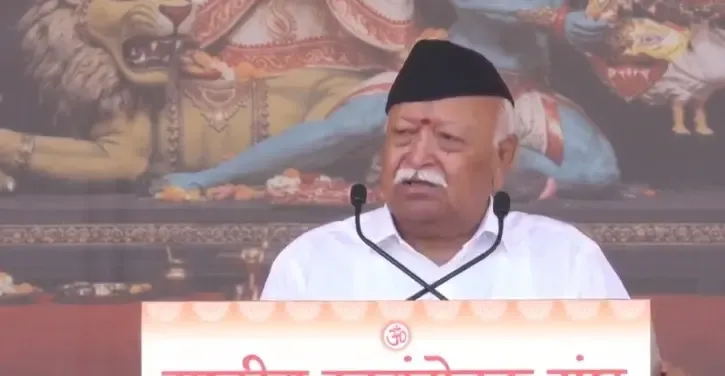
RSS chief Mohan Bhagwat used his annual Vijayadashami address in Nagpur to close the organisation's centenary year with a sweeping agenda: self-awareness, Swadeshi, social harmony, and a warning that Panch Parivartan must become habit, not headline. He also revealed that the centenary outreach touched over 10 crore households — a scale of grassroots mobilisation few organisations can claim.
Key Takeaways
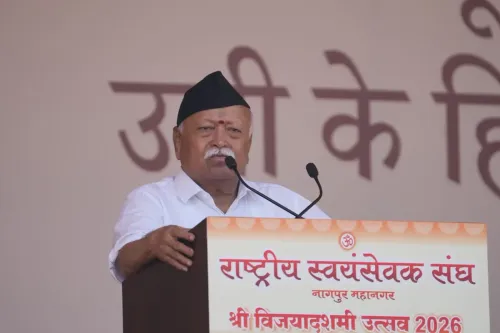
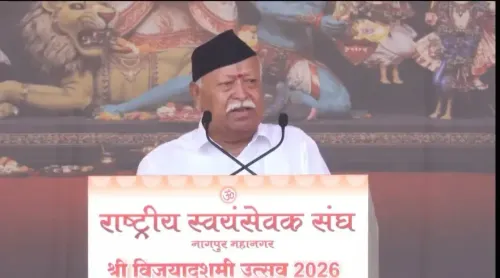
RSS chief Mohan Bhagwat delivered his Vijayadashami 2026 address in Nagpur on 20 October , formally concluding the organisation's centenary year.
Centenary outreach covered 4,61,527 villages , 41,076 urban settlements , and over 10 crore households , according to preliminary figures.
1,117 district-level symposia were held with 4,26,497 participants ; final figures to be presented at the RSS executive committee meeting.
Bhagwat stressed that Panch Parivartan must become a permanent daily habit, not a short-term campaign.
He called for government action on OTT platform regulation and warned of Himalayan ecological instability linked to unbalanced development.
Tribute paid to the 650th birth anniversary of Sant Ravidas Maharaj and the 100th year of Swami Shraddhanand's martyrdom .
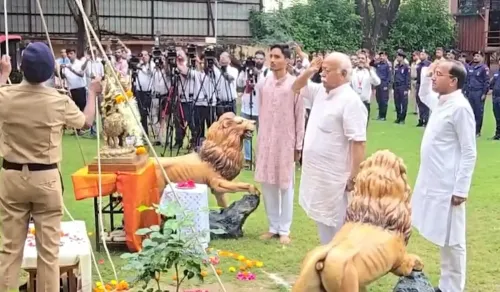
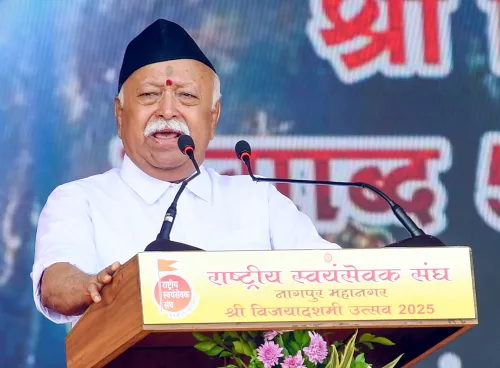
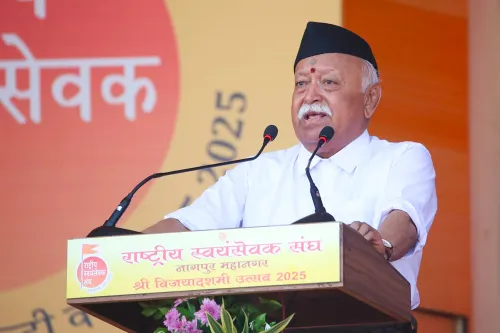
Rashtriya Swayamsevak Sangh (RSS) chief Mohan Bhagwat on 20 October delivered his annual Vijayadashami address in Nagpur, Maharashtra, calling for deeper self-awareness, Swadeshi adoption, social harmony, family values, and national unity. The address also served as the formal conclusion of the organisation's year-long centenary celebrations.
Centenary Outreach: Scale and Numbers
Bhagwat shared preliminary figures from the RSS centenary outreach campaign, describing it as an extensive effort spanning villages, urban settlements, and households. According to the data he presented, the campaign reached 4,61,527 villages and 41,076 urban settlements, touching 10,19,88,511 households and families across the country.
A total of 1,117 district-level discussions and symposia were held for prominent and intellectual citizens, with 4,26,497 men and women participating, according to preliminary figures. Bhagwat clarified that the final official count would be presented at the organisation's executive committee meeting and that numbers could rise further.
Spiritual Milestones and Cultural Anchors
A significant portion of the address paid tribute to historical and spiritual figures. Bhagwat highlighted the 650th birth anniversary of Sant Ravidas Maharaj, popularly known as Sant Shiromani, noting that programmes were being organised across the country and at RSS branches to spread awareness of his life and teachings.
He also recalled Swami Shraddhanand — an Arya Samaj ascetic, educationist, leader of the Shuddhi movement, and freedom fighter — marking 100 years since his martyrdom. Bhagwat additionally observed the birth centenary of Swami Lakshmanananda Saraswati, who dedicated his life to serving tribal communities in Odisha. He argued that remembering such figures was directly relevant to the RSS's century-long mission of awakening self-awareness and strengthening India's cultural identity.
Panch Parivartan: A Way of Life, Not a Campaign
Bhagwat stressed that Panch Parivartan — a five-fold social transformation framework — must not be treated as a short-term programme. 'Panch Parivartan is accepted everywhere, because the circumstances for which it serves as a solution are being experienced by everyone,' he said. He specifically cited family awakening, civic discipline, and environmental responsibility as elements that resonate globally.
He urged RSS volunteers and citizens to translate its principles into daily habits rather than confining them to discussions or temporary drives. 'As a way of life intended to bring transformation in our conduct, it must become a habit through direct action,' he said.
India's Global Role, Technology, and Social Concerns
Bhagwat addressed India's growing international standing, arguing that challenges born of materialism, individualism, and excessive consumption — including difficulties managing diversity, balancing development with environmental protection, and the erosion of family values — created an opening for India to offer alternative perspectives.
On technology, he acknowledged that progress was inevitable but cautioned: 'Technology is merely a tool,' stressing that it must serve society's well-being rather than undermine it. He also referenced ongoing debates in India about regulating OTT platforms, calling on the government and administration to 'consider the issue and take appropriate action.'
Addressing substance addiction, Bhagwat described it as a serious national concern, placing responsibility on parents to guide children and on the younger generation to develop the discipline to avoid harmful habits.
Disasters, Environment, and a Warning on the Himalayas
Towards the close of his address, Bhagwat expressed grief over recent tragedies in Nepal and Kolkata. On the Nepal disaster, he pointed to ecological imbalance across the Himalayan region as an underlying cause. 'Across the entire Himalayan region, spanning countries such as India, Tibet, Bhutan, and China on modern maps, unbalanced, one-sided development practices have created ecological instability throughout the Himalayas... We must relearn the science of pursuing such development,' he said.
The Kolkata incident, he noted, was linked to overcrowding and negligence rather than natural forces, while expressing solidarity with relief efforts underway in both cases. The address sets the RSS's programmatic and ideological agenda as it enters its second century of existence.
Point of View
4.6 lakh villages — are staggering if verified, and the organisation's own caveat that these are preliminary numbers is worth watching. The repeated emphasis on Panch Parivartan as a 'way of life' rather than a campaign reflects a deliberate pivot from event-driven optics to sustained behavioural change — a harder goal to track or credit. His remarks on OTT regulation and the Himalayan ecological crisis signal that the RSS is broadening its public policy footprint well beyond its traditional social agenda.
NationPress
20 Oct 2026
Frequently Asked Questions
What did RSS chief Mohan Bhagwat say at Vijayadashami 2026?
Mohan Bhagwat delivered his annual Vijayadashami address in Nagpur on 20 October 2026, calling for self-awareness, Swadeshi adoption, social harmony, family values, and national unity. He also formally concluded the RSS's year-long centenary celebrations and shared outreach figures covering over 10 crore households.
What is Panch Parivartan and why did Bhagwat emphasise it?
Panch Parivartan is a five-fold social transformation framework championed by the RSS, covering areas such as family awakening, civic discipline, and environmental responsibility. Bhagwat stressed it must become a lasting daily habit rather than a one-year campaign, urging volunteers and citizens to translate principles into direct action.
How extensive was the RSS centenary outreach campaign?
According to preliminary figures presented by Bhagwat, the campaign reached 4,61,527 villages and 41,076 urban settlements, covering over 10 crore households. A total of 1,117 district-level symposia were held with 4,26,497 participants; the final count is expected at the organisation's executive committee meeting.
Which historical figures did Bhagwat honour in his address?
Bhagwat highlighted the 650th birth anniversary of Sant Ravidas Maharaj, the 100th year since the martyrdom of Swami Shraddhanand, and the birth centenary of Swami Lakshmanananda Saraswati. He argued that these milestones were directly relevant to the RSS's mission of awakening cultural self-awareness.
What did Bhagwat say about Nepal and Kolkata disasters?
Bhagwat expressed grief over recent tragedies in Nepal and Kolkata. On Nepal, he attributed the disaster to ecological instability caused by 'unbalanced, one-sided development practices' across the Himalayan region. The Kolkata incident, he said, stemmed from human overcrowding and negligence rather than natural causes.