CM Saini: 2 Lakh Haryana Farmers Join Natural Farming Drive
Synopsis
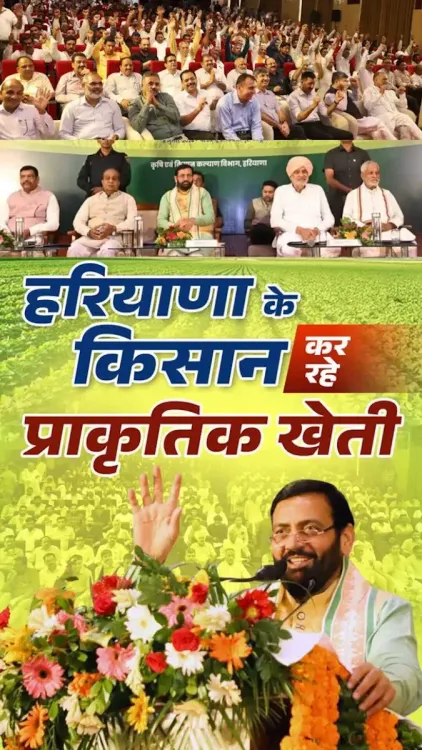
Haryana Chief Minister Nayab Singh Saini announced that roughly 2 lakh farmers in the state have registered for natural farming across 3 lakh acres, framing it as a new model connecting farmers, nature, and the future — a significant pivot for one of India's original Green Revolution states.
Key Takeaways
Haryana CM Nayab Singh Saini announced approximately 2 lakh farmers have registered for natural farming in the state.
The registered land covers nearly 3 lakh acres across Haryana .
Haryana is historically a core Green Revolution state known for chemical-intensive wheat and rice cultivation.
India's Paramparagat Krishi Vikas Yojana (launched 2015 ) provides the central policy framework underpinning such state-level registration drives.
The announcement signals a broader state push to reduce input costs, improve soil health, and align with national sustainability goals.
Sustained impact will depend on state budget allocations for training, infrastructure, and market linkages in the coming fiscal year.
Haryana Chief Minister Nayab Singh Saini announced on Wednesday, 8 July 2026 that approximately 2 lakh farmers across Haryana have registered for natural farming on nearly 3 lakh acres of land, describing the development as a new growth model linking farmers, nature, and the future.
Context
Posting on X, CM Saini wrote in Hindi: 'किसान, प्रकृति और भविष्य को जोड़ने वाला एक नया विकास मॉडल हमने खड़ा किया है' — 'We have built a new development model that connects farmers, nature, and the future.' He added that the registration figures reflect a significant grassroots shift in how Haryana's farming community is approaching agriculture.
The announcement comes as the state — historically one of the nerve centres of India's Green Revolution — signals a deliberate turn away from chemical-intensive cultivation toward low-input, ecologically sustainable methods.
Policy Backdrop
India's push toward natural farming has roots in the Paramparagat Krishi Vikas Yojana, launched by the central government in 2015, which incentivised states to form organic and natural farming clusters and register participating farmers. The scheme laid the administrative groundwork for the kind of large-scale enrolment Haryana is now reporting.
Earlier, Andhra Pradesh drew national attention from 2016 onward with its zero-budget natural farming programme under the Rythu Sadhikara Samstha, demonstrating that mass farmer registration and extension support could shift cultivation practices at scale. Haryana's registration drive follows a broadly similar playbook seen in several other states in recent years.
The broader national policy direction — reducing input costs for farmers, improving soil health degraded by decades of heavy fertiliser use, and meeting India's climate commitments — provides the strategic rationale behind such programmes. The National Mission for Sustainable Agriculture is among the central frameworks that could further underpin Haryana's efforts.
Stakeholders and Impact
The primary beneficiaries, if the programme is sustained, are Haryana's farming households — particularly smallholders who bear a disproportionate share of input costs for chemical fertilisers and pesticides. Natural farming, when supported by adequate extension services, can reduce per-acre expenditure while gradually restoring soil organic content.
For the state government, the figures — 2 lakh farmers on 3 lakh acres — represent a political as well as an agrarian milestone, signalling that the BJP-led administration is actively repositioning Haryana's agricultural identity beyond its wheat-and-rice monoculture legacy. Consumer markets and agri-export channels for certified chemical-free produce stand to benefit downstream if the registered acreage translates into verified natural-farming output.
What's Next
The scale of the registration drive will now be tested by follow-through: whether the state allocates sufficient budget for training, soil-testing infrastructure, and market linkages in the next fiscal cycle will determine whether the numbers translate into durable change on the ground.
Analysts will also watch for a possible formal linkage between Haryana's programme and central missions, which could unlock additional funding and technical support. As more states pursue similar drives, Haryana's implementation record could influence how the national natural-farming agenda is structured and evaluated going forward.
Point of View
2 lakh farmers on 3 lakh acres, is striking, but the credibility of the pivot will hinge on whether registration translates into verified, supported practice change rather than remaining a headline figure. This fits a wider pattern of BJP-governed states using natural farming drives to reframe their agricultural narratives ahead of electoral cycles and in alignment with central government sustainability messaging. The real test is fiscal: extension services, soil testing, and market linkages require sustained budgetary commitment that announcements alone cannot guarantee.
NationPress
7 Oct 2026
Frequently Asked Questions
How many farmers have registered for natural farming in Haryana?
Haryana CM Nayab Singh Saini stated that approximately 2 lakh farmers have registered for natural farming in the state, covering nearly 3 lakh acres of land.
What is natural farming and how is it different from organic farming?
Natural farming avoids all synthetic inputs — fertilisers, pesticides, and herbicides — relying instead on on-farm biological inputs and ecological processes. It is broadly similar to organic farming but typically emphasises zero external inputs and lower costs, making it more accessible to smallholder farmers.
What is the Paramparagat Krishi Vikas Yojana?
The Paramparagat Krishi Vikas Yojana is a central government scheme launched in 2015 to promote organic and natural farming clusters across Indian states, providing financial support and training to registered farmer groups.
Why is Haryana's shift to natural farming significant?
Haryana is one of India's original Green Revolution states with a long history of high chemical-input wheat and rice cultivation. A large-scale shift toward natural farming there carries symbolic and practical weight for India's broader agricultural sustainability agenda.
What happens after farmers register for natural farming in Haryana?
Registration is the first step; the programme's impact depends on the state providing extension support, soil-testing services, training, and market linkages so that registered farmers can successfully transition and sustain chemical-free cultivation.