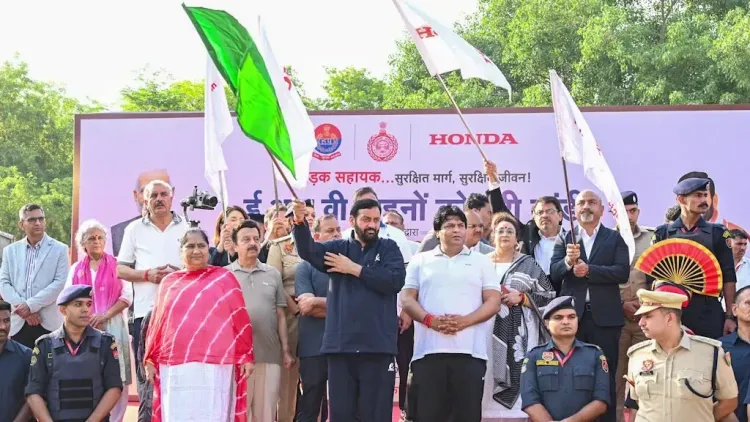
CM Nayab Saini flags off 312 ERVs for Haryana Police in Gurugram
Synopsis
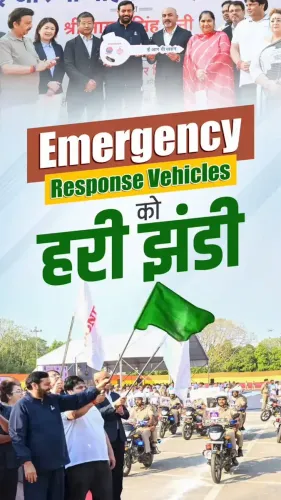
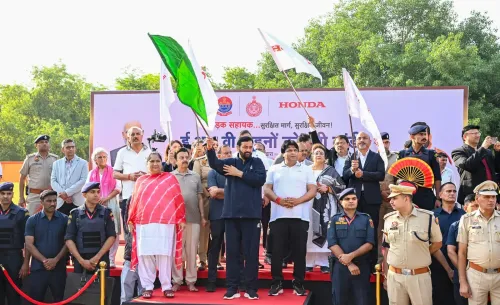
Chief Minister Nayab Saini flagged off 312 new Emergency Response Vehicles for Haryana Police in Gurugram on 1 June 2026. Donated by Honda India Foundation under CSR at ₹5 crore, the fleet of 310 motorcycles and 2 SUVs aims to sustain the state's 7-minute-3-second police response time — well below the national average of 18 minutes.
Key Takeaways
312 Emergency Response Vehicles — 310 motorcycles and 2 Honda Elevate SUVs — were flagged off by CM Nayab Saini in Gurugram on 1 June 2026 .
The fleet was donated by Honda India Foundation under its CSR programme at a total cost of approximately ₹5 crore .
Haryana Police has reduced its average emergency response time to 7 minutes 3 seconds , against a national average of roughly 18 minutes .
The new vehicles are designed to strengthen last-mile emergency reach, particularly in congested urban and peri-urban areas.
The deployment complements Dial 112 , the national integrated emergency response framework operational in Haryana since 2018 .
District-wise allocation details for the 22 districts of Haryana are yet to be announced by the state government.
The Chief Minister's Office of Haryana announced on Monday, 1 June 2026 that Chief Minister Nayab Saini flagged off 312 new Emergency Response Vehicles (ERVs) in Gurugram, marking a significant upgrade to the state police's rapid-response infrastructure. The fleet, contributed by Honda India Foundation under its Corporate Social Responsibility programme at a cost of approximately ₹5 crore, comprises 310 motorcycles and 2 Honda Elevate SUVs.
Context
Speaking at the event, CM Saini highlighted a striking performance benchmark: while the national average police response time stands at approximately 18 minutes, Haryana Police has brought its average down to 7 minutes 3 seconds. The Chief Minister described this achievement as 'सुशासन, आधुनिक पुलिसिंग और जनसेवा के प्रति हमारी प्रतिबद्धता का प्रमाण' ('proof of our commitment to good governance, modern policing and public service').
The launch was held in Gurugram, the National Capital Region's commercial and IT nerve centre, which frequently serves as the venue for high-visibility state government initiatives in Haryana.
Policy Backdrop
The deployment builds on the National Emergency Response Support System (Dial 112), rolled out from 2018 onward to integrate police, fire and ambulance services across Indian states including Haryana. The new fleet is expected to slot directly into this integrated dispatch framework, shortening the last-mile gap between a distress call and boots on the ground.
Across India, state governments have increasingly turned to corporate CSR funds to supplement police vehicle fleets and emergency infrastructure — a trend that allows faster fleet expansion without drawing entirely on state budget allocations. Honda India Foundation, the CSR arm of Honda Cars India, has previously engaged in road-safety and community-welfare projects, making this partnership a natural extension of those priorities.
Stakeholders and Impact
Haryana's approximately 3 crore residents stand to be the primary beneficiaries of a faster emergency response network. Police personnel on patrol will gain better mobility, particularly in dense urban corridors and peri-urban zones where traffic congestion can delay four-wheeled response units. The 310 motorcycles are especially suited to weaving through congested lanes in cities like Gurugram, Faridabad and Panipat.
For Honda India Foundation, the contribution reinforces its public-safety credentials and fulfils statutory CSR obligations under the Companies Act, 2013, which mandates qualifying companies to spend a portion of profits on social welfare activities.
What's Next
The government has not yet specified how the 312 vehicles will be distributed across Haryana's 22 districts, and official district-wise deployment data is awaited. Analysts and civil-society groups will watch whether the 7-minute-3-second response-time figure holds — or improves further — once the expanded fleet is fully operational across the state.
If sustained, Haryana's response-time performance could become a policy benchmark that other states seek to replicate, reinforcing the case for structured public-private partnerships in emergency policing infrastructure.
Point of View
In power since March 2024, is keen to project a data-driven, delivery-focused administration ahead of future electoral cycles. Citing a precise metric — 7 minutes 3 seconds — rather than a rounded figure signals a deliberate effort to frame Haryana as a benchmark state in public-safety governance. The use of Honda's CSR funds is also noteworthy: it allows the government to announce a visible infrastructure boost without a direct budget outlay, a model that is gaining traction across Indian states. Whether the response-time gains are sustained uniformly across rural and semi-urban Haryana, and not just in flagship urban corridors, will determine the long-term credibility of this claim.
NationPress
20 Sept 2026
Frequently Asked Questions
How many emergency response vehicles were launched for Haryana Police in June 2026?
312 Emergency Response Vehicles were launched — comprising 310 motorcycles and 2 Honda Elevate SUVs — by Chief Minister Nayab Saini in Gurugram on 1 June 2026 .
Who donated the emergency vehicles to Haryana Police?
Honda India Foundation , the CSR arm of Honda Cars India, donated the vehicles at a cost of approximately ₹5 crore under its Corporate Social Responsibility programme.
What is Haryana Police's current average emergency response time?
According to CM Nayab Saini , Haryana Police has achieved an average response time of 7 minutes 3 seconds , significantly below the national average of approximately 18 minutes .
What is the purpose of Emergency Response Vehicles (ERVs) for police?
ERVs enable police personnel to reach the site of an emergency — such as a crime, accident or distress call — rapidly. Motorcycles are especially effective in congested urban areas where larger vehicles face delays.
How does Haryana's police response time compare to the national average?
Haryana Police 's response time of 7 minutes 3 seconds is more than 10 minutes faster than the national average of approximately 18 minutes , as stated by the Chief Minister at the Gurugram launch event.